
How to Teach Colors
A practical guide to teaching colours: recognition, matching, sorting, naming, mixing, shades, art and games, everyday practice, progression, and help for common difficulties.
 Amanda Williams
Colour words give children a fast way to describe what they see: a yellow leaf, a green jumper, a blue mug. When learners can recognise, match, sort, and name colours reliably, they follow instructions more easily, join art activities with confidence, and notice detail in books and the world around them.
Table of Contents
- What Children Need to Learn About Colour
- 1. Start With a Few Basic Colours
- Printable: Basic Colour Sets
- 2. Teach Colour Recognition
- Printable: Colour Flashcards
- 3. Practise Matching Colours
- Printable: Colour Matching
- 4. Teach Sorting by Colour
- Printable: Colour Sorting
- 5. Build Colour Naming
- Printable: Colour Words
- 6. Explore Colour Mixing
- Printable: Colour Mixing
- 7. Talk About Shades: Light and Dark
- 8. Use Art and Visual Activities
- 9. Play Colour Games
- 10. Practise With Everyday Objects
- 11. Common Colour Difficulties and How to Help
- 12. How to Increase Difficulty
- A Simple Colours Lesson Structure
- How to Teach Colors Step by Step
- Colour Activities at Home
- How to Help a Child Who Struggles With Colours
- Final Thoughts
How to teach colors works best when you introduce a few strong colours at a time, practise with real objects, and keep naming games short and playful — not a long list of abstract labels. Pair colour work with how to teach shapes when children sort “red triangles” or “blue circles.” Use flashcards, maths worksheets, English worksheets, and lesson plans for matching, sorting, and vocabulary practice that fits each stage.
Whether you teach in a classroom or at home, model the colour word clearly, give children time to look and compare, and add mixing and shades only when basic naming is secure.
What Children Need to Learn About Colour
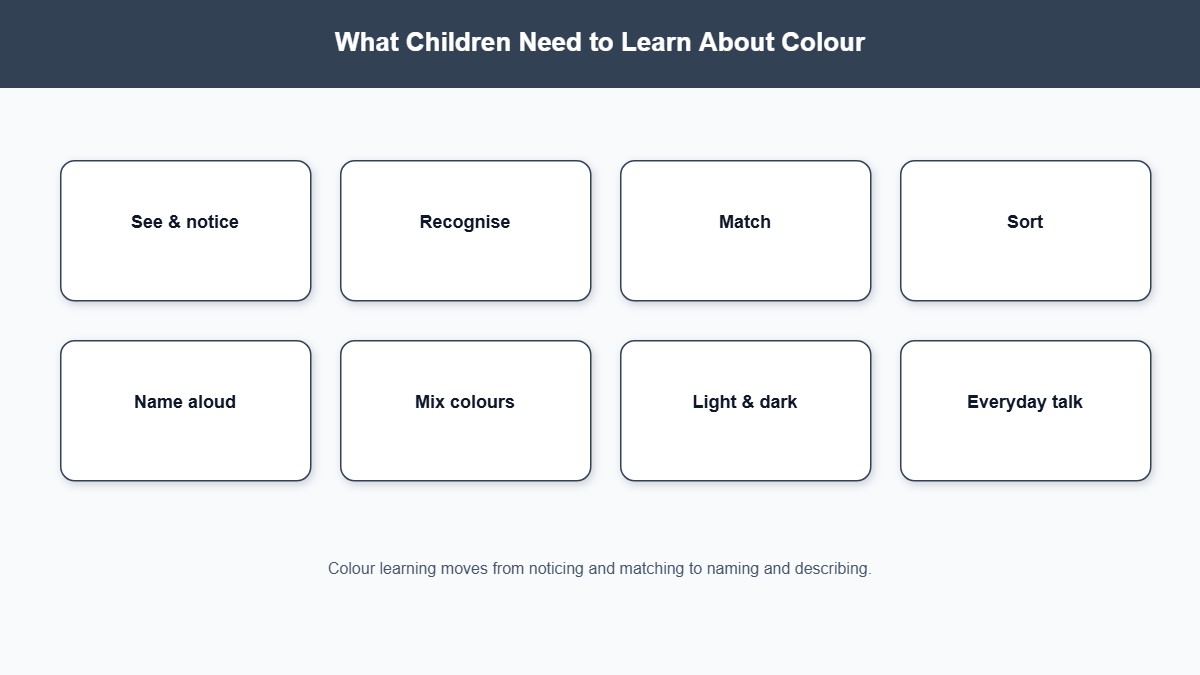
Early colour learning usually includes:
- Recognising common colours (red, blue, yellow, green, and then others)
- Matching objects or swatches that are the same colour
- Sorting collections by colour
- Naming colours when asked (“What colour is this?”)
- Finding a named colour in a busy scene (“Show me something orange”)
- Noticing simple mixing (red + yellow → orange) when ready
- Talking about light and dark shades of the same colour
A child who can chant “red, blue, green” but cannot hand you the blue crayon from a mixed pot still needs recognition and matching practice, not more song lyrics alone.
1. Start With a Few Basic Colours
Introduce a small set first — often red, blue, and yellow — then add green, orange, purple, black, white, brown, and pink as the child is ready. Some classes begin with the school’s core paint colours so art time reinforces the same words.
Show one clear object or card at a time. Say, “This is red,” have the child repeat it, and keep that example visible. Avoid laying out ten colour cards on day one.
Choose vivid, typical examples at first (a bright red block, not a dusty maroon sock) so the category is easy to see.
Printable: Basic Colour Sets
Focus on a small set of colours first with red/blue and green/yellow pages.


2. Teach Colour Recognition
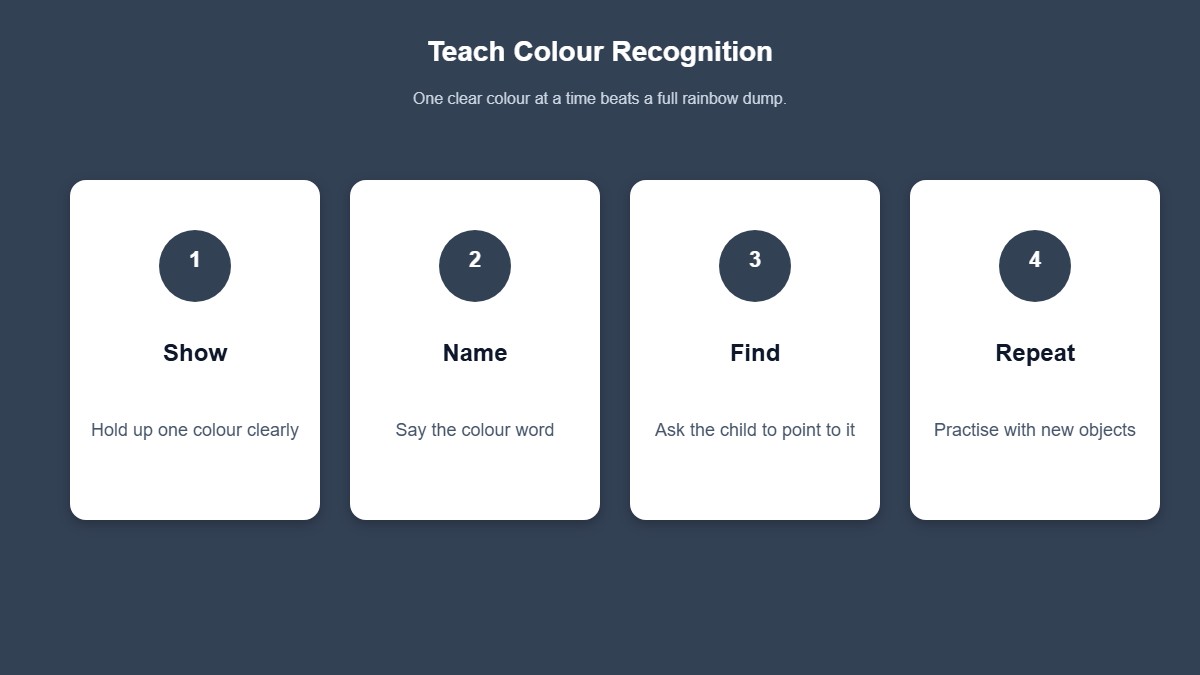
Recognition means the child can identify a colour when they see it, even before they always produce the name themselves.
Hold up a blue scarf and ask, “Is this blue or yellow?” Choice questions are easier than open naming at the start. Later ask them to point to the green cube in a line of three.
Change the object but keep the colour: blue cup, blue lid, blue bead. That stops “blue” meaning only one special toy.
Printable: Colour Flashcards
Use colour flashcards for quick name-and-point recognition practice.

3. Practise Matching Colours
Matching builds careful looking.
Give a colour card and ask the child to find an object that matches. Or place three socks on the table and find the pair that are the same colour. Peg a red card on a washing line and clip only red clothes pegs beside it.
Classroom station: a paint-chip strip and a basket of crayons. Learners lay each crayon on the matching band. Mistakes become quick teaching moments — hold the two side by side and look again rather than only saying “no.”
Simple match sheets and sorting pages sit well with maths worksheets; colour-word labels and reading links fit English worksheets.
Printable: Colour Matching
Match colours to pictures and colour words with a simple match activity.

4. Teach Sorting by Colour
Sorting asks children to group, not only match one pair.
Provide pom-poms, bottle tops, or linking cubes in three colours and three bowls. Children sort while saying the colour name for each piece. Start with strongly different colours; save pastel mixes for later.
Increase challenge by mixing sizes within a colour (“all the yellow things, big and small”) so size does not steal the focus. When ready, combine with how to teach shapes: “Put the green squares here.”
Printable: Colour Sorting
Sort by primary colours and warm/cool groups to build careful looking.


5. Build Colour Naming
Naming is saying the word without a forced choice.
Ask: “What colour is the door?” “What colour marker do you need?” Give wait time. If the child is stuck, offer a scaffold: “It starts like /r/… red,” or show two cards and let them choose, then repeat the correct word together.
Use flashcards for fast receptive-to-expressive practice: you say a colour, they find the card; then they name a card you show. Keep rounds short so guessing does not replace looking.
Printable: Colour Words
Practise reading and writing colour words with a handwriting colour sheet.

6. Explore Colour Mixing
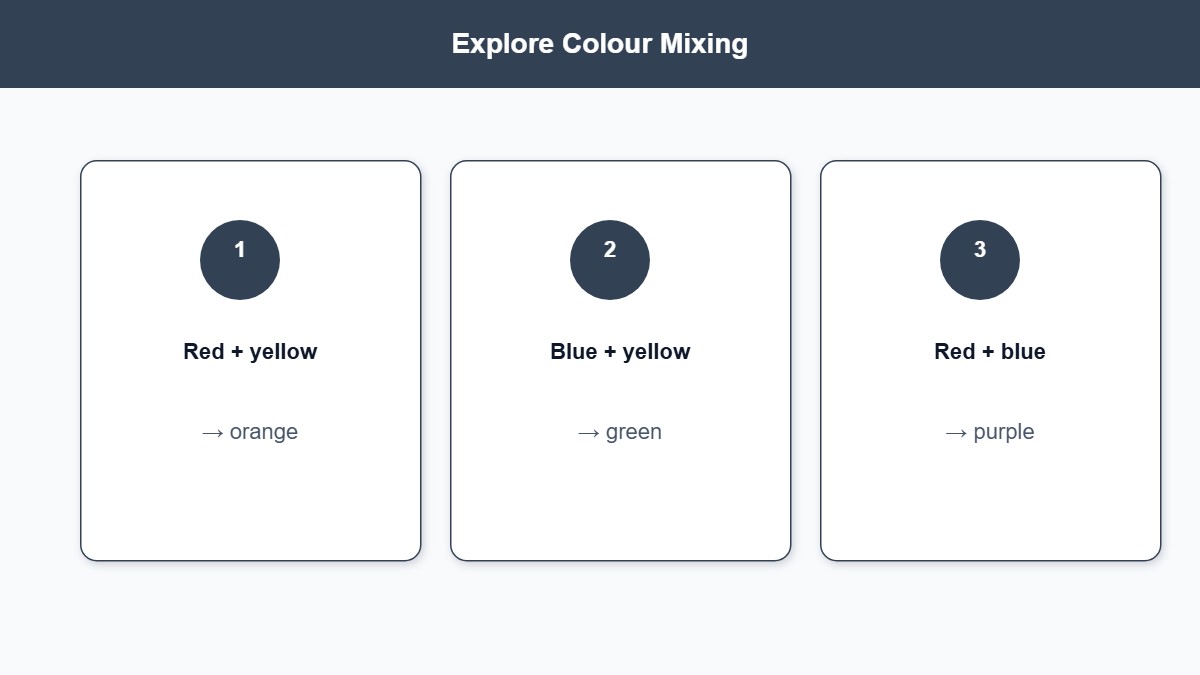
Once primary colours are familiar, show that some colours can be made from others.
With paint or playdough, mix red and yellow to make orange, blue and yellow to make green, red and blue to make purple. Narrate what you see: “The yellow is disappearing into the red — now it looks orange.”
Keep experiments controlled: two colours at a time, small amounts, and a clear “before and after.” Muddy brown mixes teach less when every pot turns brown on the first try. Save white and black for tinting and shading later.
Printable: Colour Mixing
Talk about what happens when two colours mix, then record simple results.

7. Talk About Shades: Light and Dark
Shades help children notice that “green” is a family, not one single crayon.
Place a light blue paper next to a dark blue paper and say both are blue — one is light, one is dark. Sort paint chips from lightest to darkest within one colour. Ask: “Which green is darker?”
This language supports art (“use a lighter pink”) and observation outdoors (pale sky blue vs deep sea blue) without requiring formal colour-theory terms.
8. Use Art and Visual Activities
Art gives colour words a purpose.
Ideas: rainbow order with strips of paper; colour-only collage from magazine scraps; “warm and cool” trays once basics are secure; paint a monochrome picture using only shades of one colour; dab sponges to fill a large outlined apple in reds only.
Describe while making: “You chose purple for the petals.” Adult talk during art often teaches more colour vocabulary than a silent worksheet.
9. Play Colour Games
Games make repetition feel purposeful.
- “I spy something red” around the room
- Colour treasure hunts with a checklist of four colours
- Beanbag toss onto coloured mats — say the colour before throwing
- Simon Says with colours: “Touch something yellow”
- Memory match with colour pairs from flashcards
- Traffic-light game: red = freeze, yellow = walk slowly, green = go
Keep movement and listening balanced so children still look carefully at the colour, not only rush to win.
10. Practise With Everyday Objects
Daily life is full of colour practice.
At home or school: sort laundry into colour piles, choose fruit by colour (“two green apples”), set the table with a blue placemat challenge, or name the colours of cars in a car park. Pack a bag: “Find your red gloves.”
Ask follow-ups: “Is there another one the same colour?” “Which is darker?” Those questions deepen noticing without turning every moment into a test.
11. Common Colour Difficulties and How to Help
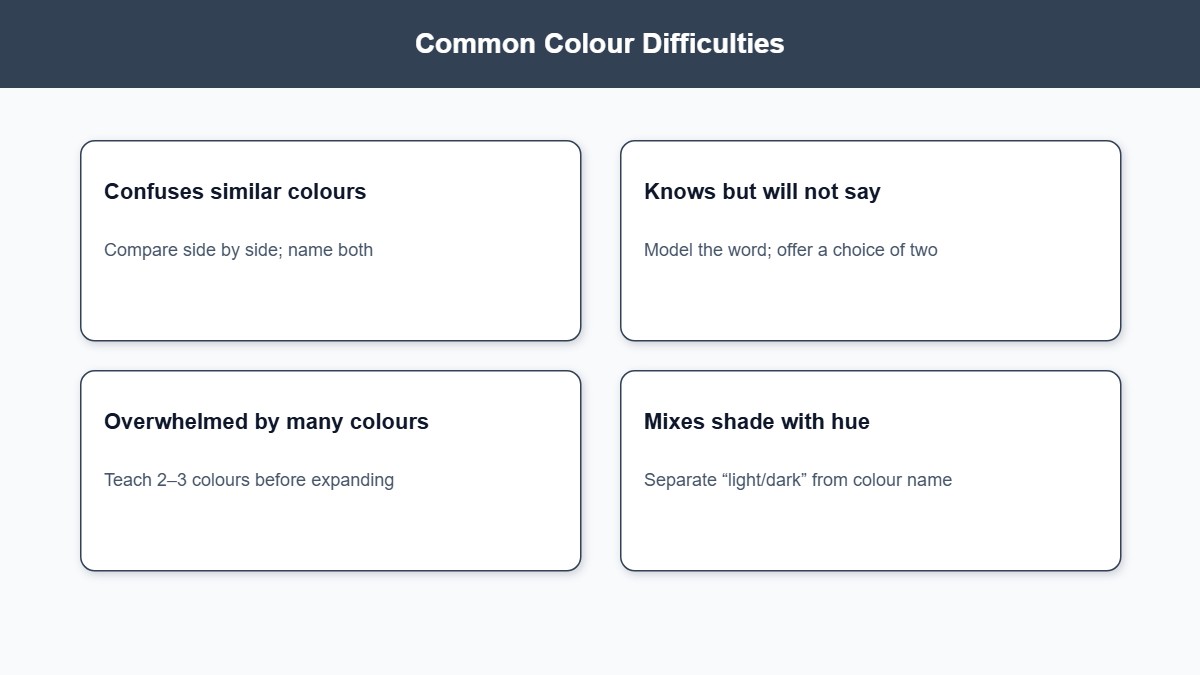
Confusing similar colours (blue/green, red/orange): Teach them side by side with clear examples. Limit the set to those two until the difference is stable, then reintroduce the wider palette.
Only knowing colours on one toy set: Practise the same colour across many objects and surfaces — fabric, plastic, paper, outdoor items.
Saying a memorised list instead of looking: Slow down. Ask the child to touch the object while naming. Cover other crayons so only one is visible.
Struggling in dim light or with patterned fabrics: Use solid, bright samples first. Patterned socks and glitter pens can wait.
Possible colour vision differences: If mix-ups are persistent and specific (often reds/greens), note what you observe and follow your school’s guidance for further checks — while still teaching colour words with high-contrast materials and pairing colour with shape or position cues.
12. How to Increase Difficulty
Raise challenge only when basic recognition and naming are accurate:
- More colour names (grey, turquoise, gold — as appropriate)
- Finding colours in busy illustrations
- Sorting by colour and another attribute (size or how to teach shapes)
- Following two-step instructions (“Take the orange scissors and the purple paper”)
- Mixing to match a target shade
- Ordering light → dark within one colour
- Reading and writing simple colour words when literacy is ready (English worksheets)
If accuracy drops, return to fewer colours and clearer objects before pushing on.
A Simple Colours Lesson Structure
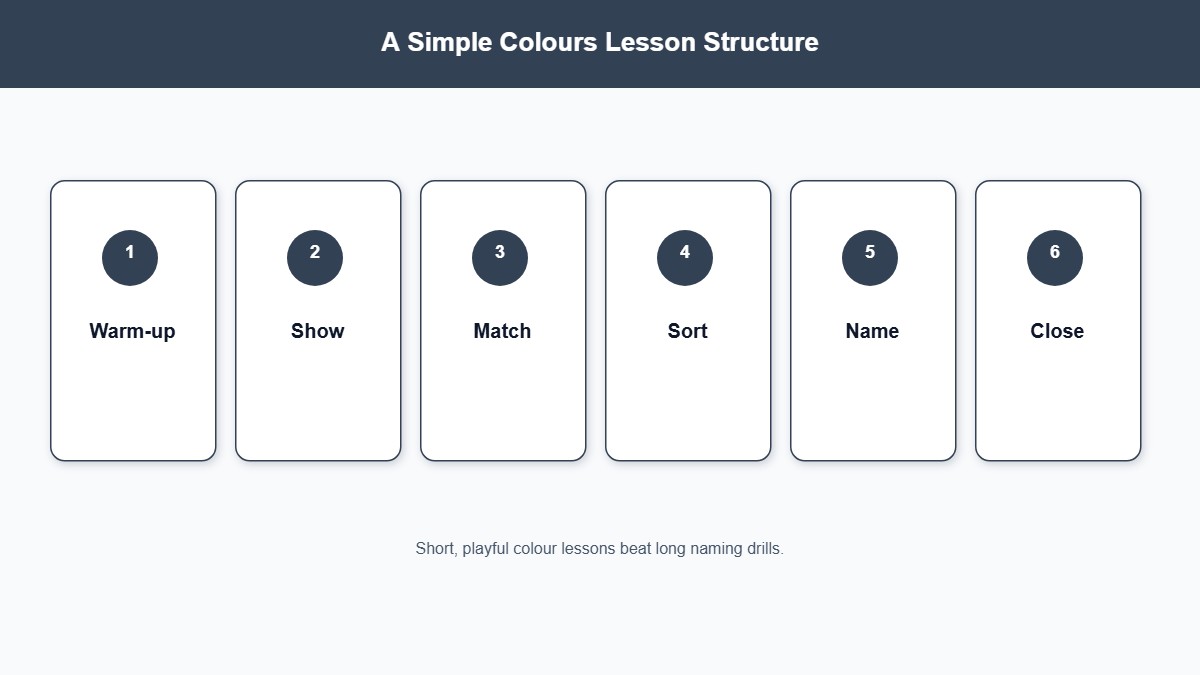
A short colour lesson can follow this sequence:
- Warm-up — Name two or three known colours on classroom objects.
- Model — Introduce or revise one colour with a strong example; children repeat the word.
- Guided practice — Match or sort a shared set; fix mix-ups by looking together.
- Independent practise — Mini hunt, flashcards game, collage strip, or a simple sort page from maths worksheets.
- Check — Hold up one object; class names the colour.
- Wrap-up — Everyday link (“Our recycling bin is green”).
Adapt timing for age. Younger learners need more handling of real objects; older beginners may add mixing, shades, and colour words in print. Plan fuller sessions with lesson plans.
How to Teach Colors Step by Step
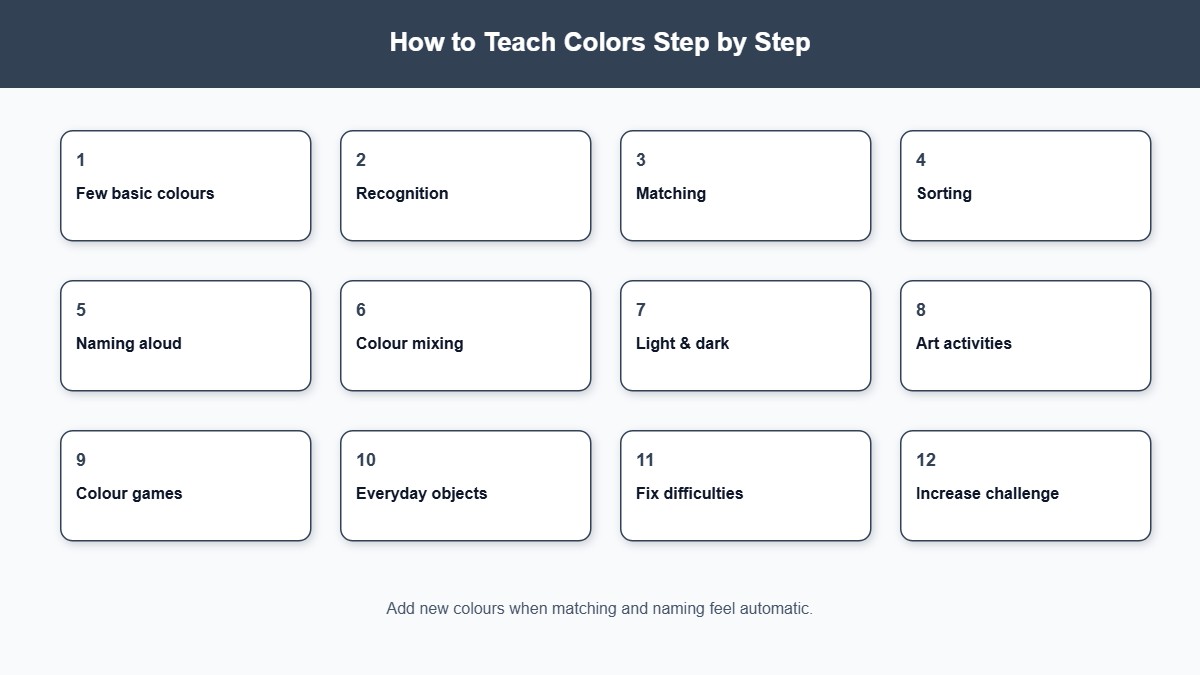
A practical progression looks like this:
- Learn a few basic colour names with clear, vivid examples.
- Recognise those colours when choosing between options.
- Match objects and swatches that share a colour.
- Sort mixed collections into colour groups.
- Name colours without a forced choice.
- Find named colours in the room and in pictures.
- Explore simple mixing with paint or dough.
- Compare light and dark shades of the same colour.
- Use art, games, and everyday jobs for fluency.
- Combine colour with shape, size, or written colour words as skills grow.
Not every learner needs the same time at each step. Stay with matching and sorting until naming feels reliable.
Colour Activities at Home
Home practice can be woven into routines.
Sort socks by colour while folding laundry. Make a “colour of the day” breakfast challenge (only yellow fruit on Monday). Paint with two primaries and predict the mix. On a walk, collect five leaves and talk about which greens are lighter or darker.
Keep tone friendly. One careful colour conversation while packing a lunchbox often teaches more than a long drill.
How to Help a Child Who Struggles With Colours
First identify what is breaking down: recognising the difference, remembering the word, or attending long enough to look carefully.
Then simplify: only two colours on the table, large solid samples, and identical objects (all cubes) so shape variety does not distract. Sit beside the child, hold samples side by side, and say the names together as you sort.
Use the same wording each time (“This is blue”) before asking open questions. Celebrate accurate matches over fast verbal lists.
If vocabulary is the barrier, practise one new colour for several days in games before adding another. flashcards and real-object sorts rebuild confidence faster than insisting on perfect naming in a busy mural.
Final Thoughts
Teaching colours well means teaching looking and naming: clear examples, matching, sorting, then confident colour words in real situations. Art, games, and everyday jobs keep practice meaningful.
Build from a few basic colours to recognition, matching, sorting, naming, simple mixing, and shades. When those foundations are firm, children can combine colour with how to teach shapes and follow richer instructions in class and at home.
Keep the palette manageable, correct mix-ups by looking again together, and use objects children already care about. Clear models, guided practice, and regular short sessions matter more than racing through every colour name in the crayon box.
Frequently Asked Questions
Common questions answered for downloading and using our premium printable designs.




Comments (0)
Leave a Reply
Be the first to leave a comment!