
How to Teach Time
A practical guide to teaching time: daily routines, before and after, clocks, o'clock to exact minutes, elapsed time, timetables, and help for common mistakes.
 Amanda Williams
Time is one of the hardest early maths ideas because children cannot see or hold an hour the way they hold cubes. They need language for the order of the day, then clock faces and digital displays, and only later exact minutes and elapsed time. Rushing straight to "draw the hands for 3:47" leaves many learners guessing.
Table of Contents
- What "Telling Time" Really Includes
- 1. Start With Daily Routines
- Printable: Morning and Afternoon
- 2. Teach Before and After
- 3. Today, Tomorrow, and Yesterday
- 4. Introduce Clocks as Tools, Not Tests
- 5. Hour Hand and Minute Hand
- 6. Teach O'Clock First
- Printable: O'Clock Times
- 7. Half Past
- Printable: Half-Hour Times
- 8. Quarter Past and Quarter To
- Printable: Quarter Hours
- 9. Exact Minutes
- 10. Analogue and Digital Together
- Printable: Digital and Analogue
- 11. Elapsed Time
- Printable: Elapsed Time
- 12. Timetables and Schedules
- Printable: School Day Times
- 13. Real-Life Time Practice
- Printable: Evening Routines
- 14. Common Mistakes and How to Help
- 15. How to Increase Difficulty
- A Simple Time Lesson Structure
- Printable: Time Review
- How to Teach Time at Home
- How to Teach Time Step by Step
- How to Help a Child Who Struggles With Time
- Final Thoughts
This guide shows how to teach time step by step: daily routines, before and after, today/tomorrow/yesterday, analogue and digital clocks, hour and minute hands, o'clock through half past and quarter hours to exact minutes, elapsed time, timetables, and real-life practice. It builds on how to teach numbers and how to teach counting, and pairs well with telling time worksheets, maths worksheets, flashcards, and maths lesson plans.
Whether you teach in a classroom or at home, keep the same rhythm: talk about the sequence of the day first, then connect events to clock pictures, practise reading and setting times with support, and increase precision only when each stage is secure.
What "Telling Time" Really Includes
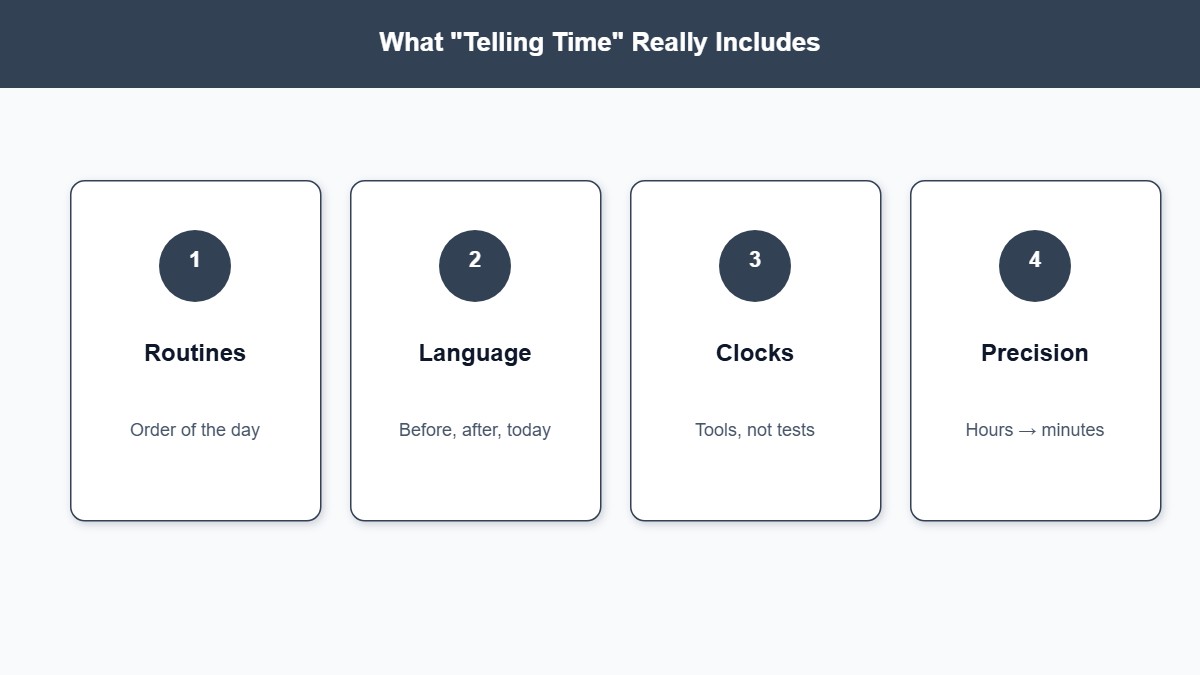
Telling time is more than reading a clock. Early on, children need to understand:
- Events happen in order — some things come before others
- Parts of the day (morning, afternoon, evening) and calendar words (today, tomorrow, yesterday)
- Clocks measure ongoing time in hours and minutes
- Analogue clocks use hand position; digital clocks use digits
- The same moment can be said in more than one way (half past two / 2:30)
A child who can chant "sixty minutes make an hour" but cannot say whether lunch comes before or after play still needs time language and routine work before hard clock worksheets.
1. Start With Daily Routines
Begin with the child's own day, not with a blank clock face.
Talk through a simple sequence: wake up, breakfast, school or play, lunch, tidy-up, bedtime. Put three or four picture cards in order and ask the child to retell the day. Move one card and ask what feels wrong.
Use real moments: "We brush teeth after dinner." "Shoes go on before we leave." Keep vocabulary concrete — first, next, then, last — so order feels useful, not abstract.
Classroom tip: a vertical "Our Day" strip with photos of morning meeting, snack, and home time gives a shared reference you can point to all week.
Printable: Morning and Afternoon
Link clock talk to familiar parts of the day before exact clock reading.


2. Teach Before and After
Before and after are the foundation of elapsed time later.
Ask questions tied to the routine strip: "What comes before lunch?" "What comes after story time?" Act out two events with toys — a doll packs a bag, then walks to the door — and have children name which happened first.
Play a quick game: show two picture cards; children hold up "before" or "after" cards to describe the pair. Correct gently by retelling the full sequence: "Snack is after outdoor play, so outdoor play comes before snack."
Stay in familiar contexts until the language is automatic. Clock numbers can wait until order words are solid.
3. Today, Tomorrow, and Yesterday
Calendar language helps children place themselves in time without needing a clock yet.
Each morning, say the day name and place a marker on a simple week strip. Ask: "If today is Tuesday, what was yesterday? What is tomorrow?" Keep answers oral at first; writing dates can come later.
Home example: "Yesterday we visited Grandma. Today we are at school. Tomorrow is the library." Link the words to one real memory so they are not empty labels.
If children confuse yesterday and tomorrow, point backward and forward on the week strip every time you say the words. Physical direction supports meaning.
4. Introduce Clocks as Tools, Not Tests
Once routines make sense, show that clocks help us know when events happen.
Point to a real wall clock or a large teaching clock when something begins: "The short hand is near 10 — that is when we start art." Avoid flooding the lesson with every hand position on day one.
Compare a classroom analogue clock with a digital display on a phone or microwave. Say the same moment both ways: "The big clock shows about ten. The microwave says 10:00." Children need both forms because real life uses both.
Keep early sessions short and linked to a real event — start of maths, lunch, home time — so clocks feel purposeful.
5. Hour Hand and Minute Hand
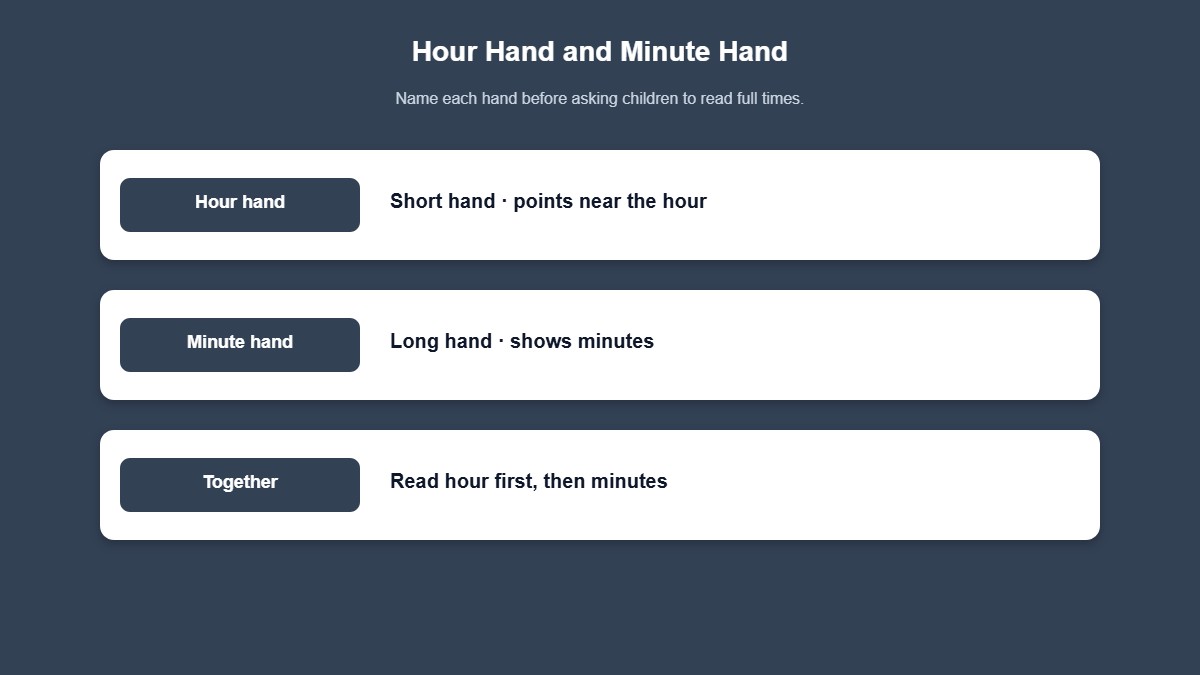
Name the hands clearly and stick to consistent language.
The short hand is the hour hand; the long hand is the minute hand. On a geared teaching clock, move the minute hand and let children watch the hour hand creep forward so they see that hours and minutes are linked.
Colour-code practice clocks if it helps: a small coloured sticker on the hour hand tip. Ask children to point to "the hand that tells the hour" before they try to read a time.
Common mix-up: reading the minute hand as the hour. Pause and ask, "Which hand is shorter?" before accepting an answer. Secure hour identification before exact minutes.
6. Teach O'Clock First
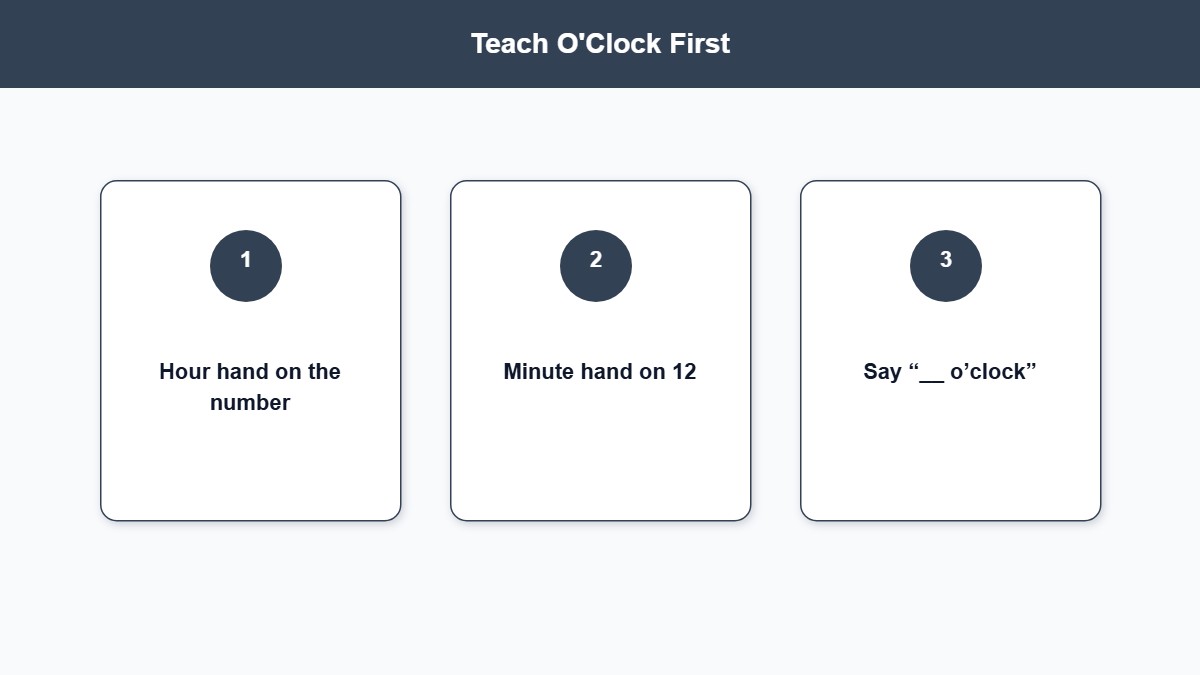
O'clock is the cleanest entry to analogue reading.
Show several times with the minute hand on 12 and the hour hand pointing exactly at a number: 1:00, 4:00, 9:00. Say, "When the long hand is on 12, we say o'clock. The short hand tells us which hour."
Children set a practice clock to "three o'clock" and "seven o'clock," then match clock faces to digital cards such as 3:00. Use telling time worksheets and flashcards for matching without inventing every card yourself.
Only when o'clock is reliable should you move the minute hand away from 12.
Printable: O'Clock Times
Practise reading and writing times on the hour.

7. Half Past
Half past shows that an hour can be split into two equal parts.
Move the minute hand to 6 and explain that it has travelled halfway around the clock. The hour hand sits halfway between two hour numbers — at half past 2 it sits between 2 and 3.
Language options: "half past two" and "two thirty." Teach both so children recognise either phrasing. Match analogue faces to 2:30 digital cards.
Concrete support: fold a paper circle in half and lay it on a clock drawing so "half" is visible. Keep practising until children stop reading half past 2 as 6:00 because they stared at the minute hand alone.
Printable: Half-Hour Times
Practise half-past times on analogue clocks.

8. Quarter Past and Quarter To
Quarters divide the clock into four equal parts.
Minute hand on 3 → quarter past (fifteen minutes past the hour). Minute hand on 9 → quarter to (fifteen minutes before the next hour). Show 4:15 as quarter past four and 4:45 as quarter to five.
Walk the minute hand from 12 to 3 to 6 to 9 while saying "o'clock, quarter past, half past, quarter to." Rhythm helps memory.
Expect confusion between quarter past and quarter to. Always ask, "Are we going forward from this hour, or counting toward the next hour?" Point at the hour hand's position between numbers as a clue.
Printable: Quarter Hours
Practise quarter past and quarter to on clear clock faces.

9. Exact Minutes
Exact minutes need skip counting by fives and careful reading of the minute marks.
Count around the clock in fives: 5, 10, 15, 20… while pointing at each numeral. Link this to how to teach counting skip-counting practice. Then introduce single minutes between the marks for times such as 2:17 or 8:42.
Teach a routine: (1) look at the hour hand for the hour, (2) count minutes with the long hand, (3) say or write the time, (4) check against a digital version if available.
Do not demand every minute on day one. Many children need a long stretch at five-minute intervals (2:05, 2:10, 2:15) before one-minute precision. Number recognition from how to teach numbers supports reading digital displays such as 14 for minutes.
10. Analogue and Digital Together
Switching between formats builds flexible understanding.
Give pairs of cards: an analogue face and a digital time. Children find matches, or write the missing form. Ask them to set a geared clock to match 7:20 on a digital card.
Discuss where each form appears: classroom wall clocks, phones, ovens, bus stops, TV guides. Real examples stop "clock work" from feeling like a separate school subject.
If a child reads digital times fluently but freezes on analogue, keep analogue hands large and return to o'clock and half past before finer minutes.
Printable: Digital and Analogue
Match the same time on analogue and digital clocks.

11. Elapsed Time
Elapsed time asks how much time passes between two moments.
Start with whole hours on a timeline or open number line: "We start at 2:00 and finish at 4:00 — how many hours?" Then try half hours: "Lunch starts at 12:00 and ends at 12:30."
Use a geared clock: set the start time, jump the minute hand forward in clear jumps, and count the jumps. For beginners, avoid crossing messy boundaries such as 11:50 to 12:15 until simpler gaps are solid.
Story problems help: "The cartoon starts at 4:00 and lasts half an hour. What time does it end?" Draw a small timeline under the question so children see start, duration, and end.
Printable: Elapsed Time
Practise how much time has passed between two clock times.

12. Timetables and Schedules
Timetables apply clock reading to real plans.
Use a simple school-day table: maths 9:00, break 10:30, lunch 12:15. Ask which subject comes first, what time break ends, and how long lunch lasts if it ends at 1:00.
Home example: a bus or swimming timetable with three or four rows only. Circle "now" and find the next event. Keep the table uncluttered so finding times is the skill, not decoding tiny print.
This stage links naturally to maths worksheets schedule-style pages and to classroom maths lesson plans that include a daily agenda.
Printable: School Day Times
Read simple school-day schedules and match them to clock times.

13. Real-Life Time Practice
Everyday use locks the skill in.
Ideas: set a kitchen timer for ten minutes of reading; check what time a favourite show starts; pack a bag "before 8:00"; estimate whether you have enough time to walk to the shop before it closes.
Ask children to be the "time keeper" for a short activity: "Tell us when fifteen minutes have passed." Start with a visible timer, then try estimating without one and checking afterward.
Keep talk natural. Time practice should solve a real need — catching a bus, starting a cake in the oven — not only fill a worksheet.
Printable: Evening Routines
Connect evening routines to clock reading in everyday contexts.

14. Common Mistakes and How to Help
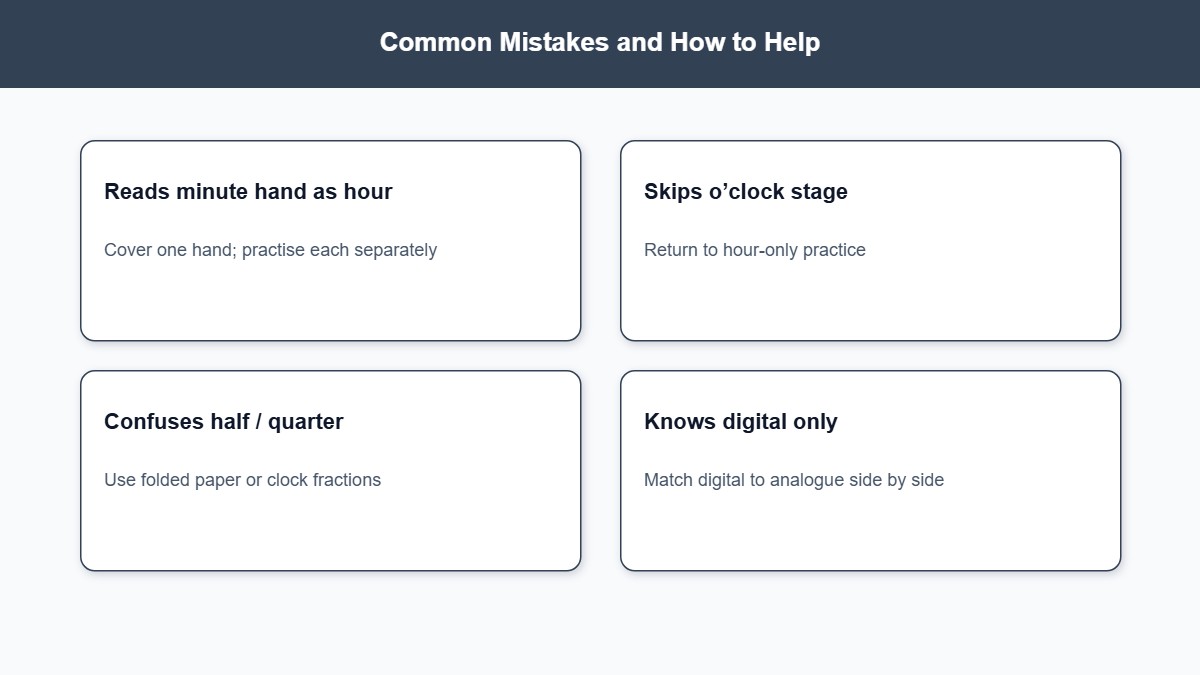
Confusing hour and minute hands: Rehearse "short hand = hour" with oversized hands. Cover the minute hand briefly and ask only for the hour.
Reading half past 3 as 6:00: The child is naming the minute-hand number as the hour. Return to o'clock, then half past with hour-hand focus: "Which number has the short hand left?"
Quarter past vs quarter to: Use a paper plate divided into four. Shade the path from 12 to 3 as "past" and from 9 to 12 as "to." Practise saying both names for 3:45.
Skipping five-minute counts: Trace the clock rim while skip-counting aloud. Pause on sticky spots (25, 35, 55).
Digital look-alikes: 2:05 vs 2:50 confuse some readers. Ask whether five minutes or fifty minutes have passed since the hour, and show both on an analogue clock.
15. How to Increase Difficulty
Raise challenge only when earlier stages are accurate:
- From o'clock → half past → quarters → five-minute times → one-minute times
- From matching cards → drawing or setting hands independently
- From single times → elapsed time across an hour boundary
- From one clock format → converting analogue ↔ digital
- From classroom clocks → messy real schedules and word problems
- 24-hour time only when 12-hour reading is secure and useful for your learners
If accuracy drops, step back one stage rather than adding more worksheet volume.
A Simple Time Lesson Structure
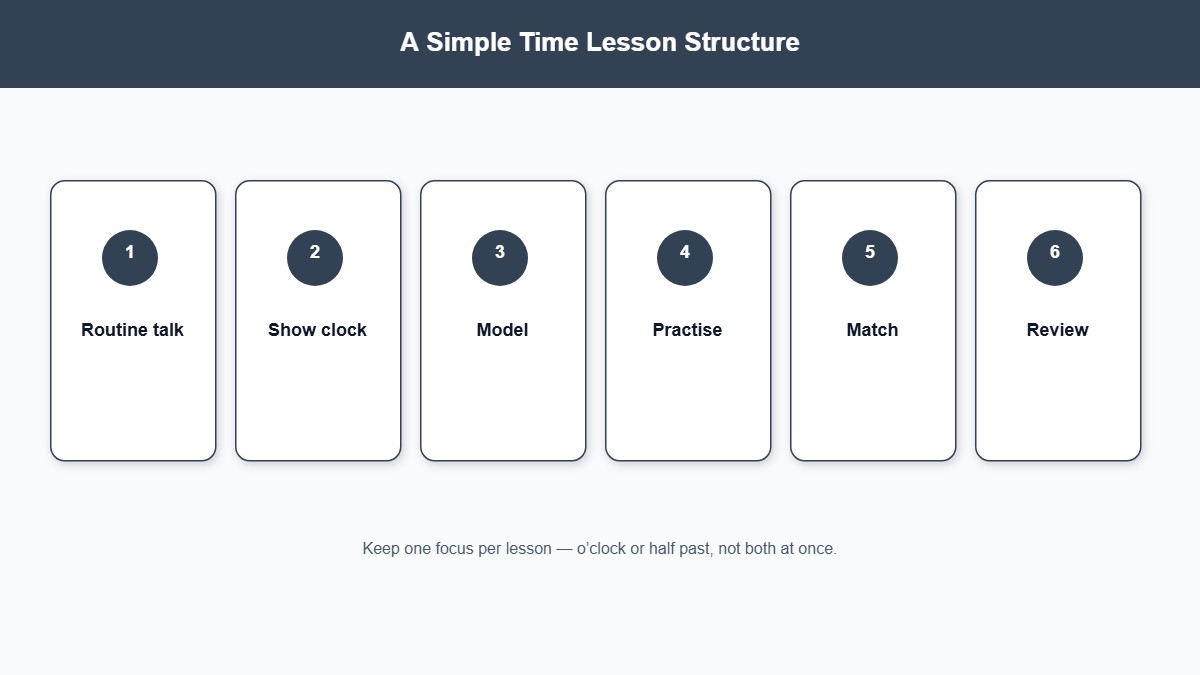
A short time lesson can follow this sequence:
- Warm-up — Order three routine cards or say today / yesterday / tomorrow.
- Model — Show one new clock idea on a large teaching clock (for example, half past).
- Guided practice — Class sets mini clocks together; fix hand mix-ups in the moment.
- Independent practise — Matching, drawing hands, or a page from telling time worksheets.
- Apply — Link to a real event on the class timetable.
- Wrap-up — One child shows a time; others say it in words or digital form.
Younger learners may spend whole lessons on routines and o'clock. Older beginners can move faster into quarters and elapsed time. Plan fuller sessions with maths lesson plans.
Printable: Time Review
Use a mixed time review page for follow-up practice after a lesson.

How to Teach Time at Home
Home practice works best in short bursts tied to real clocks.
Put a simple analogue clock where it is easy to see. At a few anchor points — breakfast, leaving the house, bedtime — ask what time it is and what comes next. Let the child set an alarm for a homework start time.
Play "match the microwave": read the digital oven time and find it on a toy analogue clock. Keep sessions under ten minutes so frustration does not build.
If clocks feel overwhelming, return to ordering the day's photos and before/after talk for a week, then reintroduce o'clock only.
How to Teach Time Step by Step
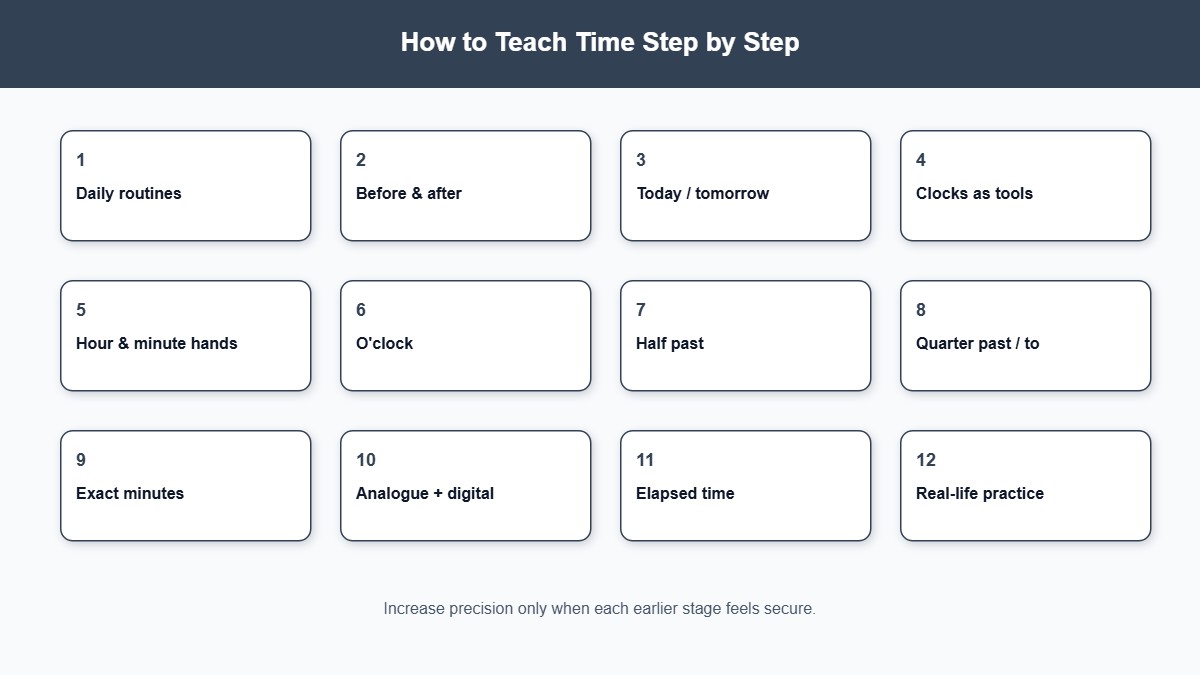
A practical progression looks like this:
- Sequence daily routines with first / next / then / last.
- Use before and after language with familiar events.
- Practise today, tomorrow, and yesterday on a week strip.
- Meet real clocks; name hour and minute hands.
- Read and set o'clock times; match to digital :00.
- Add half past, then quarter past and quarter to.
- Count minutes in fives, then read exact minutes.
- Convert between analogue and digital forms.
- Solve simple elapsed-time and timetable questions.
- Use clocks and schedules in everyday life for fluency.
Not every learner needs the same time at each step. Stay with o'clock and half past until hand reading is trustworthy.
How to Help a Child Who Struggles With Time
First identify what is breaking down: order language, hand identification, five-minute counting, or converting formats.
Then simplify: fewer times per lesson, larger clock faces, geared clocks that keep hands linked, and one language form at a time (say "half past" before insisting on "two thirty").
Skip counting by fives on a number line before returning to the clock rim. Weak number skills make minute reading feel impossible; brief work from how to teach numbers and how to teach counting often unlocks progress.
Celebrate accurate o'clock and half-past reads. Many children who "hate clocks" have only met worksheets full of times they were not ready for.
Final Thoughts
Teaching time well means teaching a sequence: daily order and language first, then clock hands, then finer minutes, then elapsed time and timetables. Demonstrations on a large clock beat silent worksheet piles.
Build from routines to o'clock, half past, quarters, and exact minutes. Practise both analogue and digital forms, and keep linking answers to real events so the skill feels useful.
Correct common hand mix-ups without fuss, increase difficulty only when accuracy holds, and use telling time worksheets and real schedules for practice that matches the stage. Clear modelling and short, regular sessions matter more than racing to every minute on the dial.
Frequently Asked Questions
Common questions answered for downloading and using our premium printable designs.




Comments (0)
Leave a Reply
Be the first to leave a comment!