
How to Teach Money
A practical guide to teaching money: coin values, counting and comparing amounts, prices, change, shopping activities, budgeting basics, word problems, and help for common mistakes.
 Amanda Williams
Money makes maths feel real: children see coins and notes, compare prices, and work out change. It is also easy to rush. Jumping straight to "give change from a five-dollar note" before children know coin values leaves them guessing which pieces to pick up.
Table of Contents
- What Children Need to Understand About Money
- 1. Explore Real Coins and Notes
- Printable: Pennies
- 2. Teach Coin and Note Values
- Printable: Nickels and Dimes
- 3. Count Money in Cent Amounts
- Printable: Mixed Coins
- 4. Compare Amounts
- 5. Make the Same Amount in Different Ways
- 6. Read Prices and "Buy" Items
- 7. Teach Change With Subtraction Thinking
- Printable: Making Change
- 8. Add and Subtract With Money
- 9. Introduce Dollars and Cents (Decimals) When Ready
- 9. Introduce Dollars and Cents (Decimals) When Ready
- Printable: Dollar Bills
- 10. Shopping Activities and Role-Play
- 11. Budgeting Basics
- 12. Money Word Problems
- Printable: Money Word Problems
- 13. Common Mistakes and How to Help
- 14. How to Increase Difficulty
- A Simple Money Lesson Structure
- Printable: Money Review
- How to Teach Money at Home
- How to Teach Money Step by Step
- How to Help a Child Who Struggles With Money
- Final Thoughts
This guide shows how to teach money step by step: recognising coins and notes, learning values, counting and comparing amounts, making a total in different ways, reading prices, giving change, linking to how to teach addition and how to teach subtraction, introducing dollars and cents (decimals) when ready, shopping activities, budgeting basics, and word problems. It builds on how to teach numbers and pairs well with maths worksheets, flashcards, and maths lesson plans.
Examples below use dollars and cents for clarity. The same teaching sequence works with any currency — adapt the coin names and values to what your learners see every day.
What Children Need to Understand About Money

Money skills combine recognition, value, and calculation:
- Coins and notes look different and are worth different amounts
- Value is not the same as size — a smaller coin can be worth more than a larger one
- Amounts can be made with different combinations of coins
- Prices tell us how much something costs; change is what is left after paying
- Adding and subtracting with money follow the same ideas as other number work, with dollars and cents as the units
A child who can name a quarter but always chooses the biggest coin as "the most money" still needs value teaching before shopping role-play with large totals.
1. Explore Real Coins and Notes
Start with handling and sorting, not with written sums.
Spread a small set of coins on a tray: pennies (1¢), nickels (5¢), dimes (10¢), quarters (25¢), and a few dollar coins or
Start with handling and sorting, not with written sums.
Spread a small set of coins on a tray: pennies (1¢), nickels (5¢), dimes (10¢), quarters (25¢), and a few dollar coins or $1 notes if you use them. Let children sort by colour, size, or picture first so they look closely.
Name each coin as you hold it up. Match plastic or paper classroom coins to a real sample so play money stays accurate. Keep the first set small — four coin types are enough for beginners.
Classroom tip: a "coin museum" tray with one labelled example of each coin gives a reference children can visit during games.
notes if you use them. Let children sort by colour, size, or picture first so they look closely.Name each coin as you hold it up. Match plastic or paper classroom coins to a real sample so play money stays accurate. Keep the first set small — four coin types are enough for beginners.
Classroom tip: a "coin museum" tray with one labelled example of each coin gives a reference children can visit during games.
Printable: Pennies
Start with one coin type so children can look carefully at value and count.

2. Teach Coin and Note Values
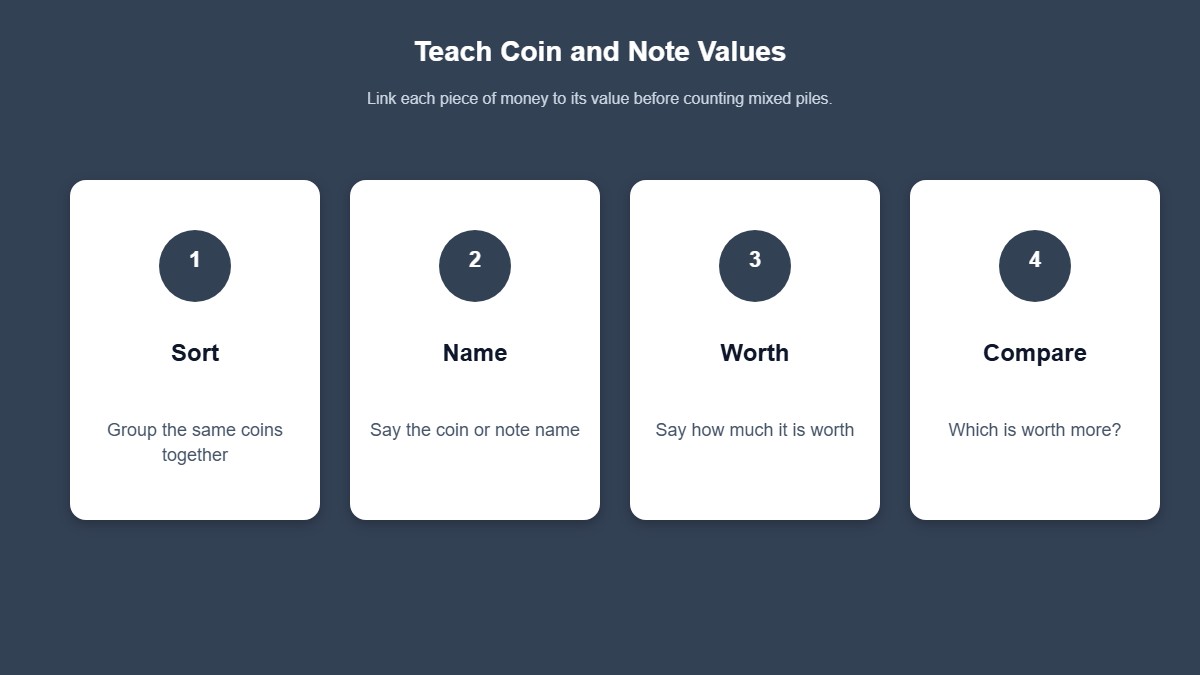
Value must be taught explicitly because size misleads.
Say and show: "This nickel is worth 5 cents. This dime is smaller but worth 10 cents." Place value cards (1¢, 5¢, 10¢, 25¢,
Value must be taught explicitly because size misleads.
Say and show: "This nickel is worth 5 cents. This dime is smaller but worth 10 cents." Place value cards (1¢, 5¢, 10¢, 25¢, $1) next to each piece. Ask children to point to "the coin worth ten cents," not only "the dime."
Compare two coins: "Which is worth more — a nickel or a dime?" Use a simple number line marked in cents so 25 sits further along than 10.
When notes enter, start with $1 and $5. Show that one $1 note matches 100 cents or four quarters. Hold back large notes until smaller values are secure.
) next to each piece. Ask children to point to "the coin worth ten cents," not only "the dime."Compare two coins: "Which is worth more — a nickel or a dime?" Use a simple number line marked in cents so 25 sits further along than 10.
When notes enter, start with
Value must be taught explicitly because size misleads.
Say and show: "This nickel is worth 5 cents. This dime is smaller but worth 10 cents." Place value cards (1¢, 5¢, 10¢, 25¢, $1) next to each piece. Ask children to point to "the coin worth ten cents," not only "the dime."
Compare two coins: "Which is worth more — a nickel or a dime?" Use a simple number line marked in cents so 25 sits further along than 10.
When notes enter, start with $1 and $5. Show that one $1 note matches 100 cents or four quarters. Hold back large notes until smaller values are secure.
and . Show that oneValue must be taught explicitly because size misleads.
Say and show: "This nickel is worth 5 cents. This dime is smaller but worth 10 cents." Place value cards (1¢, 5¢, 10¢, 25¢, $1) next to each piece. Ask children to point to "the coin worth ten cents," not only "the dime."
Compare two coins: "Which is worth more — a nickel or a dime?" Use a simple number line marked in cents so 25 sits further along than 10.
When notes enter, start with $1 and $5. Show that one $1 note matches 100 cents or four quarters. Hold back large notes until smaller values are secure.
note matches 100 cents or four quarters. Hold back large notes until smaller values are secure.Printable: Nickels and Dimes
Build coin-value knowledge with nickels and dimes before mixed counts.


3. Count Money in Cent Amounts
Counting money is skip counting with a purpose.
Begin with same-coin groups: five pennies → 5¢; three nickels → 15¢; four dimes → 40¢. Touch each coin as you count: "10, 20, 30…" for dimes. This links directly to skip counting and to how to teach numbers for reading the totals.
Then mix two coin types: three dimes and a nickel → 35¢. Teach a strategy: group the largest-value coins first, count them, then add the smaller ones.
Keep early totals under 100¢ so children are not fighting place-value overload while learning coin combinations.
Printable: Mixed Coins
Count mixed coins and write the total in cents.

4. Compare Amounts
Comparing builds number sense and shopping judgement.
Show two piles: 30¢ (three dimes) and 25¢ (one quarter). Ask which pile is worth more and how they know. Children may need to count each pile aloud before they trust the answer.
Use price tags on classroom items: eraser 15¢, sticker 20¢. Ask which costs more and which costs less. Language to practise: more, less, equal, enough, not enough.
"Enough" questions matter: "You have two dimes. Can you buy the 15¢ eraser?" Acting the answer with coins is clearer than a yes/no guess.
5. Make the Same Amount in Different Ways
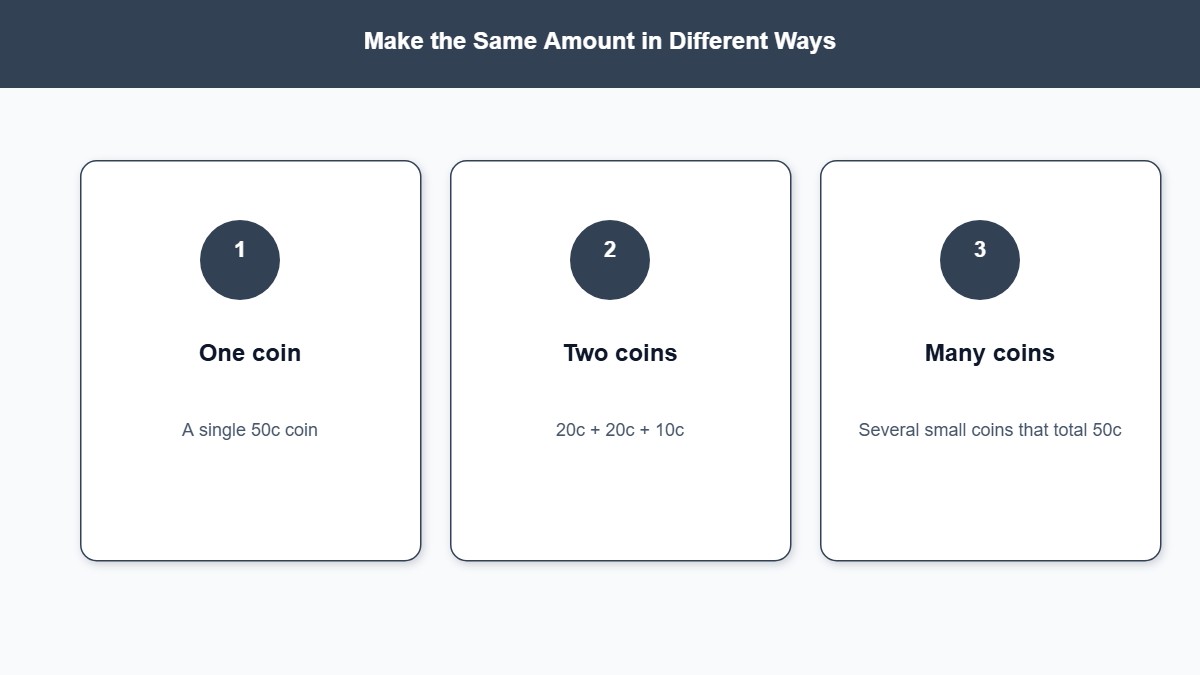
Flexible thinking about money prevents rigid "one right set of coins" habits.
Challenge: "Show 20¢." Accept two dimes, four nickels, one dime and two nickels, or twenty pennies. Record two or three ways on the board so children see equivalence.
Game idea: deal a target amount card (such as 35¢). Pairs race to build it with a shared bank of coins. Compare collections and discuss why both can be correct.
This stage prepares children for making exact payments and for understanding that change can be given in more than one way later.
6. Read Prices and "Buy" Items
Prices connect coins to real decisions.
Set up a tiny shop with four or five labelled items: pencil $0.25, bookmark $0.40, postcards $1.00. Children choose an item, count out coins, and "pay" a cashier.
Teach them to check: count the payment again, then ask, "Does this match the price?" Exact payment first — no change yet — keeps the focus on matching values.
Write prices both ways when helpful: 25¢ and $0.25. Talk briefly about the cent and dollar symbols so children are not scared of the notation.
7. Teach Change With Subtraction Thinking
Change is "how much is left" after paying — a natural bridge to how to teach subtraction.
Start with friendly numbers: price 30¢, pay with two quarters (50¢). Count up from the price to the amount paid: "30… 40, 50 — that's 20¢ change." Counting on is often clearer than formal take-away at first.
Model with a number line or by laying out the payment, pushing aside coins that cover the price, and seeing what remains. Then write a simple sentence: 50¢ − 30¢ = 20¢.
Avoid huge gaps (pay with for a 15¢ item) until children can manage smaller change problems calmly.
Printable: Making Change
Practise finding change with clear buy-and-pay examples.

8. Add and Subtract With Money
Once values are familiar, treat money as addition and subtraction with units attached.
Combining prices: "A stamp is 40¢ and a sticker is 25¢. How much altogether?" Use coins or a quick sketch, then a number sentence. This is how to teach addition in a shopping context.
Finding the difference: "You have 75¢ and want a 60¢ notebook. How much will you have left?" Or compare two price tags to find how much more one costs.
Keep units consistent — work all in cents, or all in dollars with decimal notation, rather than mixing mid-sum. Column methods and regrouping belong only after children understand the amounts with coins or drawings.
9. Introduce Dollars and Cents (Decimals) When Ready
Decimal money notation needs place-value readiness.
Show that
Decimal money notation needs place-value readiness.
Show that $1.00 means one dollar and zero cents, $1.25 means one dollar and 25 cents, and $0.45 is the same idea as 45¢. Relate the digits after the point to cents out of 100.
Practise reading aloud: "three dollars and ten cents" for $3.10. Watch for $3.1 written without a trailing zero — teach the habit of two decimal places for money.
Do not start decimals on day one of money. Secure whole-cent totals and simple dollar amounts first. When you move on, keep concrete coins beside the written amount until the point stops feeling mysterious.
.00 means one dollar and zero cents,Decimal money notation needs place-value readiness.
Show that $1.00 means one dollar and zero cents, $1.25 means one dollar and 25 cents, and $0.45 is the same idea as 45¢. Relate the digits after the point to cents out of 100.
Practise reading aloud: "three dollars and ten cents" for $3.10. Watch for $3.1 written without a trailing zero — teach the habit of two decimal places for money.
Do not start decimals on day one of money. Secure whole-cent totals and simple dollar amounts first. When you move on, keep concrete coins beside the written amount until the point stops feeling mysterious.
.25 means one dollar and 25 cents, and9. Introduce Dollars and Cents (Decimals) When Ready
Decimal money notation needs place-value readiness.
Show that $1.00 means one dollar and zero cents, $1.25 means one dollar and 25 cents, and $0.45 is the same idea as 45¢. Relate the digits after the point to cents out of 100.
Practise reading aloud: "three dollars and ten cents" for $3.10. Watch for $3.1 written without a trailing zero — teach the habit of two decimal places for money.
Do not start decimals on day one of money. Secure whole-cent totals and simple dollar amounts first. When you move on, keep concrete coins beside the written amount until the point stops feeling mysterious.
.45 is the same idea as 45¢. Relate the digits after the point to cents out of 100.Practise reading aloud: "three dollars and ten cents" for .10. Watch for .1 written without a trailing zero — teach the habit of two decimal places for money.
Do not start decimals on day one of money. Secure whole-cent totals and simple dollar amounts first. When you move on, keep concrete coins beside the written amount until the point stops feeling mysterious.
Printable: Dollar Bills
Connect note values to dollars before moving into written dollar-and-cent forms.

10. Shopping Activities and Role-Play
Role-play turns practice into purposeful talk.
Ideas: classroom café with a short menu; book swap priced in cents; "market day" with handmade goods. Assign roles — shopper, cashier, price checker — and rotate.
Give shoppers a fixed bank (for example $2.00 in mixed coins) so they must choose what they can afford. Cashiers practise counting payments and giving change with a calculation card as support.
Keep catalogues small. Five items teach more than a crowded shop that overwhelms working memory.
11. Budgeting Basics
Simple budgets introduce planning without heavy finance jargon.
Give a weekly "class job" pay of $5 in play money. Children plan how to spend or save toward a $3 classroom prize and a $2 donation jar. Ask: "If you spend $3 first, how much is left?"
Home version: a small allowance chart with two jars labelled Spend and Save. Move coins physically when money is used or set aside.
Stay age-appropriate. The goal is "I have this much; my choices must fit," not full household finance.
12. Money Word Problems
Word problems train children to understand a situation before grabbing a calculator or random coins.
Teach a routine: read the problem, underline what you know, decide whether you need to combine, compare, make an amount, or find change, then solve with coins or a number sentence and check that the answer fits the question.
Examples: "Maya has two dimes and a nickel. Does she have enough for a 30¢ eraser?" "A ball costs
Word problems train children to understand a situation before grabbing a calculator or random coins.
Teach a routine: read the problem, underline what you know, decide whether you need to combine, compare, make an amount, or find change, then solve with coins or a number sentence and check that the answer fits the question.
Examples: "Maya has two dimes and a nickel. Does she have enough for a 30¢ eraser?" "A ball costs $1.50. Sam pays with a $5 note. How much change should he get?"
Start with one-step stories. Two-step problems (buy two items, then find change) come after single-step accuracy is solid. Drawings of coins help struggling readers hold the amounts in mind.
.50. Sam pays with a note. How much change should he get?"Start with one-step stories. Two-step problems (buy two items, then find change) come after single-step accuracy is solid. Drawings of coins help struggling readers hold the amounts in mind.
Printable: Money Word Problems
Apply coin and change skills to short money story problems.

13. Common Mistakes and How to Help
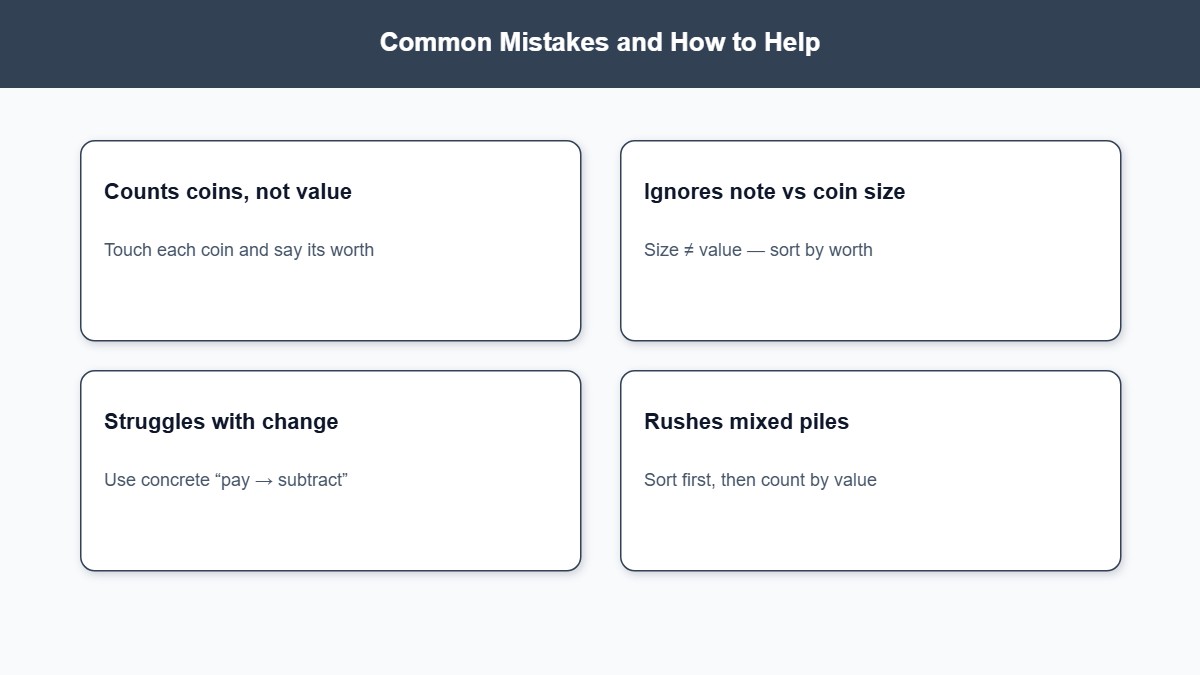
Choosing the biggest coin as the most valuable: Play "value sort" races with value cards visible. Compare a dime and a nickel every day until size-value confusion fades.
Counting mixed coins in the wrong order: Teach "largest value first." Practise with only two coin types before full mixtures.
Writing $0.5 instead of $0.50: Insist on two cent digits for money. Line up dollars and cents in columns when adding.
Giving change by guessing random coins: Return to count-on from the price to the amount paid, laying coins as you count.
Ignoring the dollar sign or cent sign: Have children say units aloud in every answer: "forty-five cents," not only "forty-five."
14. How to Increase Difficulty
Raise challenge only when earlier stages are accurate:
- From naming coins → stating values → counting same coins → mixed coins
- From amounts under $1 → amounts with dollars and cents
- From exact payment → calculating change
- From one-item shops → two-item totals
- From concrete coins → written prices and decimal notation
- From one-step word problems → two-step shopping stories
- From teacher-led shop → independent catalogues and simple budgets
If accuracy drops, shrink the coin set or the totals before adding harder worksheets.
A Simple Money Lesson Structure
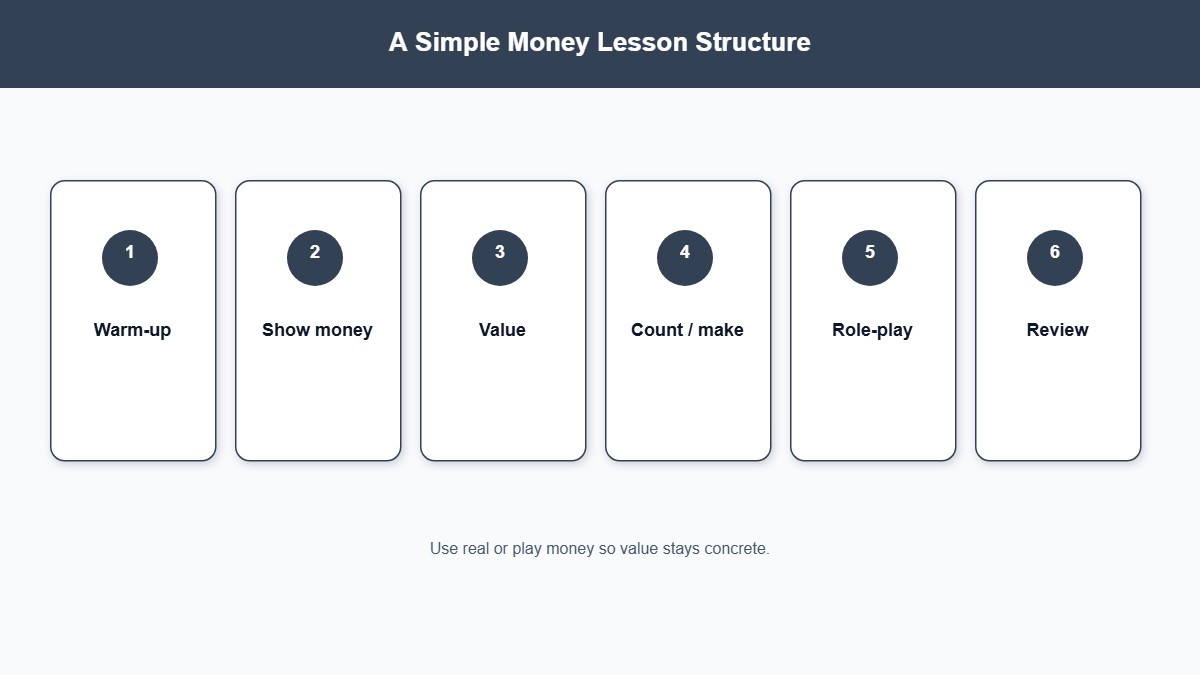
A short money lesson can follow this sequence:
- Warm-up — Quick coin name/value flash with real or plastic coins (flashcards work well alongside).
- Model — Demonstrate one focus skill (for example, counting mixed coins to 40¢).
- Guided practice — Build amounts together; fix value mix-ups in the moment.
- Independent practise — Shop cards, make-an-amount challenges, or a page from maths worksheets.
- Apply — One mini word problem or cashier role-play.
- Wrap-up — Show two ways to make the same amount.
Younger learners may spend many lessons on sorting and values. Older beginners can move sooner into change and decimals. Plan fuller sessions with maths lesson plans.
Printable: Money Review
Use a mixed money review page for follow-up practice after a lesson.

How to Teach Money at Home
Home practice works best with small real purchases and short talks.
Let the child pay for a low-cost item with your help: count the coins into the cashier's hand, then discuss any change. At home, price a few snacks in cents and run a five-minute shop with play money.
Save a clear jar for coin sorting on a rainy day. Ask comparison questions: "Do we have enough for the $1 pack of cards?" Keep sessions brief so money stays interesting.
If your local currency differs from dollars and cents, use the real coins your child sees — the teaching sequence stays the same.
How to Teach Money Step by Step
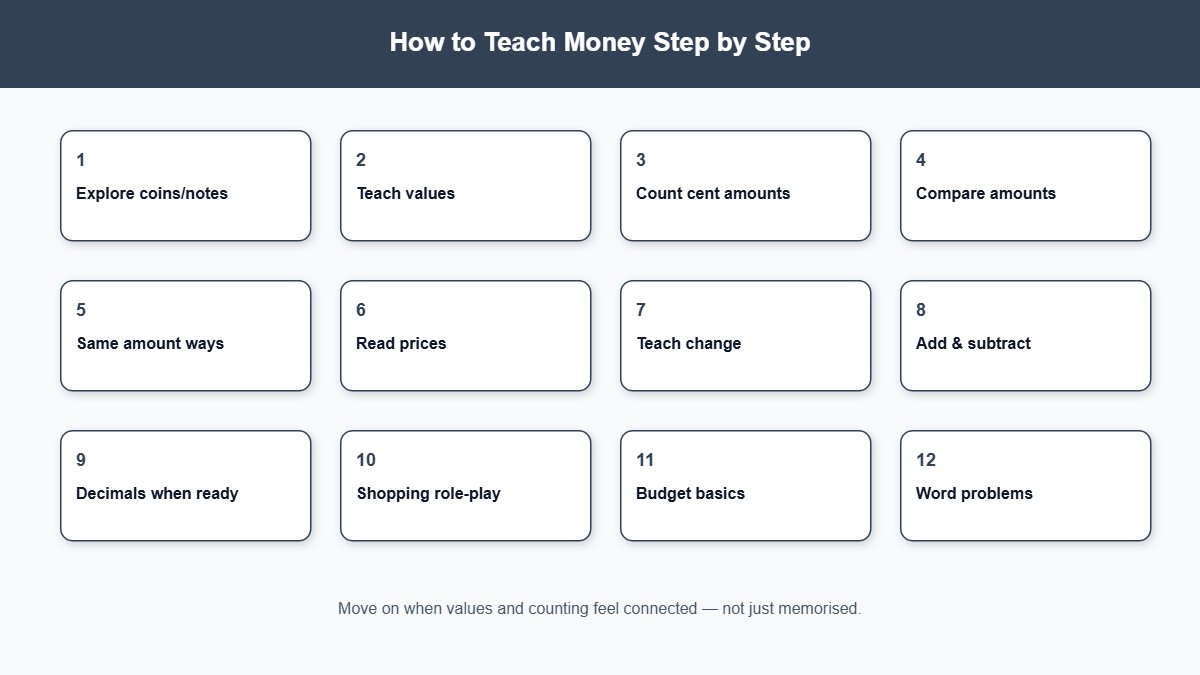
A practical progression looks like this:
- Sort and name common coins and notes.
- Learn each piece's value; challenge size-value myths.
- Count groups of the same coin, then mixed coins.
- Compare amounts and decide "enough / not enough."
- Make the same total with different coin combinations.
- Match coins to prices with exact payment.
- Find change by counting on and with subtraction.
- Add and subtract money in shopping contexts.
- Read and write dollars-and-cents notation when ready.
- Use role-play, simple budgets, and word problems for fluency.
Not every learner needs the same pace. Stay with values and counting until mixed totals are trustworthy.
How to Help a Child Who Struggles With Money
First identify what is breaking down: coin names, values, skip counting, reading prices, or change.
Then simplify: fewer coin types, totals under 50¢, value cards beside every coin, and largest-first counting every time. Sit beside the child and count aloud in unison.
Weak number skills make money feel impossible. Brief practice from how to teach numbers, how to teach addition, and how to teach subtraction with ordinary numbers often unlocks the money version of the same ideas.
Celebrate accurate small totals. Many children who avoid money tasks have only met crowded worksheets full of mixed coins they were not ready to count.
Final Thoughts
Teaching money well means teaching values before big shopping problems: recognise coins, know what they are worth, count and compare, then pay, make change, and solve stories. Hands-on coins beat silent pages of dollar signs.
Build from sorting to mixed totals, exact payment, change, and — when ready — dollars-and-cents notation. Keep examples clear with dollars and cents, or swap in your local currency using the same steps.
Correct size-value confusion and rushed counting without fuss, increase difficulty only when accuracy holds, and use real mini-shops so the skill feels useful. Clear modelling and short, regular sessions matter more than racing to large notes and tricky decimals.
Frequently Asked Questions
Common questions answered for downloading and using our premium printable designs.



Comments (0)
Leave a Reply
Be the first to leave a comment!