
How to Teach Fractions
A practical guide to teaching fractions: wholes and parts, halves and quarters, numerators and denominators, equivalents, comparing, like-fraction operations, word problems, and help for common misconceptions.
 Amanda Williams
Fractions describe equal parts of a whole. Children meet them when they share a pizza, split a chocolate bar, or divide a set of counters into fair groups. When the idea of "equal parts" is clear, written fractions stop looking like mysterious stacked numbers and start matching something they can see and make.
This guide shows how to teach fractions in a practical order: wholes and parts, halves and quarters, numerator and denominator, equivalents, comparing, adding and subtracting like fractions, and a careful introduction to multiplying and dividing when learners are ready. Pair fraction work with how to teach addition, how to teach multiplication, and how to teach division so number operations support each other. Use fraction worksheets, maths worksheets, flashcards, and maths lesson plans for practice that matches each stage.
Whether you teach in a classroom or at home, keep the same habits: model with real objects first, name parts aloud, correct misconceptions gently, and move to symbols only when the picture in the child's mind is solid.
What Fractions Are and Why They Matter
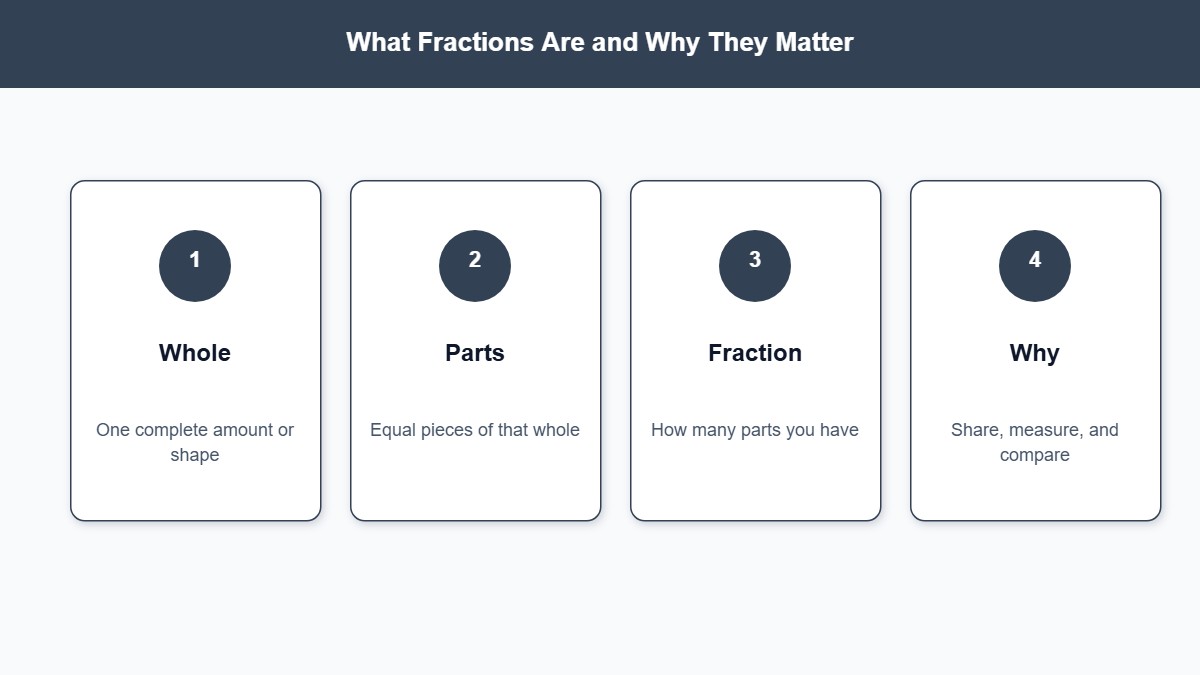
A fraction names how many equal parts of a whole you have. In ¾, the whole is split into four equal parts and you are talking about three of them.
Fractions matter because they appear in measurement, cooking, money, time, and later algebra. Children who only memorise "top and bottom numbers" without equal-parts meaning struggle when sizes change or when they must compare ½ and ⅖.
Start concrete. Fold paper, cut fair pizza slices, break a chocolate bar along the grooves, or share twelve counters into equal groups. Spoken language ("half of the bar", "three out of four slices") should come before formal notation.
1. Build the Idea of Whole and Parts
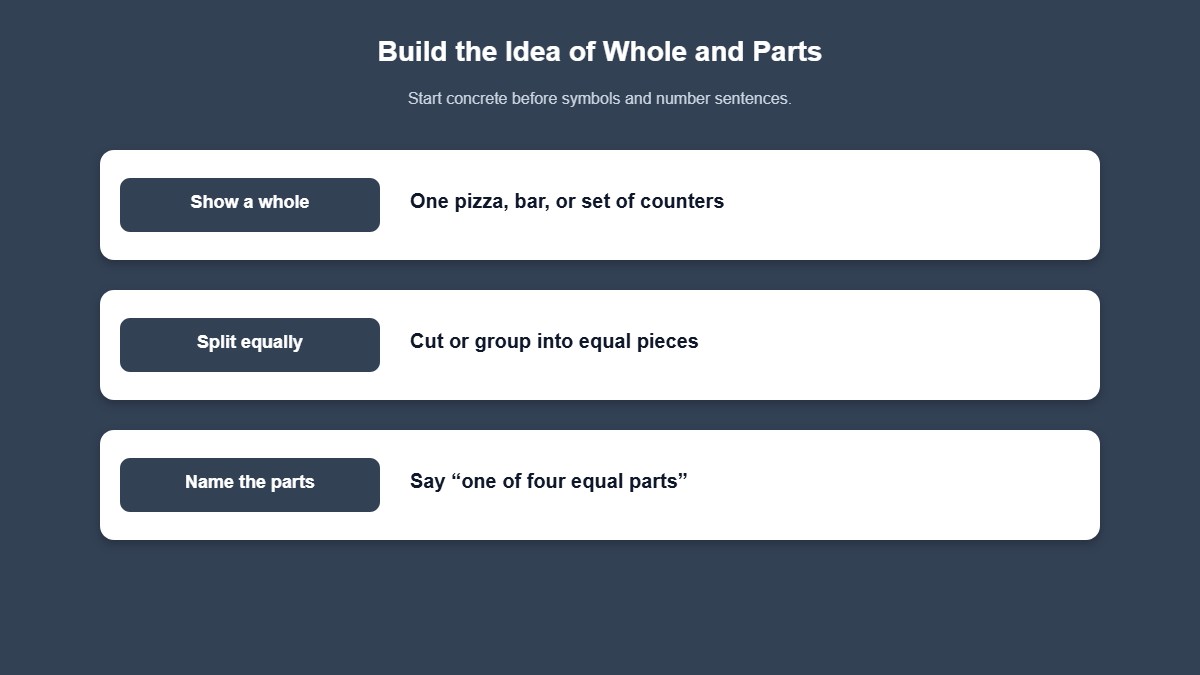
Before halves and quarters, make sure children know what a whole is and that parts must be equal to name a fraction fairly.
Show one whole pizza. Cut it into two pieces that are clearly different sizes and ask whether each person got a fair share. Then cut another pizza into two matching halves. The contrast teaches that fraction parts are equal parts of one whole.
Try the same with a chocolate bar: snap it into uneven chunks, then into equal rows. Ask: "Is this still half if the pieces are different sizes?" Keep answers short and visual — point to the pieces while you talk.
Also use discrete wholes: a bag of eight counters is one whole set. Sharing them into two equal groups of four shows half of a group, not only half of a shape.
2. Teach Halves and Quarters First
Halves (½) and quarters (¼) are the friendliest early fractions because children already hear those words in daily life.
Fold a square of paper in half, open it, and shade one part. Fold again into quarters. Say: "Four equal parts — each part is one quarter. Two quarters make one half."
Food examples stick: half a sandwich, a quarter of a pizza left on the tray, a chocolate bar broken into four equal pieces with one eaten. Always ask both "How many equal parts in the whole?" and "How many parts do we have?"
Practise recognising halves and quarters in different shapes — circles, rectangles, and simple strips — so children do not think a fraction only looks like a pie.
Printable: Halves and Fourths
Practise equal halves and quarters with clear fraction shading pages.


3. Introduce Numerators and Denominators
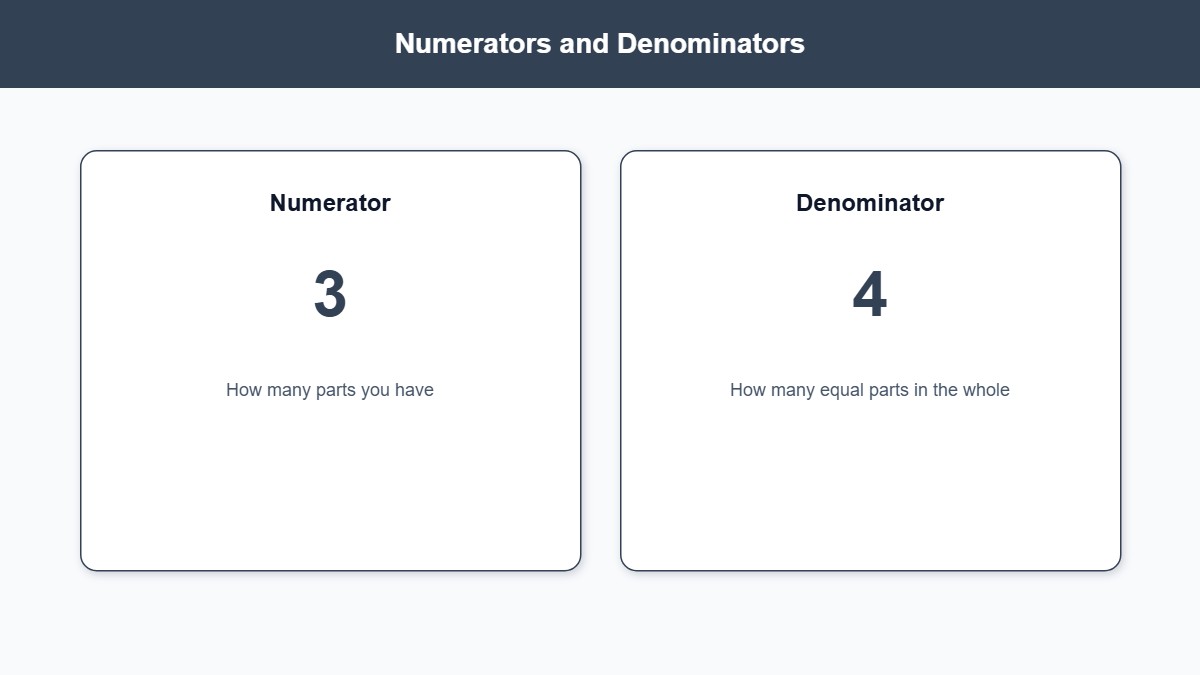
Once children can show halves and quarters with materials, attach the written form.
The denominator (bottom number) tells how many equal parts make the whole. The numerator (top number) tells how many of those parts you have. For ¾ of a pizza, the pizza is in four equal slices and you have three of them.
Build the fraction as you speak: draw or cut the whole, count the equal parts while writing the denominator, then shade or take some parts while writing the numerator. Avoid teaching "top means… bottom means…" as a chant with no objects nearby.
Compare ⅓ and ¼ with paper strips or chocolate pieces of the same whole size so children see that a larger denominator means smaller pieces when the whole stays the same.
4. Use Food, Shapes, and Groups
Rotate three kinds of models so fractions stay flexible:
- Food / area models — pizza circles, chocolate rectangles, folded sandwiches
- Shape models — fraction bars, geoboards, shaded pattern blocks
- Set models — sharing counters, beads, or stickers into equal groups
Example with counters: twelve counters are the whole. Six is ½ of the set; three is ¼. Ask children to make the groups themselves, then write the fraction.
Example with shapes: shade ⅖ of a bar split into five equal sections. Ask what fraction is left unshaded.
Switching models prevents the misconception that fractions only apply to pizzas. Printable shading and matching tasks fit well with fraction worksheets.
Printable: Fraction Models
Build understanding with thirds and shade-the-fraction model practice.


5. Teach Equivalent Fractions
Equivalent fractions name the same amount with different numbers — ½ and ⅖ of the same chocolate bar look different as pieces but cover the same total if you choose matching sizes carefully (½ equals 2/4, not ⅖).
Show a pizza cut into two halves and shade one half. On a matching pizza cut into four quarters, shade two quarters. Place them side by side: same amount of pizza, different fraction names — ½ = 2/4.
Use fraction walls or stacked bars so children see ⅓ lining up with 2/6. Fold paper: one half fold vs two quarter folds that cover the same region.
Later, connect to multiplying numerator and denominator by the same number when learners are ready for a rule — but only after they have seen the equality with materials. how to teach multiplication helps when that step arrives.
6. Compare Fractions
Comparing teaches size sense, not only procedures.
Start with same denominators: ⅜ of a bar vs ⅝ of the same bar — more shaded pieces means larger. Then same numerators: ⅓ vs ¼ of identical wholes — fewer pieces in the whole means each piece is larger, so ⅓ > ¼.
Use pizza slices of equal-sized pizzas, chocolate bars of equal length, or clear fraction strips. Ask children to explain with the model before using < and > symbols.
Avoid racing to cross-multiply. Visual comparison builds the intuition they will need for harder fractions and for word problems.
Printable: Compare Fractions
Compare fractions and place them on a number line.


7. Add and Subtract Like Fractions
When denominators match, you are combining or removing pieces of the same size.
Model: ⅖ of a chocolate bar plus ⅕ more is ⅗ of that bar — count the fifths. For subtraction, start with ¾ of a pizza and remove ¼; 2/4 (or ½) remains.
Write the number sentence beside the model: ⅖ + ⅕ = ⅗. Stress that the denominator stays the same because the piece size did not change; only the count of pieces changed. That idea links cleanly to how to teach addition with equal units.
Keep early work to like denominators. Unlike denominators can wait until equivalents are comfortable.
Printable: Add Like Fractions
Practise adding fractions that share the same denominator.

8. Introduce Multiplying and Dividing Fractions Carefully
Only move here when parts, notation, and like-fraction addition feel steady — and keep explanations concrete.
Multiplying can begin as "finding a fraction of an amount": ½ of 8 counters is 4; ⅓ of a 6-square chocolate strip is 2 squares. Connect "of" to how to teach multiplication with whole numbers first, then show simple cases such as ½ × ¼ as half of a quarter of a folded square.
Dividing can begin with sharing: ¾ of a pizza shared between two people is a how to teach division idea — how much does each get? Keep early division-of-fractions light and visual; algorithms can come later.
Do not dump invert-and-multiply as the first experience. Meaning first, shortcut second.
9. Practise Fraction Word Problems
Word problems check whether children can choose a model and a fraction, not only shade a pre-drawn bar.
Examples:
- A pizza is cut into eight equal slices. Sam eats three. What fraction is left?
- A chocolate bar has twelve equal chunks. Maya eats ¼ of the bar. How many chunks did she eat?
- Twelve counters are shared equally among three children. What fraction of the set does each child get?
Teach a routine: find the whole, check that parts are equal, decide whether the question asks for parts taken or parts left, then write the fraction. Draw a quick sketch before calculating.
Mix set problems with shape problems so children transfer the idea across contexts.
Printable: Fraction Word Problems
Apply fraction skills to short word problems.

10. Common Fraction Misconceptions
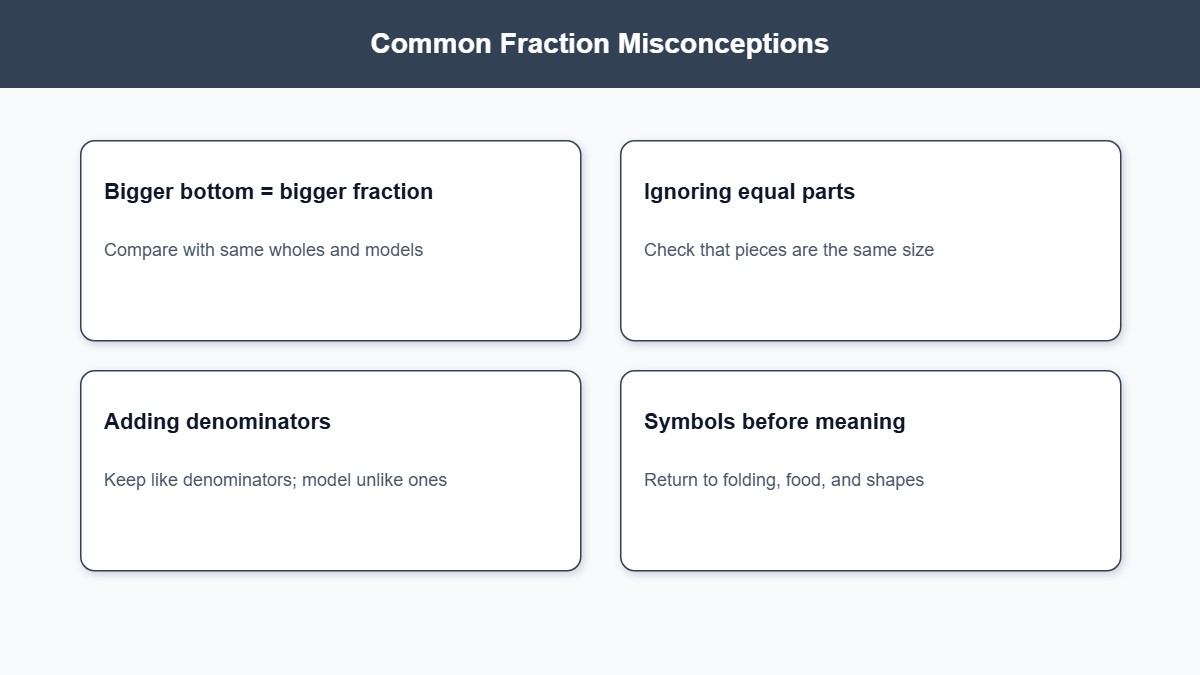
Watch for these patterns and fix them with a model, not only a verbal correction:
- Unequal parts called fractions — redraw or recut until pieces match
- Larger denominator means larger fraction — compare ⅓ and ⅛ of the same whole
- Adding denominators (½ + ½ = 2/4) — return to pizza slices of the same size and count pieces
- Confusing the whole — clarify whether the whole is one pizza, one bar, or one set of counters
- Shading without naming — always say and write the fraction after shading
When a child is stuck, put symbols away for a minute and rebuild the amount with food pieces, paper folds, or counters.
11. How to Increase Difficulty
Raise challenge only when earlier stages are accurate:
- More parts in the whole (sixths, eighths, tenths)
- Improper fractions and mixed numbers with clear "whole plus part" models
- Equivalents without a pre-drawn matching picture
- Comparing fractions with different denominators using bars or equivalents
- Adding and subtracting with related denominators
- Fraction of a set and simple fraction of a fraction
- Multi-step word problems that mix take-away and leftover questions
If confidence drops, return to halves and quarters of a familiar whole before pushing on.
A Simple Fractions Lesson Structure
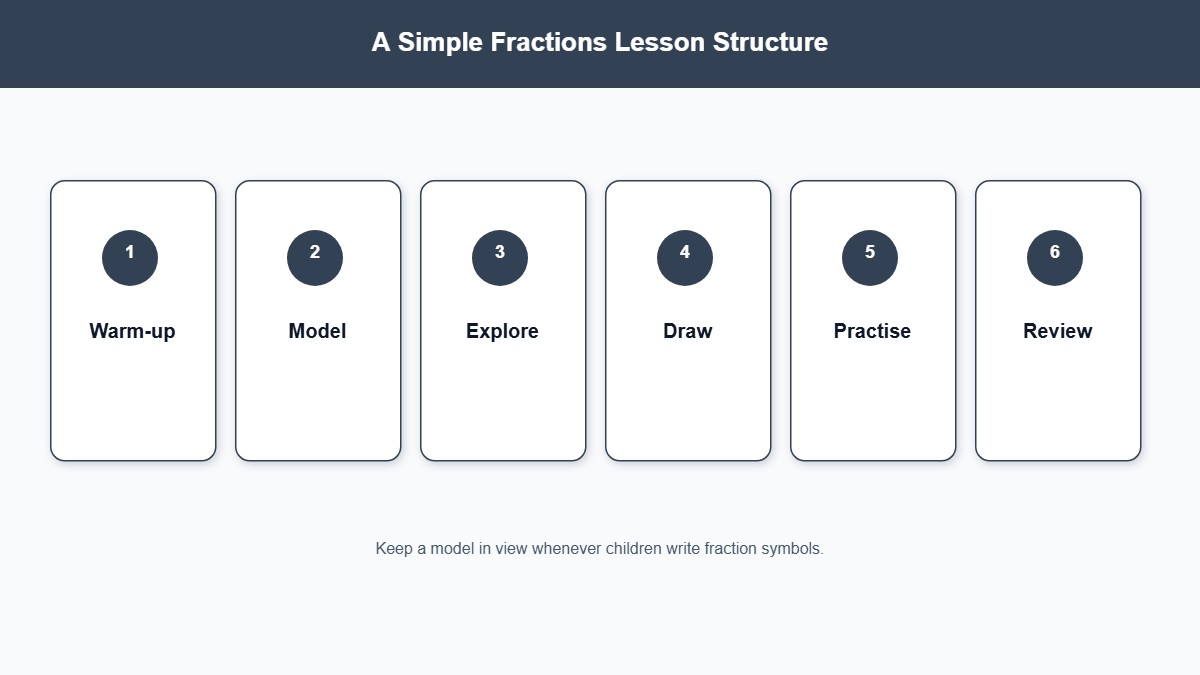
A short fractions lesson can follow this sequence:
- Warm-up — Quick oral review: show a folded paper or shaded bar and name the fraction.
- Model — Demonstrate today's idea with a pizza, chocolate bar, or counters while thinking aloud.
- Guided practice — Class or pairs make the same fraction with materials; fix unequal parts immediately.
- Independent practise — Shade, match, or solve a few items from fraction worksheets or maths worksheets.
- Check — One child explains an answer using a model; peers agree or adjust.
- Wrap-up — Real-life prompt: "Where might we use halves today?"
Younger learners need more modelling time; older beginners may move faster into equivalents and like-fraction addition. Plan fuller sessions with maths lesson plans.
How to Teach Fractions Step by Step
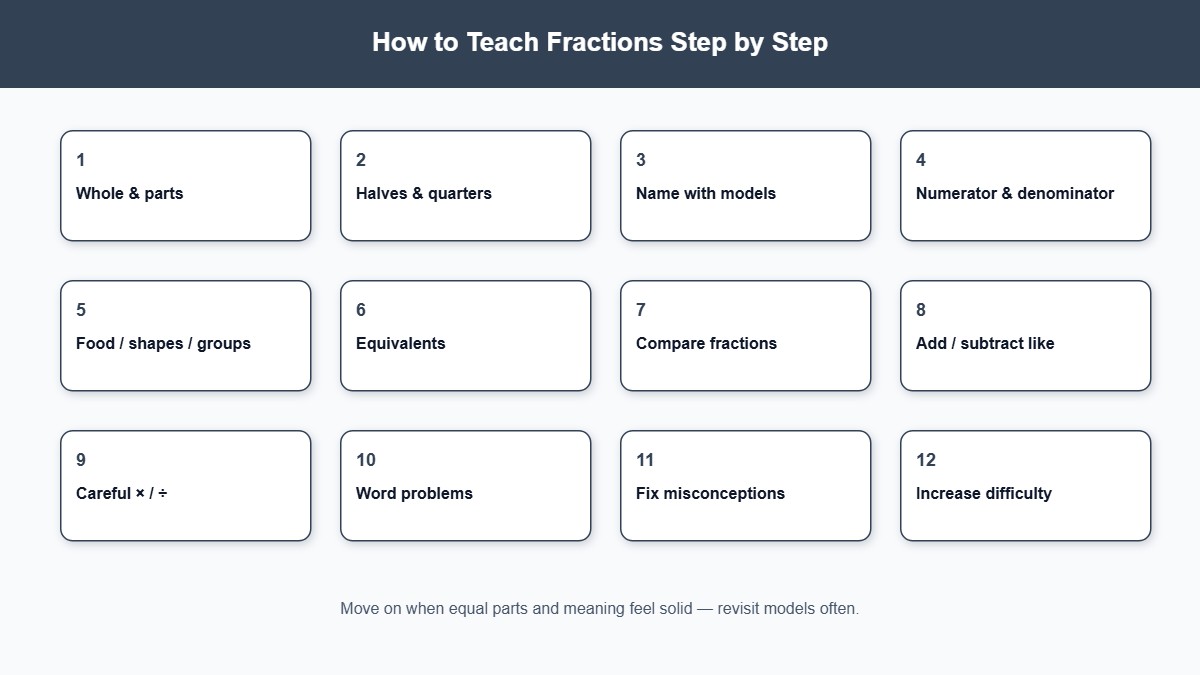
A practical progression looks like this:
- Establish whole vs equal parts with real objects.
- Master halves and quarters in shapes and sets.
- Link models to numerator and denominator.
- Practise with food, shapes, and groups of counters.
- Explore equivalent fractions side by side.
- Compare fractions using the same whole.
- Add and subtract like fractions with models and number sentences.
- Introduce simple fraction-of-a-quantity ideas (multiply/divide lightly).
- Solve short word problems with sketches.
- Increase denominators, mixed numbers, and independence.
Stay at each step until children can show and explain the fraction, not only copy a shaded example.
How to Help a Child Who Struggles With Fractions
First find the sticky point: unequal parts, reading the symbols, understanding the whole, or comparing sizes.
Simplify the whole. Use one pizza or one short chocolate bar. Stick to halves and quarters. Have the child cut or fold so they control the equal parts.
Keep spoken labels glued to actions: "Four equal pieces — denominator four. We shaded one — numerator one." Use flashcards for fraction names only after the model is clear.
Avoid racing peers into unlike denominators. Short, successful builds with counters or paper restore confidence faster than extra worksheets alone.
Home Activities for Fractions
Everyday moments make fractions feel useful:
- Cooking: measure ½ cup; cut a sandwich in half; share a pizza fairly
- Snacks: break a chocolate bar into equal chunks and name the fraction eaten
- Play: share a pot of counters or building bricks into two or four equal groups
- Paper: fold napkins or scrap paper into halves and quarters and colour one part
- Talk: "You ate ¾ of your apple slices — how many were in the whole?"
Keep sessions short and hands-on. Home practice should feel like sharing and making, not a formal test.
Final Thoughts
Teaching fractions well means teaching equal parts of a clear whole — with pizza, chocolate, counters, and shapes — before leaning on rules. Numerators and denominators make sense when children have already built the amount with their hands.
Move from halves and quarters to equivalents, comparing, and like-fraction addition, then ease into simple multiply-and-divide ideas when ready. Link back to how to teach addition, how to teach multiplication, and how to teach division so operations feel connected.
Model carefully, correct misconceptions with materials, and use real sharing situations so fractions stay meaningful. Clear demonstrations and short, regular practice matter more than rushing to abstract algorithms.
Frequently Asked Questions
Common questions answered for downloading and using our premium printable designs.



Comments (0)
Leave a Reply
Be the first to leave a comment!