
How to Teach Addition
A practical guide to teaching addition: combining objects, counting on, number lines, number bonds, regrouping, mental strategies, word problems, and help for common mistakes.
 Amanda Williams
Addition is joining amounts to find a total. Children understand it best when they first combine real objects, then pictures, and only later write number sentences. Jumping straight to sums on a page often leads to memorising answers without knowing what the plus sign means.
This guide shows how to teach addition step by step: combining sets, counting on, number lines, number bonds, single-digit facts, regrouping, larger numbers, mental strategies, and word problems. It pairs well with how to teach counting and how to teach numbers, and prepares learners for how to teach subtraction and later how to teach multiplication. Use addition worksheets, maths worksheets, flashcards, and maths lesson plans for practice that matches each stage.
Whether you teach in a classroom or at home, keep the same rhythm: show joining with objects, practise with small numbers, talk about what changed, then move to symbols and written methods when the idea is secure.
What Addition Means
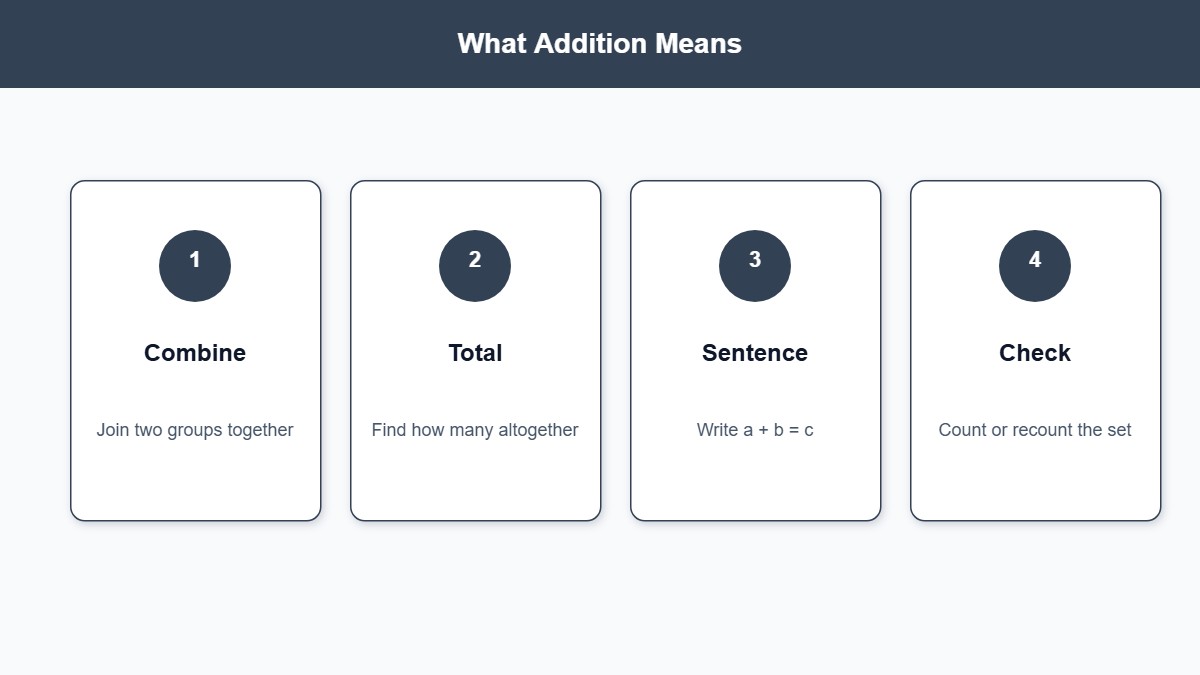
Addition answers "how many altogether?" when two or more amounts are put together. Early on, children need to see:
- Two groups can become one larger group
- The total is usually greater than either part (when adding positive whole numbers)
- The order of the parts does not change the total (3 + 5 and 5 + 3)
- A number sentence is a written record of something that already happened with objects or pictures
A child who can chant "six plus four equals ten" but cannot make six counters and four counters and find ten still needs concrete joining practice before more formal work.
1. Combine Objects Before Number Sentences
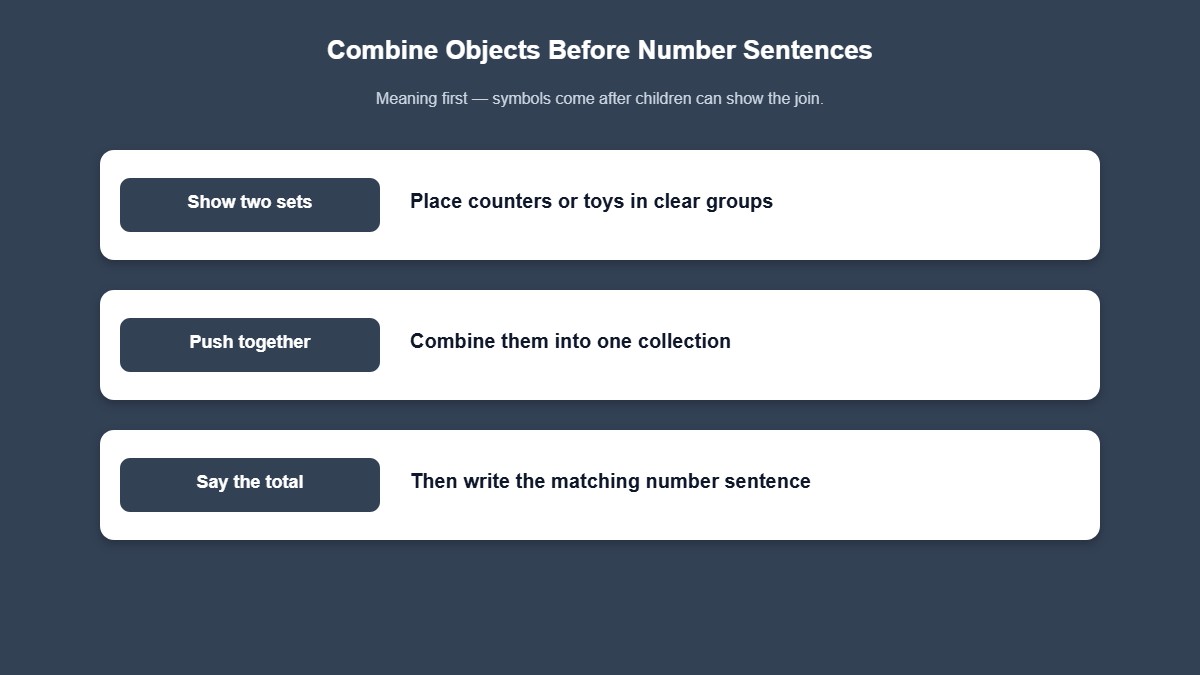
Start with the action of adding, not the symbols.
Put four red cubes in one dish and three blue cubes in another. Ask, "How many in each dish?" Then tip both into a tray: "Now how many altogether?" Sweep your hand under the combined set as you say the total so the join is visible.
Repeat with different items — bottle tops, crayons, grape pieces on a plate — so "altogether" is not tied to one toy. Keep language consistent: "and," "join," "put together," "altogether," then gradually introduce "add" and "plus."
Only after several successful joins should you write something like 4 + 3 = 7 underneath the trays. The sentence should describe what the child already saw.
Printable: Combining and Ten-Frames
Start with small sums and ten-frame models before formal equations.


2. Make Sense of "Adding" With Stories
Short stories turn joining into something children can picture.
Example: "Maya had two stickers. Her friend gave her five more. How many stickers does Maya have now?" Act it with real stickers or counters before anyone writes a sum.
Another example: "There are three buses at the stop. Two more buses arrive. How many buses are there now?" Draw a quick sketch or use toy vehicles.
Ask children to retell the story in their own words and point to the first amount, the amount added, and the total. That habit later supports word problems and stops children from grabbing numbers at random.
3. Teach Counting On
Counting on is more efficient than recounting every object from one each time.
Model with fingers or counters: start at the larger number and count forward the smaller amount. For 7 + 2, hold "seven" in mind (or cover seven cubes), then say "eight, nine" while adding two more. Emphasise starting from the bigger part so counting on stays short.
Practise orally: "Start at nine. Count on three." Use a small pile the child can see for the starting number until the idea sticks, then hide it and count on from memory.
Counting on depends on a secure number sequence — strengthen that with how to teach counting if children lose their place when they leave one behind.
4. Use Number Lines
A number line shows addition as hops forward.
Mark a start (for example 5). To add 4, hop 6, 7, 8, 9 and land on 9. Count the hops, not the marks between, so children do not land one short or one long.
Begin with empty or partly numbered lines and large hops of one. Later use jumps of two or five when children are ready for bigger steps. Floor number paths work well: step forward while saying each landing number aloud.
Number lines also prepare children for how to teach subtraction as hops backwards, so teach careful landing early.
5. Move From Objects to Pictures
Once object joining is reliable, use drawings and picture cues.
Draw five circles and three circles in a second group; cross or loop them into one total. Worksheet rows of apples, stars, or dots let children count and combine without physical counters every time — addition worksheets are useful here.
Encourage children to sketch their own quick marks for word problems ("draw four balloons, then two more") before writing the number sentence. Pictures are a bridge, not a permanent crutch: fade them as mental methods grow.
6. Build Number Bonds
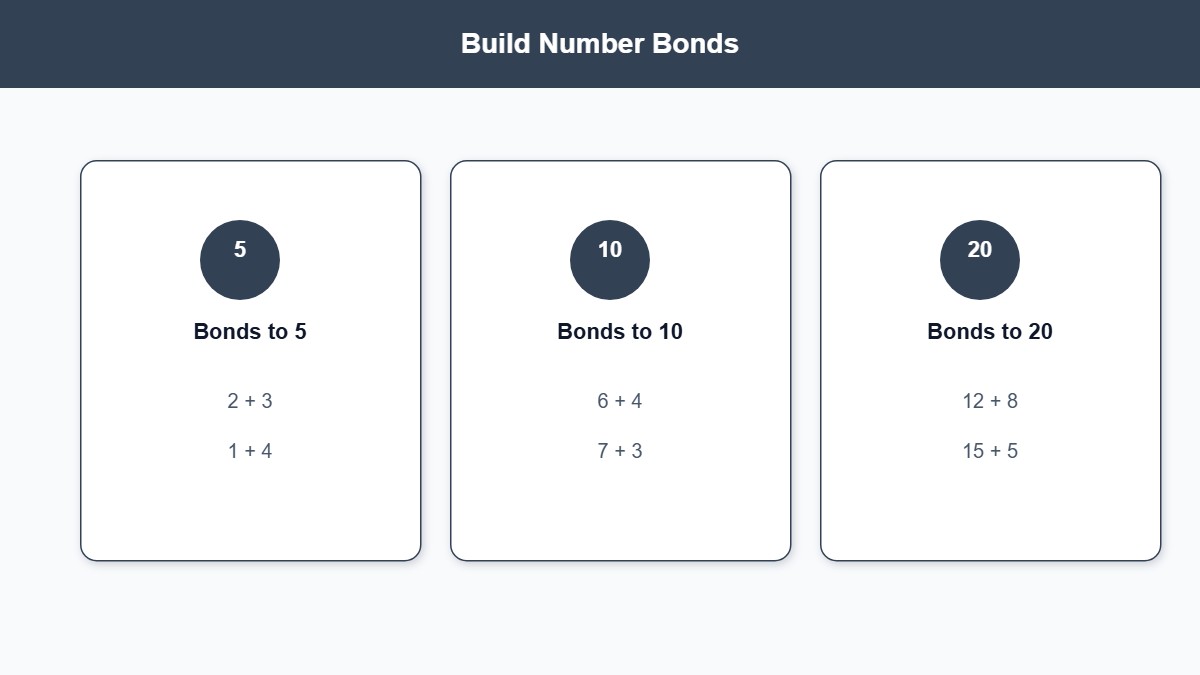
Number bonds are pairs that make a target total — the parts that join to a whole.
Focus first on bonds to 5 and 10: 1+4, 2+3, 7+3, 6+4, and so on. Use a ten-frame: fill seven cells, ask how many empty cells remain to make ten. Part–whole circles (one whole, two parts) make the relationship visual.
Games help: hide some counters under a cup from a known total of ten; the child works out how many are hidden. flashcards for bonds to 10 support quick recall after the concrete stage.
Strong bonds make single-digit addition faster and support regrouping later (knowing 8 + 5 is 8 + 2 + 3 because 8 + 2 makes 10).
Printable: Number Bonds
Practise part–whole relationships with bonds to 5 and 10.


7. Practise Single-Digit Addition
When joining and counting on are secure, practise facts within 10, then within 20.
Mix strategies: doubles (4+4, 6+6), near doubles (6+7 as 6+6+1), bonds to 10, and counting on for small addends. Avoid only timed tests at the start — understanding should come before speed.
Short daily practice beats long mixed sheets. Say facts aloud, build them with cubes, then write them. Record progress on a simple chart so children see growth without shame about gaps.
Link written practice to addition worksheets that still allow drawing or ten-frames for learners who need support.
Printable: Single-Digit Addition
Build fluency within 10 and make-10 strategies.


8. Introduce Regrouping (Carrying)
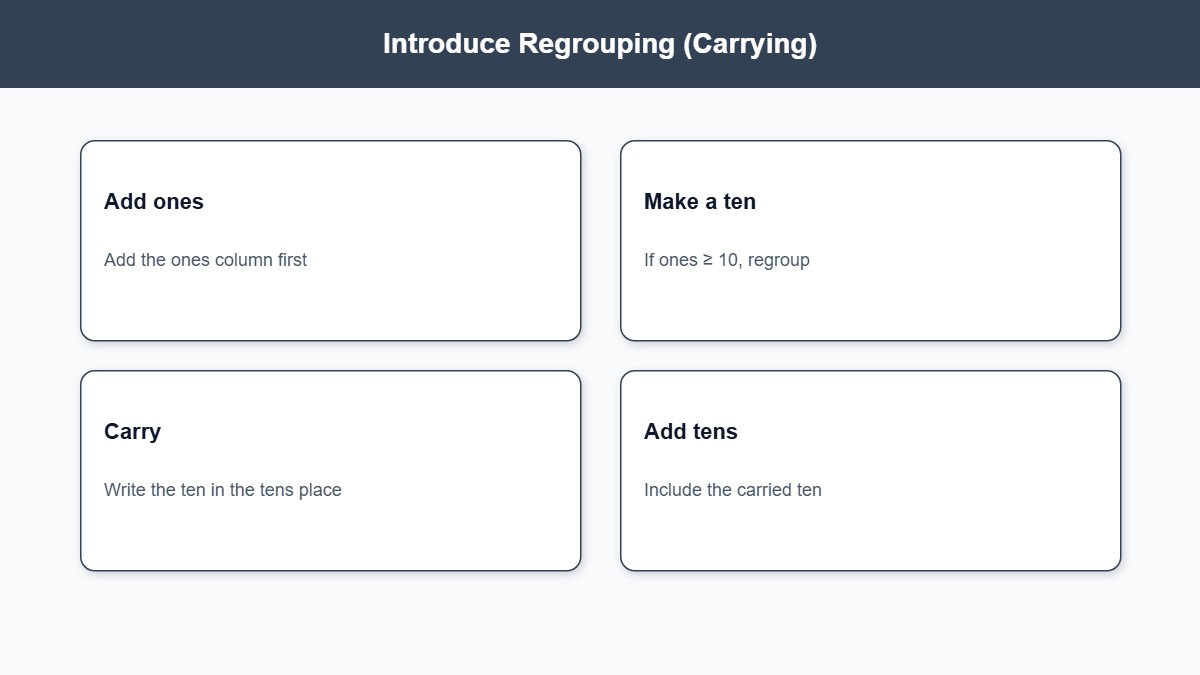
Regrouping matters when a column sum is ten or more — for example, adding 27 + 15 in the ones place: 7 + 5 = 12, which is 1 ten and 2 ones.
Teach with base-ten blocks or bundled straws first. Make 27 as 2 tens and 7 ones; add 1 ten and 5 ones. Combine the ones: twelve ones become one ten and two ones. Move that new ten into the tens place so children see why we "carry" 1.
Only then show the written column method with a small carried digit. Name it clearly: "We exchange ten ones for one ten." If the language of carrying feels empty, return to bundles until the exchange is obvious.
Common error: writing 12 in the ones place instead of regrouping. Fix by always asking, "Can we make a group of ten ones?"
Printable: Two-Digit Regrouping
Practise two-digit addition with regrouping (carrying).

9. Add Larger Numbers
Extend to two-digit and then three-digit addition once regrouping with materials is understood.
Progression ideas:
- Two-digit + one-digit without regrouping (34 + 2)
- Two-digit + one-digit with regrouping (34 + 8)
- Two-digit + two-digit without regrouping (42 + 35)
- Two-digit + two-digit with regrouping (47 + 28)
- Then hundreds, with the same place-value talk
Estimate first: "47 + 28 is about 50 + 30, so near 80." Estimation catches wild answers from place-value slips. Keep place-value language tied to how to teach numbers when digit value is still shaky.
10. Teach Mental Addition Strategies
Mental strategies help children add without always needing a written column.
Useful methods:
- Add tens, then ones (45 + 32 → 45 + 30 = 75, then +2 = 77)
- Bridge through ten (9 + 6 → 9 + 1 = 10, then +5 = 15)
- Use doubles and near doubles
- Compensate (29 + 8 → 30 + 8 = 38, then subtract 1 → 37)
Model thinking aloud. Ask, "Which way is easiest for these numbers?" so children choose a strategy instead of guessing. Mental work grows from strong bonds and counting on, not from secret tricks.
11. Tackle Word Problems
Word problems apply addition to real situations — joining, adding on, and sometimes comparing totals.
Teach a simple routine: read the problem, underline what you know, identify what you need to find, choose objects/pictures/numbers, solve, then check whether the answer fits the question.
Example (join): "A shelf holds 18 fiction books and 14 information books. How many books are on the shelf?"
Example (add on): "Sam has 25 trading cards. He buys 9 more. How many does he have now?"
Include problems with extra unused numbers occasionally so children think, not just add every digit they see. Connect later multi-step ideas carefully; early problems should stay one clear join.
Printable: Addition Word Problems
Apply addition to short story problems.

12. Common Mistakes and Memorising Without Understanding
A frequent problem is memorising facts or procedures with no sense of joining amounts.
Chanting facts but failing with objects: Return to combining sets and stories. Facts should describe something real.
Always counting all from one: Teach counting on from the larger number with covered starting sets.
Miscounting hops on a number line: Practise landing on numbers; count hops together.
Regrouping errors: Rebuild with tens and ones; ask whether a group of ten ones can be made.
Adding digits in the wrong place: Line numbers in columns on squared paper; say "ones with ones, tens with tens."
Word-problem grabs: Retell the story and act it before choosing an operation — sometimes the situation is subtraction, covered in how to teach subtraction.
13. How to Increase Difficulty
Raise challenge only when smaller steps are accurate:
- Larger addends and three or more numbers (5 + 3 + 2)
- Missing-number sentences (7 + __ = 12)
- Regrouping across more than one place
- Mental strategies with less drawing support
- Multi-step word problems
- Adding money, lengths, or data totals in context
If accuracy drops, step back to objects, bonds, or single-digit work before pushing place value again.
Addition at Home
Home practice works best in short, useful moments.
Ideas: add the forks and spoons while setting the table; combine scores in a board game; add two prices on a simple shopping list; count how many socks are in the wash and how many more are needed for a matching pair set. Cook together: "We have two eggs in the bowl — crack three more. How many now?"
Keep sessions brief and positive. A few well-understood joins beat a long worksheet done in a rush. Printable addition worksheets can support quiet practice after hands-on play.
A Simple Addition Lesson Structure
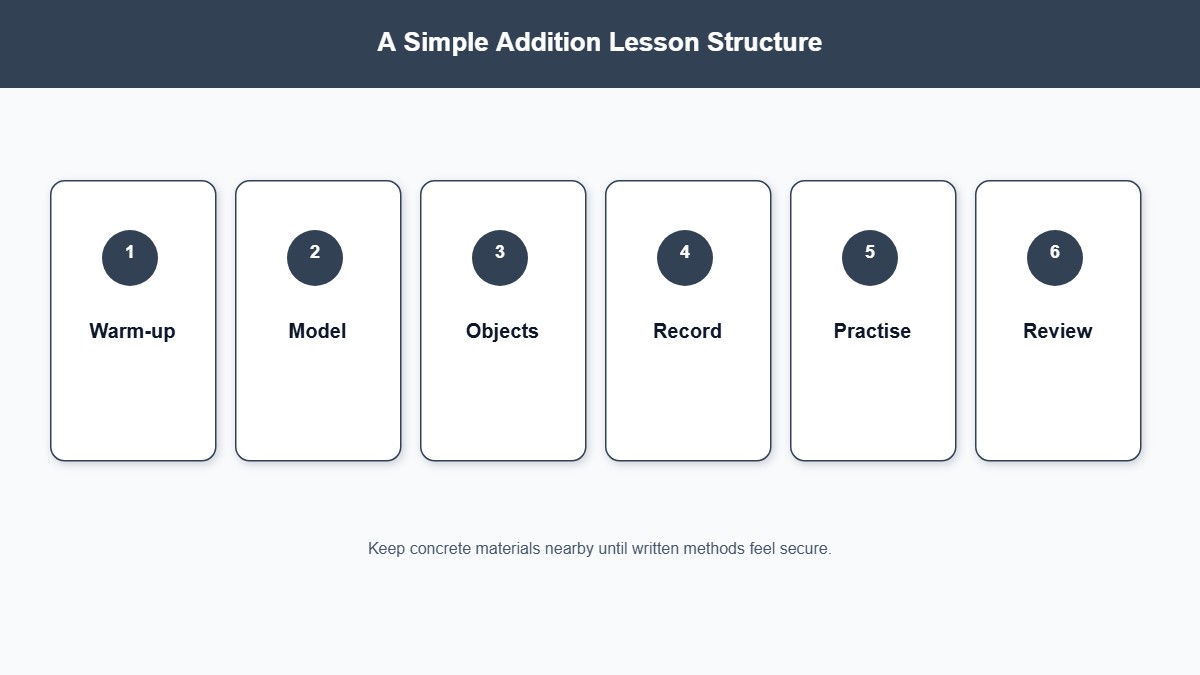
A short addition lesson can follow this sequence:
- Warm-up — Quick bonds to 10, counting on oral practice, or a doubles chant.
- Model — Show a join with objects or a number-line hop; write the matching sentence last.
- Guided practice — Solve two or three related problems together; fix strategy errors in the moment.
- Independent practise — Children work with counters, pictures, or a focused page from addition worksheets.
- Check — Compare one answer; ask someone to explain their method.
- Wrap-up — One mental strategy or a quick real-life add-on story.
Adapt timing for age. Younger learners need more objects; older beginners may spend longer on regrouping and mental methods. Plan fuller sessions with maths lesson plans.
How to Teach Addition Step by Step
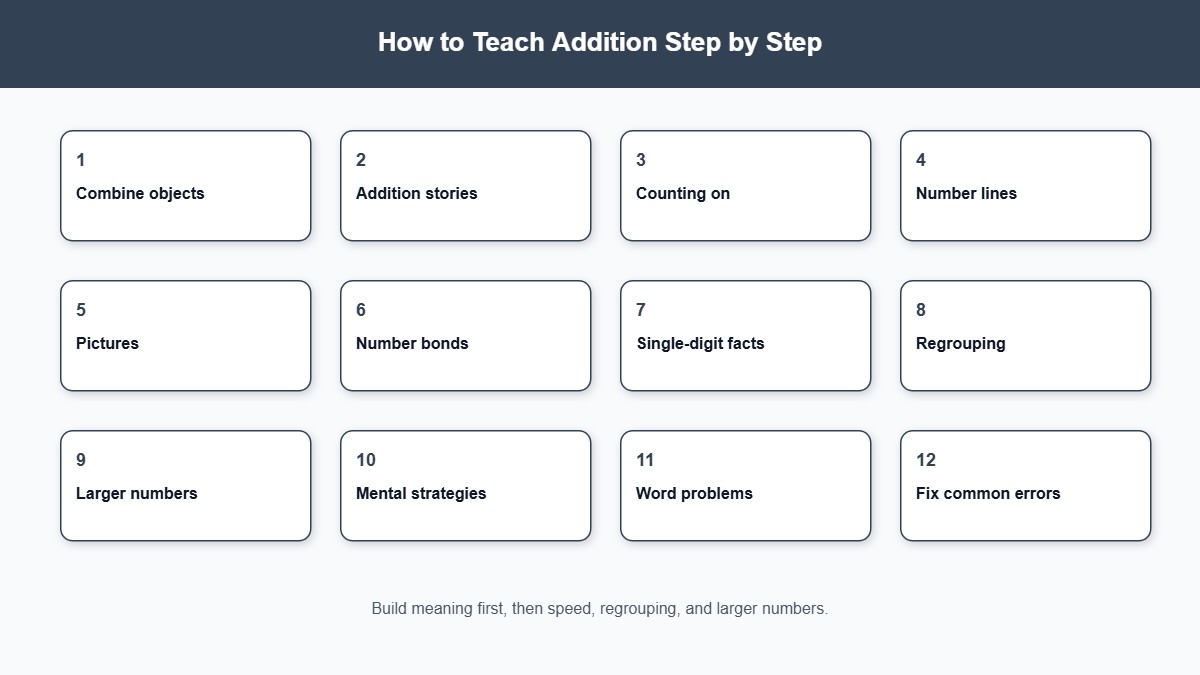
A practical progression looks like this:
- Combine two sets of objects and name the total.
- Tell and act simple "and more" stories.
- Count on from the larger number.
- Show addition as forward hops on a number line.
- Move to pictures, then number sentences.
- Learn number bonds to 5 and 10.
- Practise single-digit facts with strategies, not only speed.
- Add two-digit numbers with base-ten materials; introduce regrouping.
- Use column addition and mental strategies for larger numbers.
- Solve word problems and explain methods; link toward how to teach subtraction and how to teach multiplication when ready.
Stay at each step until the idea is clear. Written methods should record understanding, not replace it.
How to Help a Child Who Struggles With Addition
Find what is breaking down: counting sequence, joining sets, place value, or reading word problems.
Simplify: smaller numbers, physical objects, one strategy at a time, and slower pace. Sit beside the child and model "start at six, count on two" in unison.
Avoid piling on timed drills when understanding is weak — that often deepens anxiety and memorising without meaning. Rebuild with trays of counters, ten-frames, and stories, then return to written sums.
Celebrate clear explanations ("I made ten, then added three") as much as correct answers. Gaps in numeral knowledge or counting can be supported with how to teach numbers, how to teach counting, and flashcards alongside addition practice.
Final Thoughts
Teaching addition well means teaching joining first: objects, stories, counting on, and number lines, then bonds, facts, regrouping, and mental strategies. Number sentences and column methods should describe something children already understand.
Watch for memorising without meaning. When that appears, go back to combining sets and talking about totals. Steady progression, short practice, and real-life joins at home build confidence.
With clear demonstrations and the right level of challenge, children learn not only how to get answers, but what addition is — a foundation for how to teach subtraction, how to teach multiplication, and wider maths through maths worksheets and maths lesson plans.
Frequently Asked Questions
Common questions answered for downloading and using our premium printable designs.




Comments (0)
Leave a Reply
Be the first to leave a comment!