
How to Teach Division
A practical guide to teaching division: equal sharing, grouping, repeated subtraction, multiplication links, facts, remainders, long division, word problems, and help for common struggles.
 Amanda Williams
Division answers two everyday questions: “How do we share this fairly?” and “How many equal groups can we make?” Children who only memorise symbols often stall when a story problem appears or when a remainder is left over. Strong teaching starts with objects, then drawings, then number sentences — and only later moves toward written algorithms.
This guide shows how to teach division step by step: equal sharing, grouping, repeated subtraction, the link to how to teach multiplication, division facts, remainders, an introduction to long division, and word problems. Use maths worksheets, flashcards, and maths lesson plans for practice that matches each stage. Related skills such as how to teach addition, how to teach subtraction, and later how to teach fractions sit naturally beside division work.
Whether you teach in a classroom or at home, keep sets small, model one idea at a time, and increase difficulty only when sharing and grouping feel secure.
What Division Means
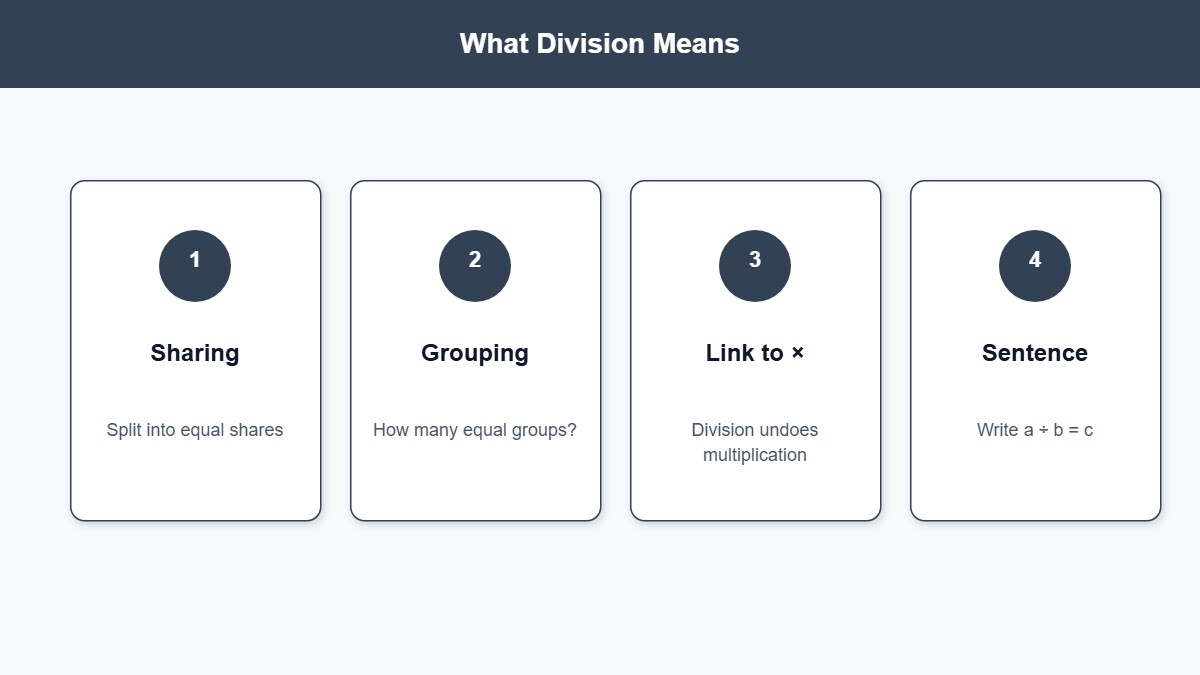
Division splits a whole into equal parts or equal groups. Two common models matter from the start:
- Sharing (partitive): 12 grapes shared among 3 bowls — how many in each bowl?
- Grouping (quotitive): 12 grapes put into bowls of 3 — how many bowls?
Both can be written as 12 ÷ 3 = 4, but children need to hear and act out both meanings. Division is also the inverse of multiplication: if 3 × 4 = 12, then 12 ÷ 3 = 4 and 12 ÷ 4 = 3. That connection is the bridge from “fair shares” to fluent facts.
1. Begin With Equal Sharing
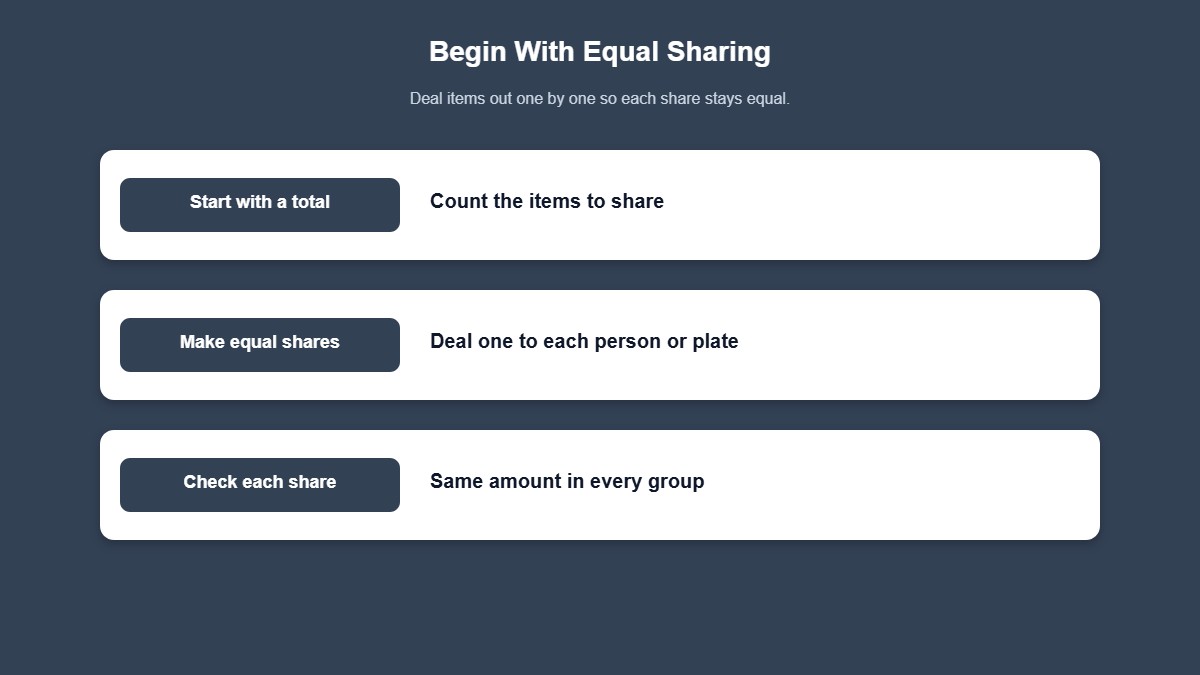
Start with a real pile and a clear number of people or plates — no symbols yet.
Example: Give a child 15 stickers and 5 friends’ name cards. Deal one sticker to each card, round after round, until none remain. Ask: “How many stickers does each friend get?” Count one card’s pile to check.
Classroom version: Share 18 counters among 6 trays on a table. Narrate: “One for you, one for you…” so the dealing rhythm is visible. Keep totals that divide evenly at first so fairness is obvious.
Only after several successful shares introduce the language “15 shared by 5 is 3” and later the ÷ sign. Hands-on sharing stops children from guessing answers to look “quick.”
Printable: Equal Sharing
Practise sharing objects into equal groups.

2. Teach Grouping (How Many Groups?)
Grouping asks a different question with the same numbers.
Example: You have 20 building bricks and want towers of 4 bricks each. How many towers can you build? Children pull groups of 4 aside and count the groups: five towers. That is 20 ÷ 4 = 5.
Contrast with sharing using the same total: “Share 20 bricks among 4 children” versus “Make groups of 4.” Write both stories under one equation so learners see why ÷ can mean two related ideas.
Sorting trays, egg cartons, and muffin tins make grouping concrete. Ask both “How many groups?” and “How many in each group?” so vocabulary stays precise.
3. Connect Division to Repeated Subtraction
Repeated subtraction shows that division is taking away equal chunks until nothing (or a remainder) is left.
Example: 18 ÷ 3. Start at 18 on a number line or with 18 cubes. Subtract 3: 15, then 12, 9, 6, 3, 0. Count how many times you subtracted 3 — six times — so 18 ÷ 3 = 6.
This links cleanly to how to teach subtraction and helps children who already understand “take away” but freeze at the ÷ symbol. Keep jumps equal and tally each subtraction with a mark or finger so the quotient is countable, not guessed.
When the last jump cannot be full size, you have reached remainders — introduce that idea only after exact division feels comfortable.
4. Link Division to Multiplication
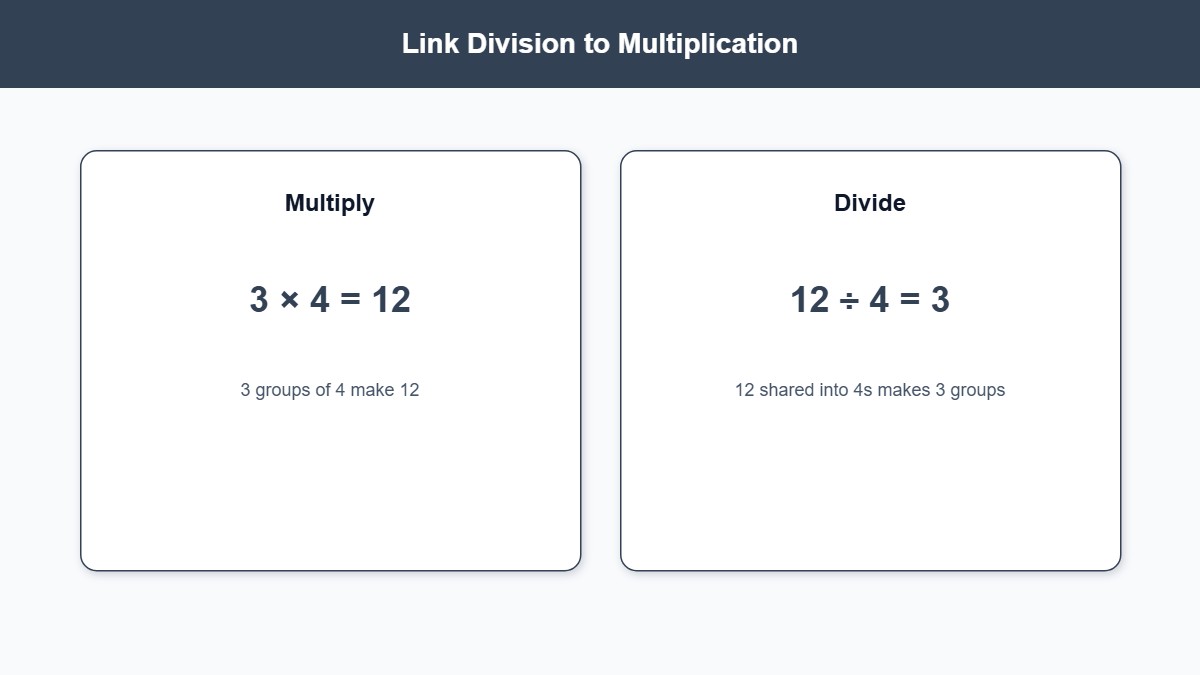
Treat every early division fact as a multiplication fact “run backwards.”
If a child knows 6 × 7 = 42 from how to teach multiplication practice, ask: “42 is 6 groups of what?” and “42 shared into 7 equal groups — how many in each?” Build a fact family card: 6 × 7 = 42, 7 × 6 = 42, 42 ÷ 6 = 7, 42 ÷ 7 = 6.
Arrays work both ways: cover one factor and ask for the missing number. A 3-by-8 array of dots shows 3 × 8 = 24; covering the “8” column count turns it into 24 ÷ 3 = 8.
Children who skip this inverse link often treat division as a separate, scary topic. Spend time here before racing through worksheets of mixed ÷ problems.
5. Build Division Facts Gradually
Fluency comes after meaning — not instead of it.
A practical order for many learners:
- ÷2 and ÷10 (halving and tens patterns)
- ÷5
- ÷1 and dividing a number by itself
- ÷3, ÷4
- ÷6, ÷8, ÷9
- ÷7 and mixed review
Practise with equal-group pictures, then missing-number sentences (□ × 4 = 28 → 28 ÷ 4 = □), then timed retrieval only when accuracy is high. flashcards help for known facts; keep unknown facts tied to arrays or counters.
Short daily drills beat long weekly cram sessions. Celebrate strategies (“I used 5 × 6”) as much as speed.
Printable: Division Facts
Build fluency with dividing by 2s, 5s, and 10s.


6. Teach Remainders Clearly
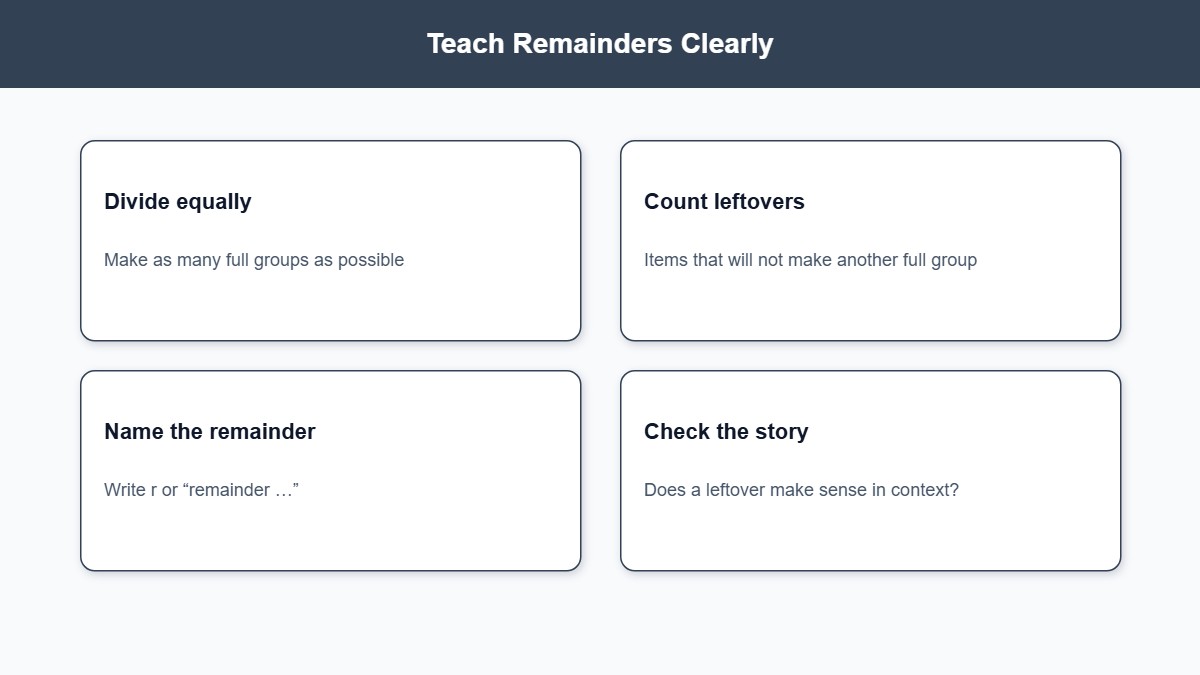
Remainders appear when equal groups cannot use the whole amount.
Example: Share 14 pencils among 4 pots. Each pot gets 3 pencils, and 2 pencils are left over: 14 ÷ 4 = 3 remainder 2. Let children see the leftover pile — do not hide it.
Discuss what the remainder means in context. If 14 children need teams of 4 for a game, you can make 3 full teams and 2 children wait — you cannot split a child. If you are sharing 14 crackers among 4 people, you might break the leftovers later (a gentle nod toward how to teach fractions), but early lessons can keep remainders as whole leftovers.
Write remainders as “r 2” or in words before introducing fraction or decimal forms. Mixing notations too early confuses beginners.
Printable: Remainders
Practise division with remainders and what leftover means.

7. Introduce Long Division When Ready
Long division is an organised way to divide larger numbers once place value and basic facts are steady.
Before the formal layout, practise partitioning: 96 ÷ 4 as “90 ÷ 4 and 6 ÷ 4,” or sharing base-ten blocks (9 tens and 6 ones) into 4 groups. Children who can explain that step rarely treat the algorithm as magic.
When you introduce the written method, model one digit place at a time with the same language you used for sharing: “How many groups of 4 fit into 9 tens? Bring down…” Keep early problems with single-digit divisors and no remainder, then add remainders, then two-digit divisors carefully.
Estimate first (“Will 84 ÷ 7 be closer to 10 or 20?”) so answers can be checked. Estimation catches many long-division errors early.
8. Move From Concrete to Drawings to Algorithms
A reliable progression for almost every division lesson:
- Concrete — counters, cubes, snacks, or stickers shared or grouped.
- Drawings — circles for groups, tallies, or simple arrays on paper.
- Number sentences — 24 ÷ 6 = 4 with a quick sketch still allowed.
- Algorithm — short or long division for larger numbers when concepts stick.
If a child stalls on paper, hand the objects back for one more round, then redraw. Skipping straight to the algorithm is a common reason students “know the steps” but cannot explain or check an answer.
9. Practise Division Word Problems
Word problems reveal whether children understand sharing versus grouping.
Vary the language:
- “Sam has 27 marbles and puts 9 in each bag. How many bags?” (grouping)
- “Sam shares 27 marbles equally among 9 friends. How many each?” (sharing)
- “A coach needs teams of 5 from 23 players. How many full teams? How many left out?” (remainder)
Teach a simple habit: underline the total, circle the size of each group or the number of groups, then decide which model fits. Act out one problem with objects before solving three on paper.
Mix in a few how to teach addition or how to teach subtraction stories so children read for meaning instead of hunting for the ÷ keyword alone.
Printable: Division Word Problems
Apply sharing and grouping to short word problems.

10. Why Students Struggle With Division
Division often feels harder than multiplication because it asks children to undo equal groups, track leftovers, and choose between two models that look identical in symbols.
Common underlying gaps:
- Weak multiplication facts, so every ÷ becomes slow counting
- Unclear place value when dividends grow past 20 or 30
- Rushing to algorithms without sharing/grouping experience
- Confusion about what the remainder represents in a story
Name the gap out loud and reteach that piece — usually with smaller numbers — rather than repeating harder worksheets.
11. Common Mistakes and How to Fix Them
Swapping dividend and divisor: Writing 3 ÷ 12 instead of 12 ÷ 3. Retell the story: “We start with twelve.” Point to the first number as the whole amount.
Ignoring remainders: Giving only the quotient when leftovers matter. Always ask, “Is anything left?” after a share.
Uneven shares: One plate gets four grapes, another gets two, but the child still writes an exact answer. Recount each plate together.
Using multiplication facts that do not match: Saying 8 ÷ 2 = 5 because 2 × 5 = 10. Build the matching array or fact family on the spot.
Mechanical long division errors: Bring-down or place-value slips. Have the child estimate first and check with multiplication (quotient × divisor + remainder = dividend).
12. How to Increase Difficulty
Raise challenge only when smaller exact divisions are accurate:
- Larger totals, then two-digit dividends
- Problems that need a remainder interpretation
- Missing-number sentences and fact-family triangles
- Mixed sharing and grouping word problems
- Dividing by 10 and 100 with place-value talk
- Short division, then supported long division
- Multi-step stories (share, then use one share in a second question)
If accuracy drops, return to objects or drawings with friendlier numbers before pushing the algorithm again.
Classroom and Home Activities
Classroom: Fair-share snack math (planned amounts), “deal the cards” into a set number of hands, group classroom supplies into equal tubs, or run a quick “remainder relay” where teams share counters and report leftovers.
Home: Share grapes onto plates, pack sandwiches into lunch bags of two, sort laundry into pairs then count pairs, or divide pocket money for savings jars. Cooking offers natural talk: “We need half of these 12 strawberries” — useful practice before formal how to teach fractions lessons.
Keep sessions short. One well-modelled problem plus three independent ones beats a long, confusing page. Extra practice pages sit well with maths worksheets.
A Simple Division Lesson Structure
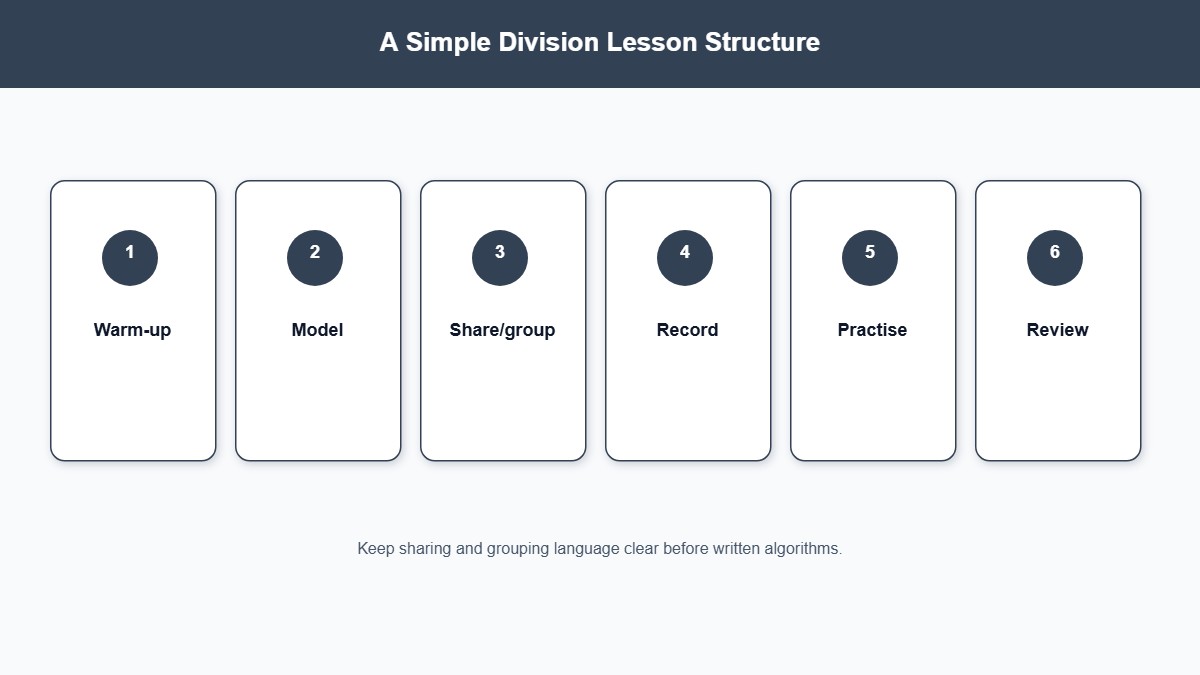
A short division lesson can follow this sequence:
- Warm-up — Two related multiplication facts or a quick equal-groups flash.
- Model — Act out one sharing or grouping story with objects; write the ÷ sentence together.
- Guided practice — Class or pairs solve two similar problems; fix uneven shares in the moment.
- Independent practise — A few problems with drawings allowed, or a page from maths worksheets.
- Check — Verify one answer with multiplication or by rebuilding the groups.
- Wrap-up — One remainder or word-problem challenge, or a fact-family exit ticket.
Adapt timing for age. Younger learners need more concrete sharing; older beginners may move faster into facts and short division. Plan fuller sessions with maths lesson plans.
Printable: Extra Division Practice
Add missing-number and review sheets for follow-up sessions.


How to Teach Division Step by Step
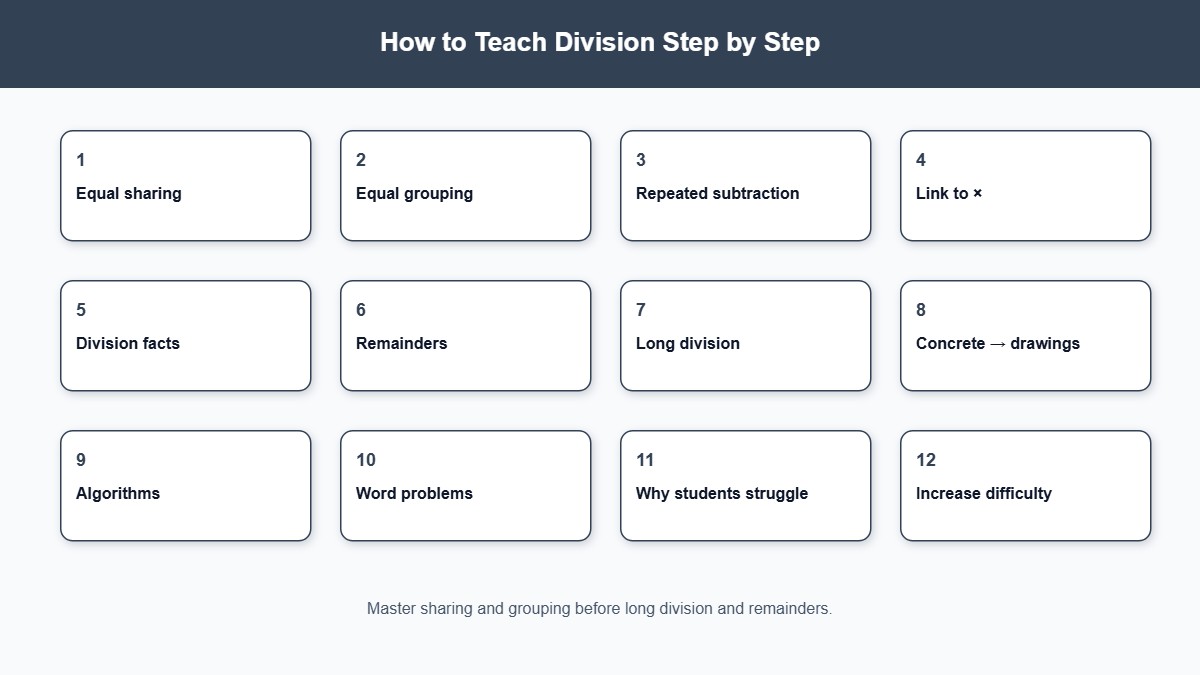
A practical progression looks like this:
- Share small collections equally with no symbols.
- Group objects into equal sets and count the groups.
- Connect both models to a ÷ number sentence.
- Show repeated subtraction on a number line or with cubes.
- Build fact families with multiplication.
- Practise selected division facts with visuals, then fluency.
- Introduce remainders with clear leftovers.
- Solve sharing and grouping word problems.
- Move from drawings to short methods, then long division when ready.
- Increase number size and multi-step stories carefully.
Not every learner needs the same time at each step. Stay with objects until equal groups and leftovers make sense.
How to Help a Child Who Struggles With Division
First identify what is breaking down: sharing fairness, knowing which number is the whole, multiplication recall, remainders, or place value in written methods.
Then simplify: totals under 20, divisors of 2 or 5, moveable objects, and one model per lesson (only sharing, or only grouping). Sit beside the child and deal items together so the rhythm of “one for each…” is felt.
Use check-with-multiplication as a habit: after 56 ÷ 7 = 8, ask them to show 7 × 8. Wrong products surface fact gaps quickly; fix those with how to teach multiplication practice and flashcards rather than more ÷ drills alone.
Keep sessions successful and short. Many children who “hate division” have been hurried into long division before equal sharing felt real. Rebuild confidence with concrete wins, then redraw, then calculate.
Final Thoughts
Teaching division well means teaching meaning first: fair shares, equal groups, and clear leftovers. Symbols, facts, and algorithms grow out of that understanding — they should not replace it.
Build from objects to drawings to number sentences, keep the multiplication link visible, and treat remainders as something children can see and explain. When those foundations are firm, long division and harder word problems become organised next steps instead of mysteries.
Model carefully, practise with manageable numbers, and use real sharing at home and school so the skill feels useful. Clear demonstrations and regular short sessions matter more than racing to bigger dividends.
Frequently Asked Questions
Common questions answered for downloading and using our premium printable designs.



Comments (0)
Leave a Reply
Be the first to leave a comment!