
How to Teach Numbers
A practical guide to teaching numbers: recognition vs quantity, matching, formation, order, before/after, comparing, games, and a bridge to early maths.
 Amanda Williams
Numbers are more than symbols on a page. When children learn numbers well, they can recognise a digit, say its name, link it to a real amount, put numbers in order, and compare which is bigger or smaller. Those skills sit under almost every later maths topic.
Table of Contents
- What Does It Mean to Know Numbers?
- 1. Separate Number Recognition From Quantity
- 2. Teach Number Names With Clear Models
- 3. Build Quantity With Real Objects
- 4. Match Numerals to Quantities
- Printable: Count and Match Quantities
- 5. Teach Number Formation
- Printable: Number Formation
- 6. Teach Number Order
- Printable: Order and Compare Numbers
- 7. Teach Before and After
- 8. Compare Amounts: More, Less, and the Same
- 9. Introduce Greater Than and Less Than
- 10. Use Number Games
- 11. Everyday Number Activities
- 12. Bridge From Numbers Into Basic Maths
- A Simple Numbers Lesson Structure
- How to Teach Numbers Step by Step
- Common Mistakes and Difficulties
- How to Help a Student Who Struggles With Numbers
- How to Teach Numbers at Home
- Final Thoughts
How to teach numbers works best when you separate two ideas that often get mixed up: recognising the numeral (knowing that “7” is seven) and understanding quantity (knowing that seven means this many things). Teach both, with lots of objects and short practice, before rushing into written sums.
This guide is for teachers and parents. It covers recognition, quantity, counting objects, matching, number formation, order, before and after, comparing, games, everyday practise, and a bridge into early calculation. Pair it with how to teach counting, how to teach addition, and how to teach shapes, and use number worksheets, maths worksheets, flashcards, and maths lesson plans for ready-made practice.
What Does It Mean to Know Numbers?
A child who “knows numbers” can usually do several related things:
- Recognise numerals (0–10 first, then beyond)
- Say the number name when they see the digit
- Understand that a number stands for a quantity
- Count a set of objects accurately
- Match a numeral to a matching group
- Write or form the digit
- Say what comes before and after a number
- Put numbers in order
- Compare two amounts (more, less, equal)
A learner might read “5” confidently but still grab three blocks when asked for five. Treat that as incomplete number sense, not failure — and practise the missing piece.
1. Separate Number Recognition From Quantity
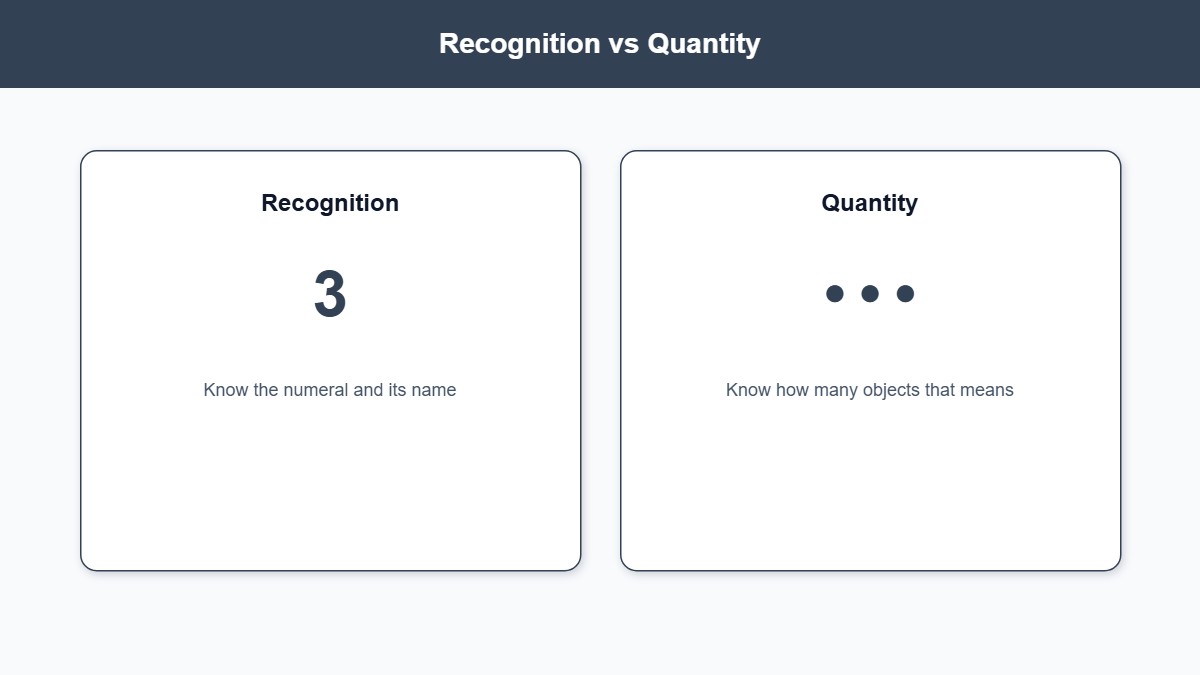
Start by naming what you are teaching.
Recognition is visual and verbal: show a card with 4 and ask, “What number is this?” Quantity is concrete: place four spoons on the table and ask, “How many spoons?”
Keep the two skills clear in your language. Say “This is the number four” when you show the digit, and “There are four spoons” when you count the set. Mixing the ideas too early leaves some children able to chant numbers without understanding amount.
2. Teach Number Names With Clear Models
Introduce a small set of numerals at a time — often 0–5, then 6–10 — rather than the whole line at once.
Show a large numeral, say its name, and ask the learner to repeat it. Mix the cards and ask them to find “six” or “point to nine.” Include zero early so children learn that zero means none, not “a forgotten number.”
Vary the look of numerals a little (different fonts on flashcards or posters) so recognition is not tied to one decorative style.
3. Build Quantity With Real Objects
Quantity sticks when children handle things.
Use counters, bottle tops, pegs, crayons, or snack pieces. Say a number, then build that many together. Start small: “Show me three lids.” Later: “Show me eight lids.”
Ask the child to check by touching each object once while counting aloud. If they skip or double-count, slow down and model one-to-one pointing. Deeper counting strategies are covered in how to teach counting.
4. Match Numerals to Quantities
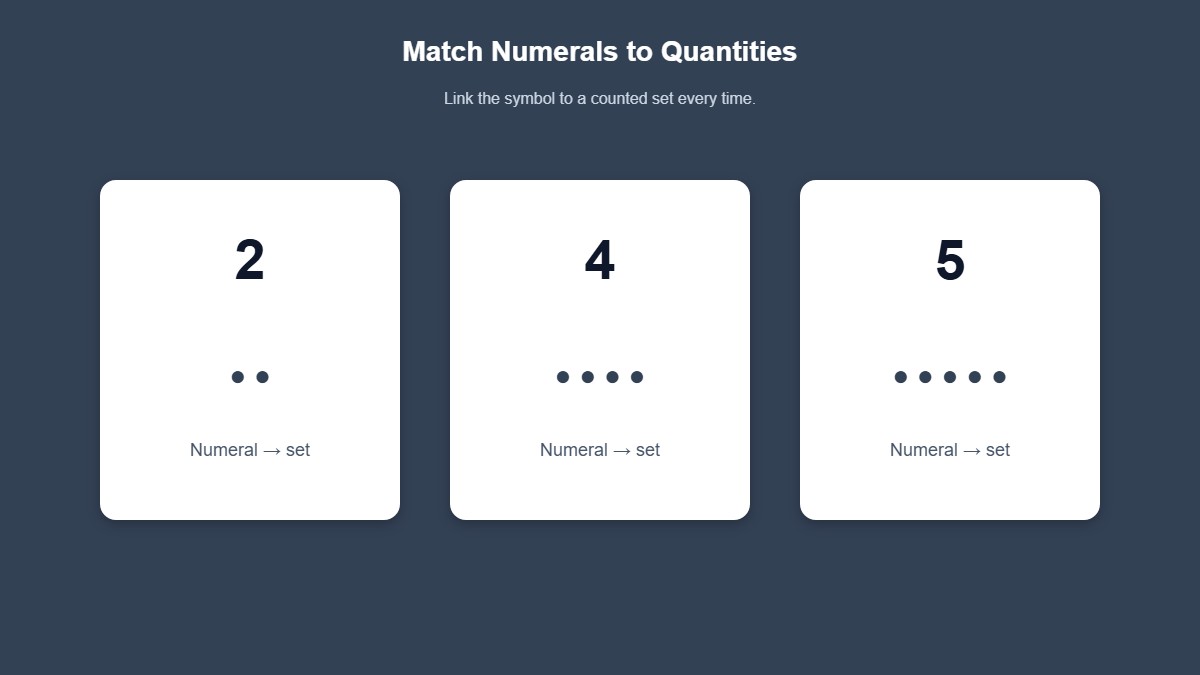
Matching joins recognition and quantity.
Give numeral cards and small groups of objects. Ask the child to place the card 7 next to a tray that holds seven buttons. Or reverse it: show a plate of five crackers and ask which card matches.
A simple classroom station: three bowls holding 2, 5, and 9 cubes, and a mixed pile of number cards. Learners place the correct card on each bowl. Wrong matches become quick teaching moments — recount together rather than only saying “no.”
Printable: Count and Match Quantities
Link numerals to amounts with counting pages, ten-frames, and count-and-write practice.


5. Teach Number Formation
Writing numbers supports memory, but formation should not block understanding of quantity.
Demonstrate start points and stroke order for each digit. For example, show that 5 often begins with a short top line, then a curve, then a crossbar — or use the formation sequence your school prefers, and keep it consistent.
Use a short path: air-write → finger-trace a large digit → pencil trace → copy → write from memory. Keep practice brief. If grip or control is weak, reduce writing load and keep quantity work oral and hands-on until formation is less frustrating.
Printable: Number Formation
Trace and write numerals from 0–5 and 6–9 with clear stroke practice.


6. Teach Number Order
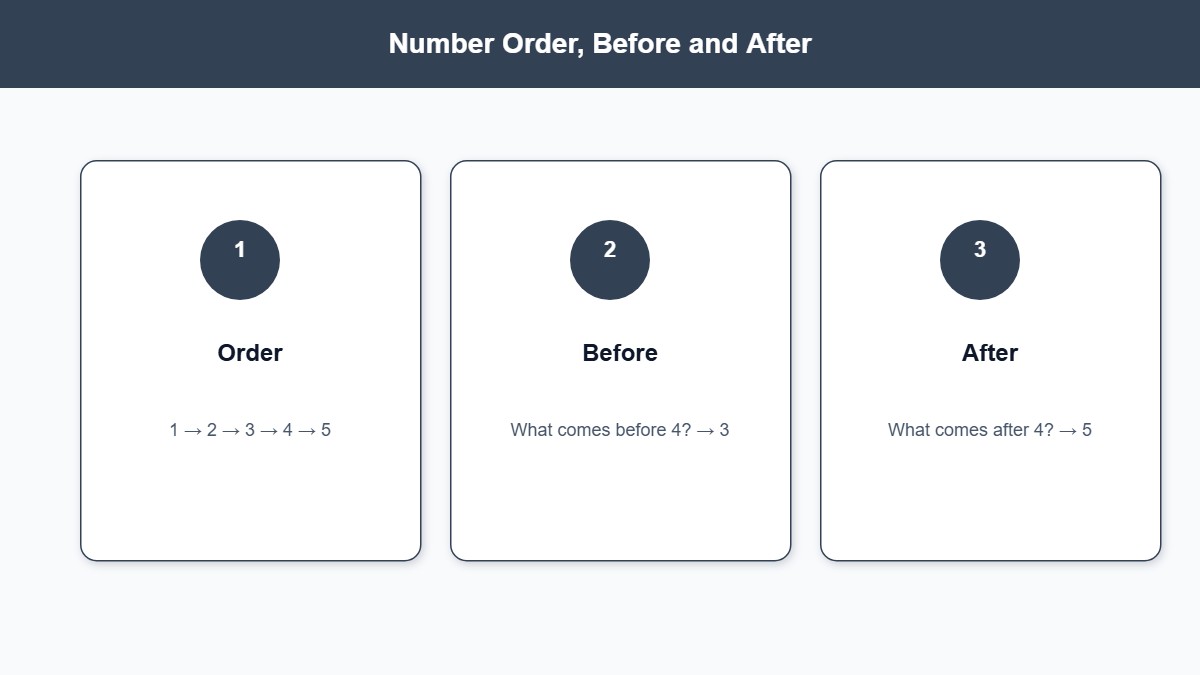
Once children know several numbers, teach that numbers have a fixed order.
Line up cards from 0 to 10. Say the sequence together. Mix a few cards and ask, “Which number is missing?” or “Put these back in order: 3, 1, 2.”
Use a number line on the wall or floor. Children hop from 0 to 6, or place a counter on each number as they say it. Order practice prepares them for before/after and for reading scales later.
Printable: Order and Compare Numbers
Practise before and after, comparing amounts, and reading number words.


7. Teach Before and After
Before and after strengthen number sequence without needing formal addition yet.
Ask: “What comes after 4?” “What comes before 9?” Point on a number line so the answer is visible, then fade the support.
Game idea: draw a card such as 6. The child says the neighbour numbers (“5 before, 7 after”) and places counters on either side of a floor number. Keep language steady — “before” and “after” — so the idea does not blur with “bigger” and “smaller” too soon.
8. Compare Amounts: More, Less, and the Same
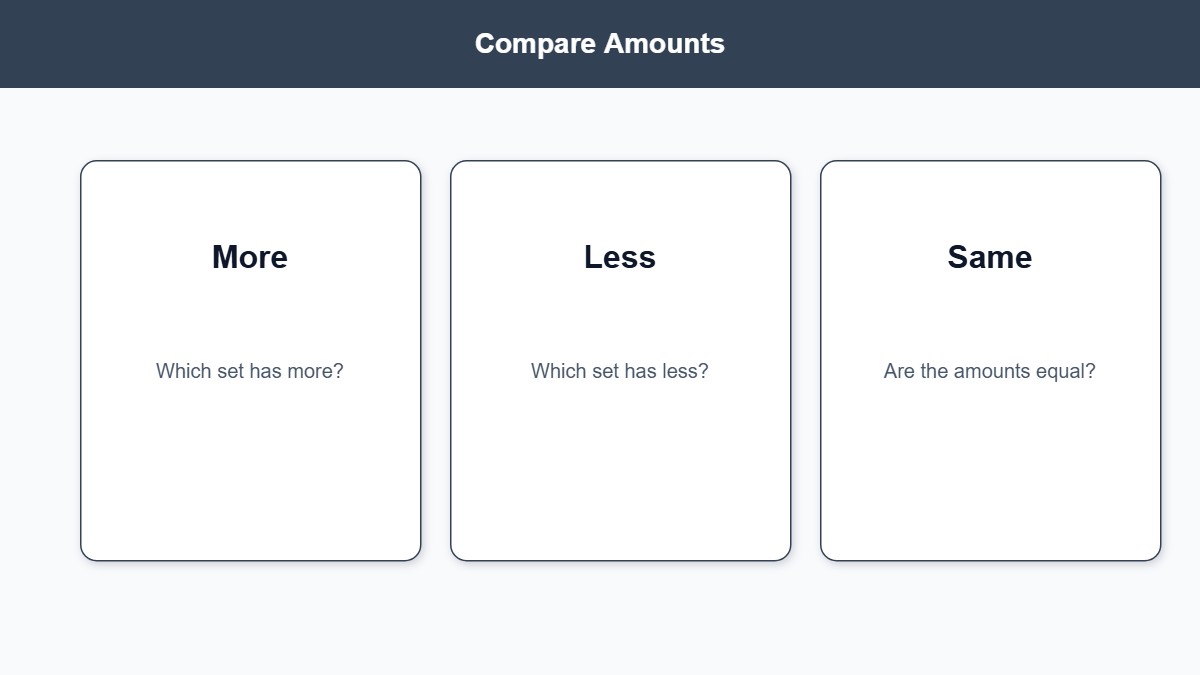
Comparison grows from quantity, not from digit shape alone.
Make two rows of objects: six red cubes and four blue cubes. Ask which row has more, which has less, and whether any amounts are the same. Encourage lining objects up so the difference is easy to see.
Only after comparing sets should you compare numerals: “Which is greater, 8 or 3?” Link back to objects whenever a child guesses from digit size (for example, thinking 9 is smaller than 12 because the digit looks “simpler”).
9. Introduce Greater Than and Less Than
When children can say “more” and “less” confidently, introduce the symbols if your curriculum expects them.
Keep meaning first: 7 > 2 means seven is greater than two; 2 < 7 means two is less than seven. Use the same two groups of objects under both sentences so children see that the relationship has not changed — only the way we write it.
Avoid relying only on “alligator eats the bigger number” stories if they confuse the learner. Prefer clear language plus a number line: numbers further right are greater (for the positive whole numbers they meet first).
10. Use Number Games
Short games keep practice lively and reveal who still mixes recognition with quantity.
- Number hunt: Find the digit 8 on a page, a clock, or a classroom label.
- Fill the ten-frame: Roll a die, place that many counters, say the total.
- Snap match: Match a numeral card to a picture card with the same count of stars.
- Order race: Race to arrange 0–10 cards correctly.
- Before/after toss: Toss a beanbag onto a floor number; say neighbours.
Stop while energy is still good. One focused round beats a long, noisy session where accuracy slips.
11. Everyday Number Activities
Daily life is full of natural number practice.
Count stairs as you climb. Ask how many plates are needed for dinner. Read house numbers on a walk. Compare who has more grapes on their plate. Notice the page number in a picture book. Sort laundry into “pairs of socks” and count the pairs.
Keep questions short and purposeful: “We need five forks — have we got enough?” Everyday talk builds number sense without a worksheet every time, though number worksheets help when you want quiet, independent practice.
12. Bridge From Numbers Into Basic Maths
When recognition, quantity, order, and comparison feel secure for a range (often 0–10, then 0–20), begin gentle calculation.
Combining two small groups (“3 apples and 2 apples — how many altogether?”) leads naturally into how to teach addition. Taking some away leads into subtraction. Sorting by attributes (circles vs squares) links number counting with how to teach shapes.
Do not skip the foundation. Children who only memorise digit shapes struggle when problems ask them to reason about amounts.
A Simple Numbers Lesson Structure
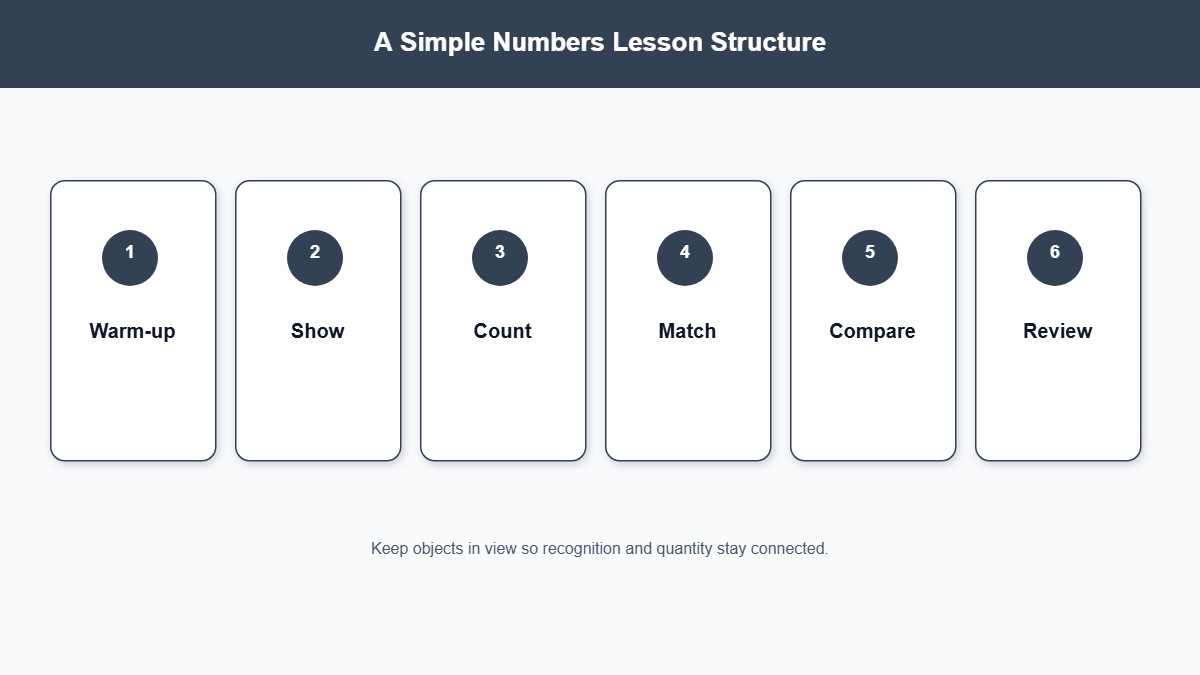
A clear lesson might look like this:
- Warm-up — Quick numeral flash or count aloud to a target number.
- Teach — One focus (for example matching 6 to six objects, or “what comes after 11”).
- Model — Show the correct way with objects or a number line.
- Guided practice — Do two or three examples together.
- Independent practice — Short task with cards, counters, or a printable from maths worksheets.
- Check — Ask one child to explain how they know their answer is right.
Keep the focus narrow. One solid skill per lesson is better than rushing recognition, writing, and comparison in the same sitting. Ready-made outlines are available in maths lesson plans.
How to Teach Numbers Step by Step
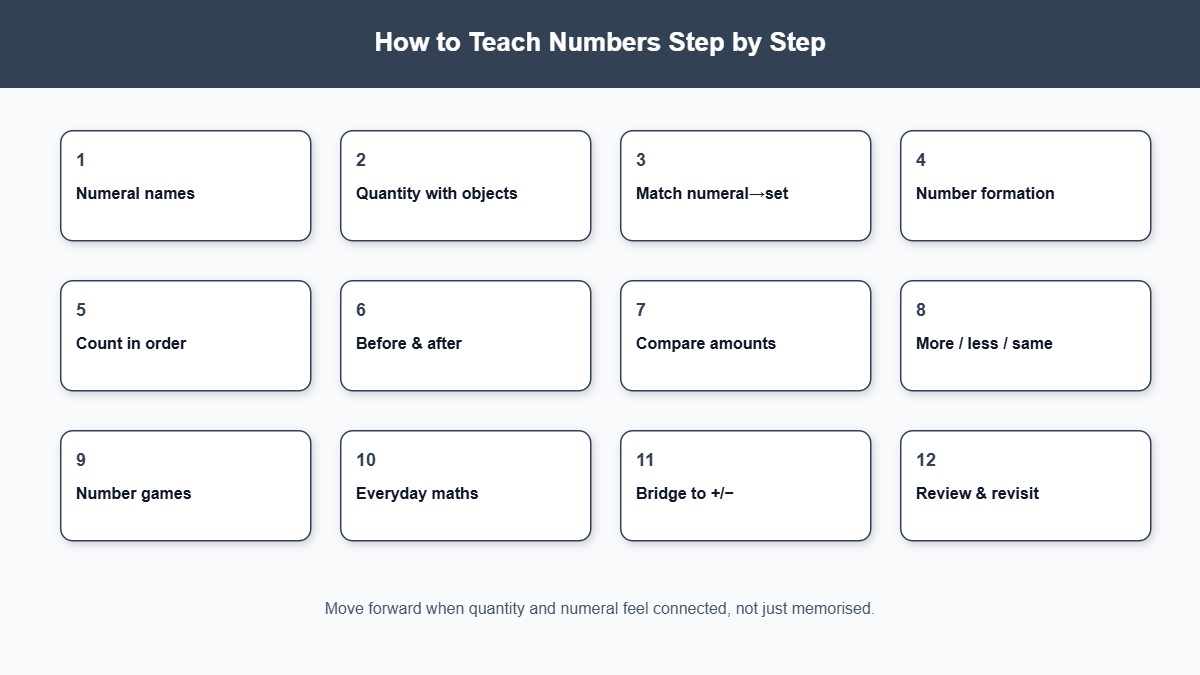
A practical progression for beginners:
- Recognise and name a small set of numerals (start with 0–5).
- Build and count matching quantities with objects.
- Match numeral cards to sets.
- Practise number formation for the digits you have taught.
- Extend to 0–10 (then teens) with the same cycle.
- Practise number order on a line or with sequenced cards.
- Teach before and after.
- Compare sets, then compare numerals (more/less/equal).
- Introduce greater-than and less-than language or symbols when ready.
- Use games and everyday situations for fluency.
- Bridge into simple combining and separating of groups.
Stay on a step until the learner is mostly accurate, then move on. Revisiting earlier steps briefly keeps skills sharp.
Common Mistakes and Difficulties
Watch for these patterns:
- Saying number names in order while pointing unevenly at objects
- Recognising a digit but choosing the wrong quantity
- Reversing similar digits when writing (such as 6 and 9)
- Thinking a “taller” or “longer-looking” numeral is always greater
- Confusing before/after with bigger/smaller
- Skipping zero or treating teens as “ten and something” inconsistently
Respond by returning to objects and a number line. Name the exact confusion (“You said eight, but we only counted six — let’s touch each one”) instead of only marking the answer wrong.
How to Help a Student Who Struggles With Numbers
Find which layer is weak: name, quantity, matching, order, or comparison.
If the child cannot match 4 to four blocks, pause written work and stay with concrete sets. If they can match but freeze on “what comes before 7,” practise with a visible number line and fewer numbers at a time.
Reduce the range. Master 0–5 thoroughly before 0–20. Use the same materials across days so the task feels familiar. Celebrate accurate checking — recounting to verify — as much as fast answers.
How to Teach Numbers at Home
Parents do not need a full lesson every day.
Five minutes with bottle tops and number cards is enough. Cook together and count spoonfuls. Set the table and match “one napkin per person.” Play shop with coin values later, but early on focus on “how many” and “which number is this.”
Keep tone calm. If a child guesses wildly, pause, model one correct example, and try a smaller number. Printable number worksheets can support quiet practice after hands-on play.
Final Thoughts
Teaching numbers well means teaching meaning, not only digit names. Move from recognition to quantity, matching, formation, order, before and after, and comparison — then into early maths operations when the foundation is steady.
Use objects often, keep lessons short and focused, and correct gently by recounting together. With regular, practical practice at school and at home, children gain the number sense they need for counting, addition, and the wider maths curriculum.
Frequently Asked Questions
Common questions answered for downloading and using our premium printable designs.




Comments (0)
Leave a Reply
Be the first to leave a comment!