
How to Teach Counting
A practical guide to teaching counting: oral sequences, one-to-one correspondence, object counting, forwards and backwards, groups, skip counting, games, and fixing common mistakes.
 Amanda Williams
Counting is more than saying number words in order. Children need to connect those words to real quantities, touch or move one object for each number, and trust that the last number said tells them how many there are. When counting is shaky, later skills such as how to teach addition and how to teach subtraction become much harder.
This guide focuses on teaching the process of counting — aloud, with objects, forwards and backwards, in groups, and with skip counting — rather than only recognising written numerals. Pair it with how to teach numbers when learners also need symbol recognition, formation, or comparing amounts. Use maths worksheets, flashcards, and maths lesson plans for practice that matches each stage.
Whether you teach in a classroom or at home, the same idea applies: model carefully, practise with small sets of objects, correct common errors gently, and increase difficulty only when accuracy is solid.
What Counting Really Means
Rote counting is saying "one, two, three…" from memory. True counting also includes:
- Knowing the stable order of number words
- Matching one number word to one object (one-to-one correspondence)
- Understanding that the last number is the total (cardinality)
- Counting the same set in different arrangements and getting the same total
- Counting on, counting back, and later counting in jumps
A child who can recite to twenty but points twice at the same block, or stops mid-row and restarts, still needs structured counting practice.
1. Start With Counting Aloud
Begin with the spoken number sequence before demanding perfect object counting.
Practise short stretches: 1–5, then 1–10, then beyond as the child is ready. Count together while clapping, marching, or tapping a table so rhythm supports memory.
Use everyday moments: stairs ("one, two, three…"), lining up, or packing five crayons into a pot. Keep the pace steady so number words do not blur together.
Once the sequence feels automatic for a small range, move to objects so the words gain meaning as quantities.
2. Connect Counting Words to Quantity
After children can say a short sequence, show that each number stands for an amount.
Place three buttons in a clear line. Count them slowly: "one… two… three. There are three buttons." Sweep your hand under the whole set as you say the total so cardinality is visible.
Repeat with different items — shells, pencils, toy cars — so "three" is not tied to one picture. Ask: "How many are there?" and expect the last number, not a restart of the whole list, as the answer.
Keep sets small (up to five, then ten) until the idea is secure. Numeral work belongs alongside this; see how to teach numbers for digit recognition while you keep the focus here on "how many."
3. Teach One-to-One Correspondence
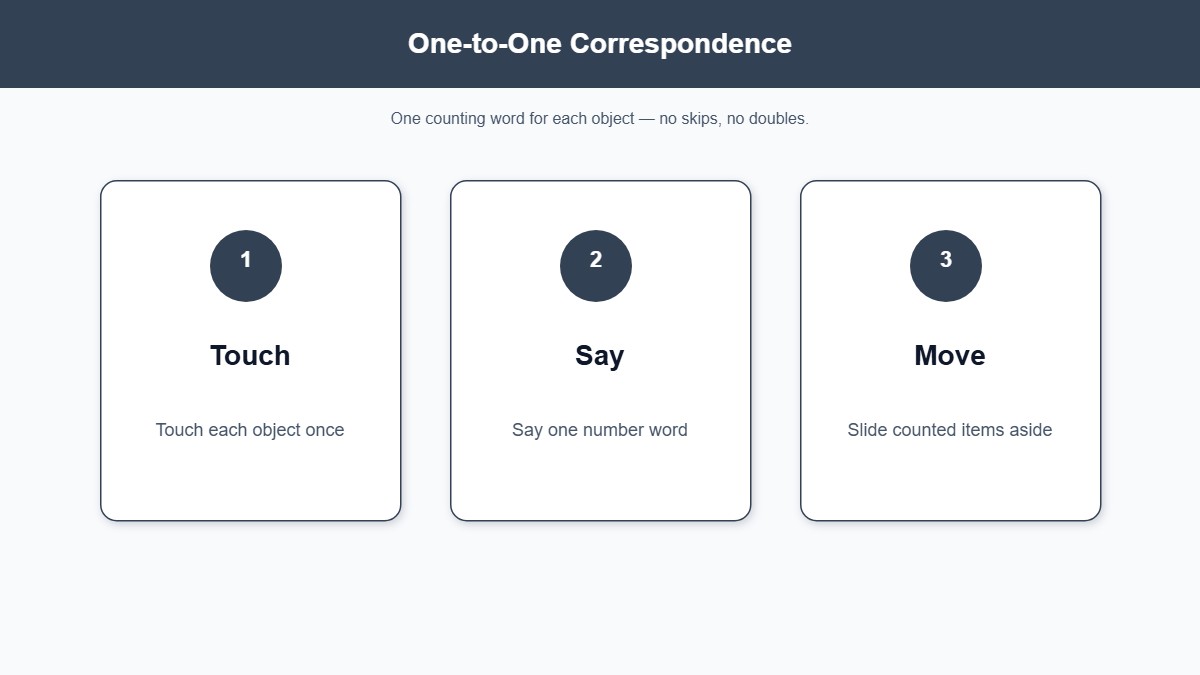
One-to-one correspondence means one number word for one object — no skips, no double-counts.
Model touching or moving each item as you say its number. A useful routine is "say it, move it": slide each counter from a "to count" pile into a "counted" pile.
Line objects in a row before counting so eyes and fingers travel in one direction. Circles of items scattered on a desk invite children to lose track.
If a child says two numbers while touching one block, pause, return that block, and recount together. Accuracy matters more than speed.
4. Practise Counting Objects Accurately
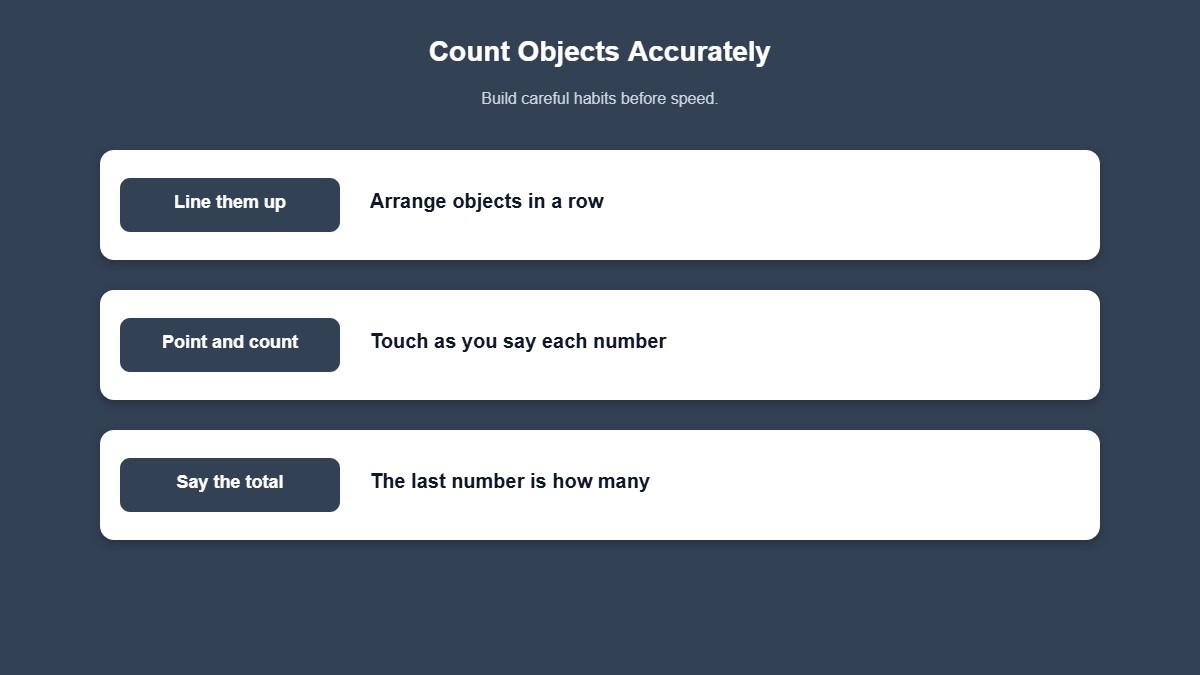
Give short, focused object-counting tasks with a clear start and finish.
Examples: Count the red beads only. Count how many spoons are on the tray. Count the windows on this side of the room.
Strategies that help:
- Point or touch each object once
- Move counted items aside
- Mark pictures with a light pencil tick as each is counted
- Count aloud so you can hear skips or repeats
Check by recounting in a different order (left to right, then right to left). Same total builds trust in the count. Printable sets of pictures to count sit well with maths worksheets.
Printable: Object Counting
Count sets carefully with 1–10, 11–20, and ten-frame practice pages.


5. Count Forwards and Backwards
Forwards counting is usually easier; backwards counting strengthens number order and prepares children for how to teach subtraction.
Start backwards from a small number: "Five, four, three, two, one, zero" while removing one block each time. Rocket "lift-off" counts from five or ten keep it playful.
Number paths on the floor or a simple strip of numerals let children step forward to count on and step back to count back. Ask: "What comes before eight when we count backwards?"
Do not rush long backwards sequences. Secure 10→0 and 20→10 before expecting fluent counting back from larger numbers.
6. Recognise Numbers While Counting
Link spoken counts to written numerals without turning every lesson into handwriting practice.
As you count five leaves, point to a large 5 card and say, "That number shows five." Match a counted pile to the correct numeral from a small choice of cards (3, 5, 8).
Call a number and ask the child to build that many cubes, then find the matching flashcards numeral. This bridges quantity and symbol while counting remains the main skill.
If numeral confusion dominates, pause and use targeted number recognition from how to teach numbers, then return to object counting.
7. Count in Groups
Once single-item counting is reliable, introduce groups so children see structure, not only one-by-one tallies.
Sort ten counters into pairs and count "two, four, six…" with support, or count how many groups of three are in a muffin tray. Ask both "How many groups?" and "How many altogether?"
Classroom examples: Count chairs by tables. Count books by shelf. Pack crayons in cups of five and count the cups first, then discuss the total.
Grouping sets up equal-groups thinking used later in multiplication and makes large sets less overwhelming than pointing at every single item.
8. Teach Skip Counting
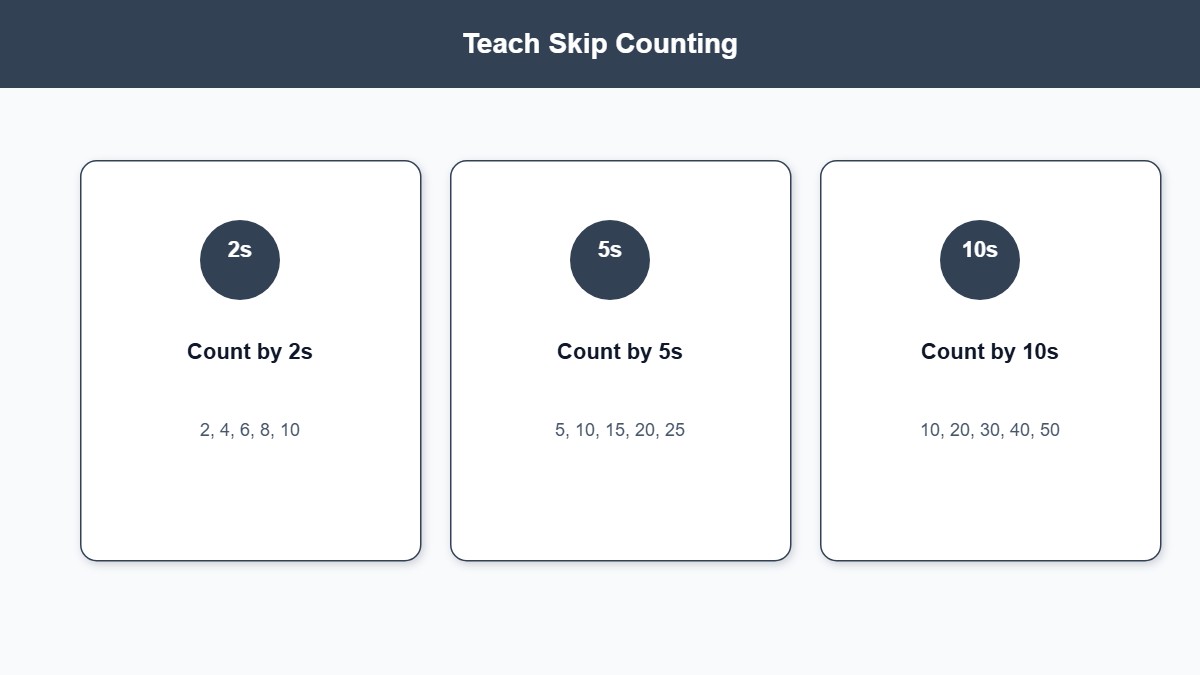
Skip counting is counting in equal jumps: 2s, 5s, 10s, and later 3s or 4s.
Begin with 10s using fingers or a hundreds chart highlight: 10, 20, 30. Then 5s with a clock face or five-frames: 5, 10, 15, 20. Twos work well with pairs of socks or shoes lined up.
Say the sequence while tapping every second bead on a string, or hop along a number line landing only on skip-count numbers. Keep a written track visible so children see the pattern.
Skip counting supports money, time, and times tables later. Keep early skip counting oral and visual before expecting children to fill blank worksheets from memory.
Printable: Skip Counting
Practise counting in 2s, 5s, and 10s with clear skip-count sheets.


9. Use Games, Songs, and Movement
Active practice helps the sequence stick and makes repetition feel purposeful.
Ideas:
- Counting songs and rhymes for 1–10 or 1–20
- "I spy" counts: "I spy four blue pencils — can you count them?"
- Beanbag toss: count catches aloud without skipping
- Hopscotch or floor numbers: step and say each number
- Dice games: roll, count out that many counters
- Hide-and-count: find objects, then count the collection together
Short movement breaks — ten star jumps counted aloud — reinforce sequence and one number per action. Keep rules simple so counting accuracy stays the focus.
10. Practise Everyday Counting
Real-life counting shows why the skill matters.
At home or school: count plates for dinner, stairs to the classroom, pegs on a washing line, stops until your bus station, or stickers left on a sheet. Shopping: "We need six apples — count them into the bag."
Ask follow-ups: "Do we have enough?" "How many more do we need?" Those questions gently bridge toward how to teach addition and how to teach subtraction without formal algorithms.
Keep language natural. Everyday counting should feel useful, not like a test.
11. Common Counting Problems and How to Help
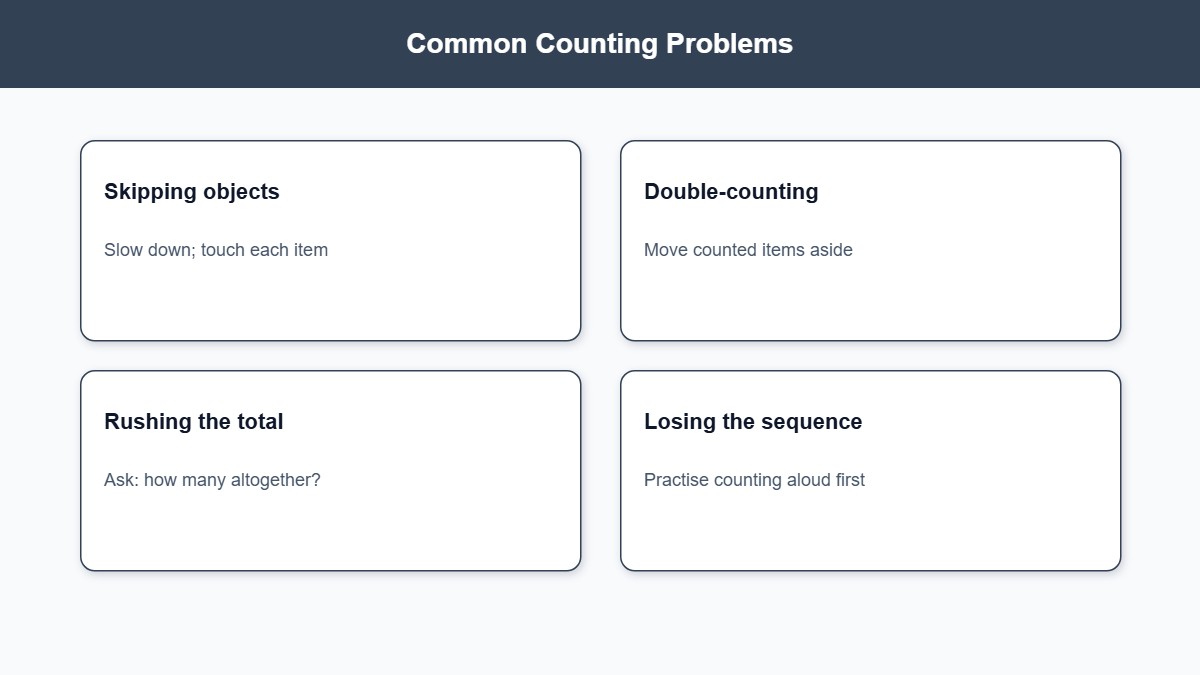
Two frequent errors are skipping numbers in the sequence and counting the same object twice (or missing one).
Skipping numbers while saying the sequence: Slow down. Count with a number line or strip visible. Practise the sticky spot in isolation (for example, the teens: thirteen, fourteen, fifteen). Echo-count: you say a number, the child says the next.
Double-counting or missing objects: Use the move-aside method. Line items up. Have the child use a pointing stick so only one object is touched per word. Recount together and compare totals.
Not knowing the last number is the total: After counting, ask "How many?" If they recount from one, model: "You already counted — the last number you said was seven, so there are seven."
Rushing: Cap the set size. Praise careful pointing over fast answers.
12. How to Increase Difficulty
Raise challenge only when smaller counts are accurate:
- Larger totals (beyond 10, then 20, then 100 with support)
- Scattered arrangements instead of neat rows
- Counting a subset ("only the yellow cubes")
- Counting on from a number rather than always starting at one
- Counting back over longer stretches
- Skip counting with less visual support
- Counting mixed collections, then sorting and recounting by type
If accuracy drops, return to a smaller set or a clearer layout before pushing on.
A Simple Counting Lesson Structure
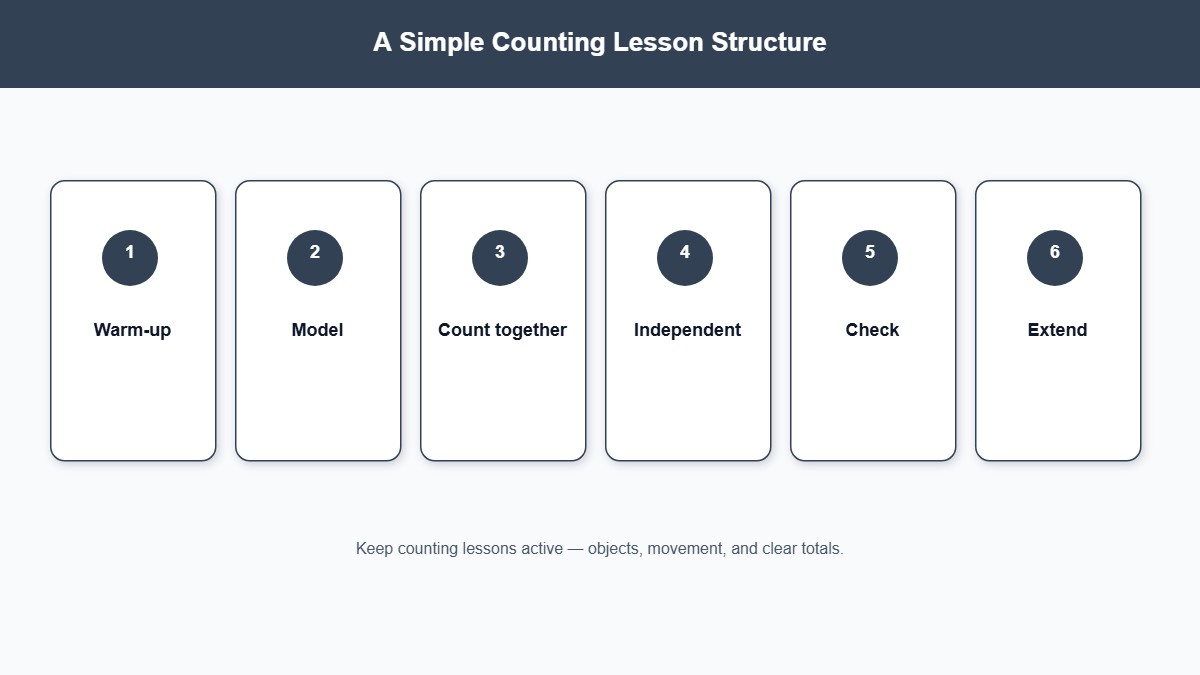
A short counting lesson can follow this sequence:
- Warm-up — Count aloud together (forwards or a known skip-count pattern) with claps or steps.
- Model — Demonstrate counting a set with clear one-to-one pointing or moving.
- Guided practice — Count a shared set as a class or pair; fix skips and double-counts in the moment.
- Independent practise — Children count their own small collections, match to a numeral, or complete a simple counting page from maths worksheets.
- Check — Recount one set together; ask "How many?" to reinforce cardinality.
- Wrap-up — Quick game, song, or everyday count on the way out.
Adapt timing for age. Younger learners need more modelling; older beginners may move faster into groups and skip counting. Plan full sessions with maths lesson plans.
Printable: Extra Counting Practice
Add ordinal-number practice and a ready counting lesson plan for follow-up sessions.


How to Teach Counting Step by Step
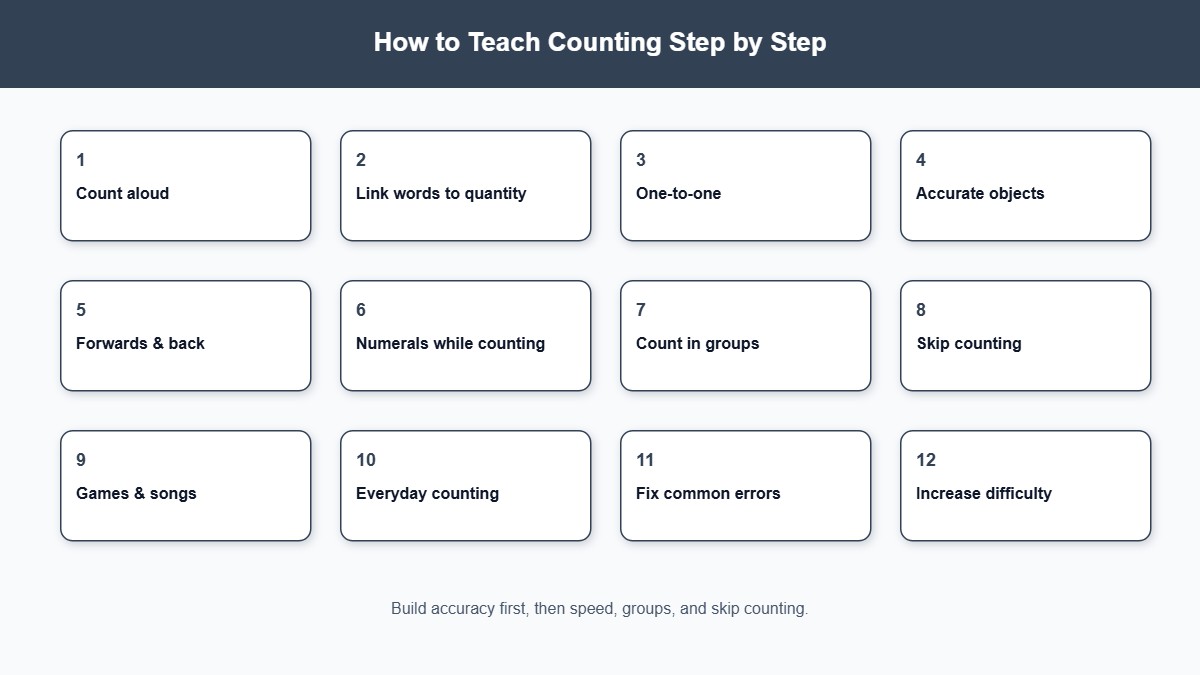
A practical progression looks like this:
- Learn a short oral counting sequence with rhythm and movement.
- Count small sets of objects with one-to-one correspondence.
- Practise cardinality — the last number is "how many."
- Count neatly arranged sets, then messier layouts.
- Count forwards and backwards on a number path.
- Match counted quantities to numerals.
- Count in simple groups (pairs, fives).
- Introduce skip counting by 10s, 5s, and 2s.
- Use games, songs, and everyday situations for fluency.
- Extend range and accuracy; link toward addition and subtraction.
Not every learner needs the same time at each step. Stay with object counting until pointing and totals are reliable.
How to Help a Child Who Struggles With Counting
First identify what is breaking down: the spoken sequence, pointing, remembering the total, or tracking large sets.
Then simplify: fewer objects, a straight line, moving items as they are counted, and slower speech. Sit beside the child and count in unison so they feel the pace.
Use identical objects at first (all the same colour and size) so visual distractions do not steal attention. Save mixed collections for later.
Celebrate careful recounts. Many children who "hate maths" are tired of being hurried through counts they cannot yet control. Short, successful sessions rebuild confidence. Numeral gaps can be addressed with how to teach numbers and flashcards in parallel.
Final Thoughts
Teaching counting well means teaching a process: steady number words, one touch per object, and a clear total. Songs and games keep practice lively, but accuracy still comes from modelling and hands-on sets.
Build from oral counting to objects, then forwards and backwards, groups, and skip counting. When those foundations are firm, children are ready for stronger number sense and for early how to teach addition and how to teach subtraction.
Keep sets manageable, correct common errors without fuss, and use real-life counts so the skill feels useful. Clear demonstrations, guided practice, and regular short sessions matter more than racing to higher numbers.
Frequently Asked Questions
Common questions answered for downloading and using our premium printable designs.



Comments (0)
Leave a Reply
Be the first to leave a comment!