
How to Teach Subtraction
A practical guide to teaching subtraction: take away, difference, compare, objects, count back, number lines, facts, missing numbers, regrouping, mental strategies, word problems, and fixing common mistakes.
 Amanda Williams
Subtraction is how children find what is left, how far apart two amounts are, or which group has more. It is not only “take away.” Learners also need the difference and compare meanings, or they stall when a word problem does not say “remove.”
Table of Contents
- What Subtraction Really Means
- 1. Begin With Take Away Using Objects
- Printable: Take Away Practice
- 2. Teach Finding the Difference and Comparing
- 3. Count Backwards to Subtract
- 4. Use Number Lines
- 5. Build Subtraction Facts
- Printable: Subtraction Facts
- 6. Teach Missing-Number Problems
- Printable: Missing Numbers
- 7. Introduce Borrowing and Regrouping
- Printable: Two-Digit Regrouping
- 8. Move to Larger Numbers
- 9. Teach Mental Strategies
- 10. Practise Subtraction Word Problems
- Printable: Subtraction Word Problems
- 11. Common Mistakes and How to Help
- 12. How to Increase Difficulty
- A Simple Subtraction Lesson Structure
- Printable: Subtraction Review
- Subtraction Practice at Home
- How to Teach Subtraction Step by Step
- How to Help a Child Who Struggles With Subtraction
- Final Thoughts
How to teach subtraction works best after solid how to teach counting and early how to teach numbers sense, and alongside how to teach addition so children see that putting together and taking apart are related. Later, firm subtraction supports how to teach division and larger calculation. Use subtraction worksheets, maths worksheets, flashcards, and maths lesson plans to match practice to each stage.
Whether you teach in a classroom or at home, model with objects first, name which meaning of subtraction you are using, practise small numbers until they feel automatic, then move to number lines, facts, regrouping, and word problems.
What Subtraction Really Means
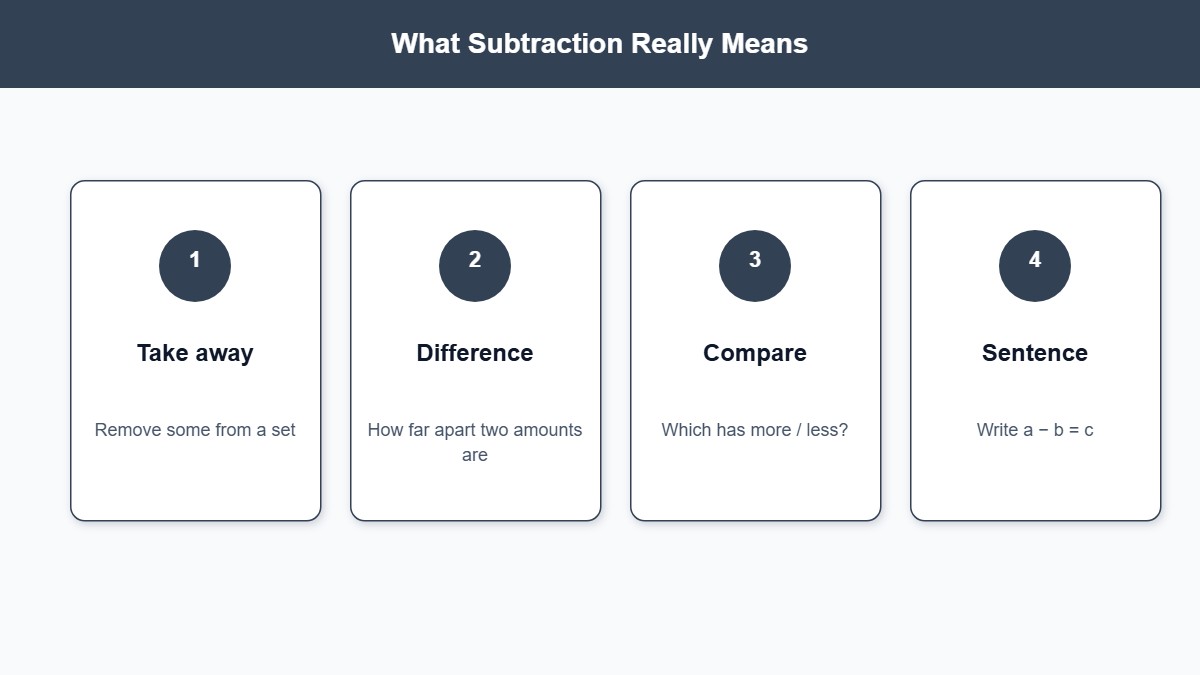
Subtraction answers different questions depending on the situation:
- Take away — Start with a set, remove some, find how many remain (8 grapes, eat 3, how many left?)
- Difference — Find how far apart two amounts are (a tower of 9 cubes and a tower of 4 — how many cubes taller?)
- Compare — Ask who has more or less, and by how many (Sam has 7 stickers, Mia has 5 — how many more does Sam have?)
Write the same number sentence 9 − 4 = 5 for more than one story so children see that the symbols can describe take away, difference, or compare — not only “crossing out.”
1. Begin With Take Away Using Objects
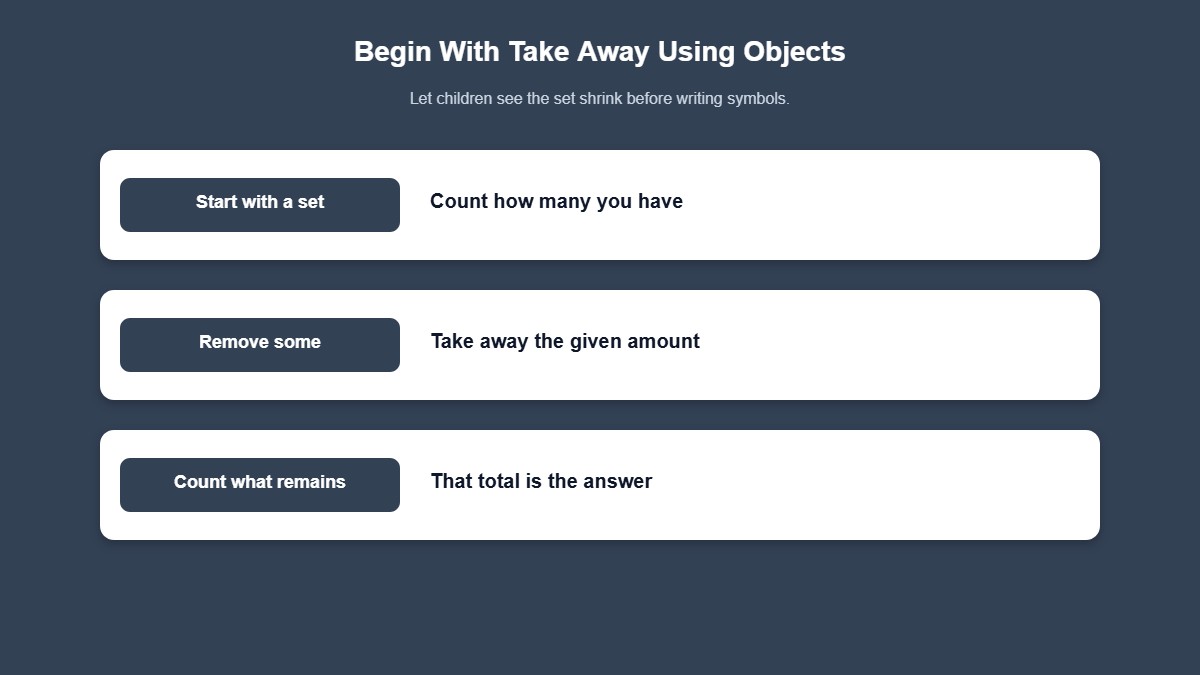
Start concrete. Place nine bottle tops in a clear row. Say, “We have nine. We take away four,” slide four tops aside, and count what remains: “Five left. So 9 take away 4 is 5.”
Keep sets under ten at first. Use identical objects so counting stays accurate. Have the child move the removed items — not only watch you — then say the full sentence: “Nine take away four equals five.”
Classroom tray idea: ten pegs on a card; draw a number card (2–5); remove that many; record the sentence. Home version: ten dried beans on a plate, “eat” (remove) some into a cup, count the plate.
If pointing or totals wobble, pause and revisit how to teach counting before pushing written subtraction.
Printable: Take Away Practice
Practise simple take-away sums within 5 and within 10.


2. Teach Finding the Difference and Comparing

Once take away feels clear, show that subtraction also compares two amounts without “removing” from a story in the same way.
Build two cube towers: one with 8, one with 3. Ask, “How many more cubes does the tall tower have?” Match them side by side and count the unmatched cubes on the taller tower. That unmatched count is the difference: 8 − 3 = 5.
Compare collections: six red counters and four blue. “How many fewer blue?” Line them up in pairs; the two unmatched reds show the answer. Use language carefully — more, fewer, difference — so children do not only hunt for the word “left.”
This meaning appears often in tests and real life (scores, ages, prices). Practise it on purpose, not only as an afterthought to take-away sheets.
3. Count Backwards to Subtract
Counting back connects oral number order to subtraction.
For 7 − 2, start at 7 and count back two steps: “six, five.” Land on 5. Use fingers, floor numbers, or a strip of cards so each step is visible. Rocket-style “7, 6, 5…” while removing one block each time makes the link playful.
Teach children when counting back helps (small subtrahends such as 1, 2, or 3) and when it becomes clumsy (12 − 9 is usually easier as difference or related addition than nine backward steps).
Secure short backward stretches first. Long shaky count-backs create wrong answers even when the child “knows” the idea of take away.
4. Use Number Lines
A number line shows subtraction as movement, which helps many visual learners.
For 11 − 4, put a counter on 11 and hop back four jumps, landing on 7. Count the hops aloud so the subtrahend is not guessed. Open number lines (a blank line where children mark their own jumps) work well once they understand direction.
Try “jump to a friendly number”: for 14 − 6, jump back 4 to 10, then back 2 to 8. That strategy later supports mental maths.
Keep early number-line work large and physical — tape on the floor or a desk strip — before expecting tiny worksheet lines. Printable number-line practice sits well with subtraction worksheets.
5. Build Subtraction Facts
Facts are the small subtractions children should eventually recall quickly, such as within 10 and then within 20.
Teach related families, not random lists. If 6 + 3 = 9, then 9 − 3 = 6 and 9 − 6 = 3. Show the three numbers on a triangle or bar model so the link to how to teach addition is obvious.
Practise in short bursts: “Subtract 1” races on a 0–10 line, doubles take-aways (8 − 4), and “make ten” partners (13 − 3, 12 − 2). Use flashcards for oral fact games, but keep objects nearby when a fact is forgotten — rebuild it, then try again.
Fluency grows from understanding plus spaced practice, not from long timed sheets alone.
Printable: Subtraction Facts
Strengthen fact knowledge with subtract-from-10 and fact-family sheets.


6. Teach Missing-Number Problems
Missing-number items such as □ − 5 = 9 or 14 − □ = 6 check whether children understand relationships, not only left-to-right take away.
Translate into a question: “What number, take away five, leaves nine?” or “Fourteen take away what leaves six?” Cubes and a part–whole diagram help: whole known, one part known, find the other part.
Common trap: children always subtract the two numbers they see, writing 14 − 6 = 8 for 14 − □ = 6 without checking. Ask them to prove the answer by putting the missing number back into the sentence and reversing with addition.
Start with missing results (8 − 3 = □), then missing subtrahends, then missing starts. Increase only when each type is secure.
Printable: Missing Numbers
Find the missing number in subtraction sentences.

7. Introduce Borrowing and Regrouping
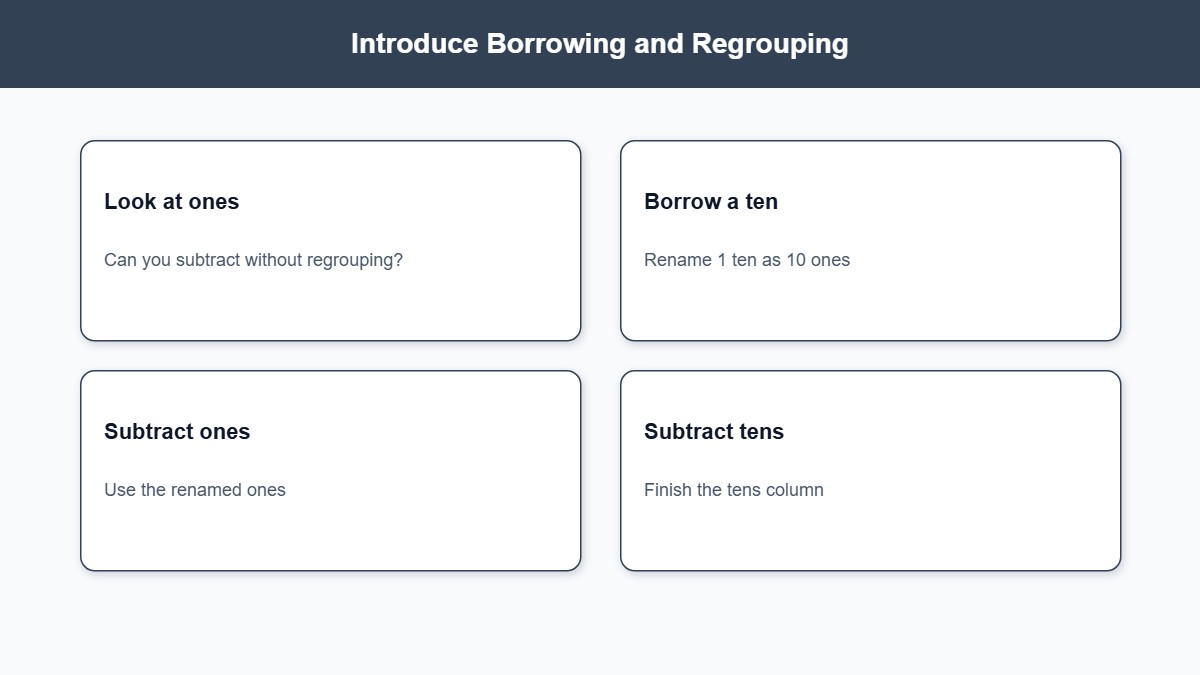
When a digit in the top number is too small to subtract from, children need regrouping (often called borrowing).
Example: 52 − 28. In the ones place, 2 is smaller than 8. Regroup one ten: 52 becomes 4 tens and 12 ones; then 12 − 8 = 4 ones and 4 tens − 2 tens = 2 tens, so 24.
Before the written algorithm, trade physical base-ten blocks: exchange one ten rod for ten ones, then subtract. Say “trade” or “regroup” consistently with your school language.
Do not rush multi-digit work if single-digit facts and place value are weak. A child who still counts all ones for 9 − 6 will find regrouping exhausting. Strengthen facts and tens/ones first.
Printable: Two-Digit Regrouping
Practise two-digit subtraction with borrowing and regrouping.

8. Move to Larger Numbers
Extend range in clear steps: within 10 → within 20 → two-digit without regrouping → two-digit with regrouping → three-digit with support.
For 63 − 40, highlight subtracting tens only. For 70 − 35, discuss whether to count back, use a number line to 70, or regroup. For larger amounts, empty number lines or expanded form (700 + 50 + 3) keep place value visible.
Check answers with the inverse: add the answer to the number subtracted and see if you return to the start. That habit catches many regrouping errors.
9. Teach Mental Strategies
Mental subtraction is a toolkit, not one trick.
Useful strategies:
- Count back for −1, −2, −3
- Use doubles (14 − 7 because double 7 is 14)
- Subtract through ten (15 − 6 → 15 − 5 − 1)
- Compensate (41 − 19 → 41 − 20 + 1)
- Think addition (“what do I add to 8 to make 15?” for 15 − 8)
Model choosing a strategy aloud: “For 16 − 9 I would rather think 9 + □ = 16 than count back nine times.” Let children explain their method so they own the choice.
10. Practise Subtraction Word Problems
Word problems reveal whether children recognise take away, difference, or compare.
Give varied stories with unique details — not only “apples eaten.” Examples: 12 library books on a shelf, 5 borrowed, how many remain? A rope of 20 beads and a rope of 13 — what is the difference? Ori had 18 points, Nia had 11 — how many more points did Ori score?
Teach a simple routine: read → underline the amounts → decide the meaning → choose objects, a drawing, or a number sentence → check with the inverse. Avoid teaching “key words only” (left, more) as a shortcut; those words appear in addition stories too.
Mix one-step problems first. Two-step problems wait until single-step accuracy is steady. Ready-made sets appear in subtraction worksheets and wider maths worksheets.
Printable: Subtraction Word Problems
Apply subtraction to short story problems.

11. Common Mistakes and How to Help
Always subtracting the smaller digit from the larger, ignoring place: In 42 − 17 they write 5 ones (7 − 2) and 3 tens. Return to base-ten blocks and insist on regrouping when the top ones digit is smaller.
Counting back one too many or too few: Have them land a finger on the start number first, then hop; the start number is not a hop.
Mixing up difference and take away language: Act out both with the same numbers and compare the stories.
Guessing missing numbers: Require a check with addition every time.
Rushing facts: Shrink the set, rebuild with objects, then retry two or three facts — not twenty wrong answers in a row.
12. How to Increase Difficulty
Raise challenge when smaller steps are accurate:
- Larger starting numbers and crossing ten
- Compare and difference stories, not only take away
- Missing numbers in different positions
- Two-digit regrouping, then three-digit
- Mental strategies without manipulatives
- Word problems with extra unused numbers
- Explaining why a strategy works
If accuracy drops, step back to objects or a number line for that number range before pushing on.
A Simple Subtraction Lesson Structure
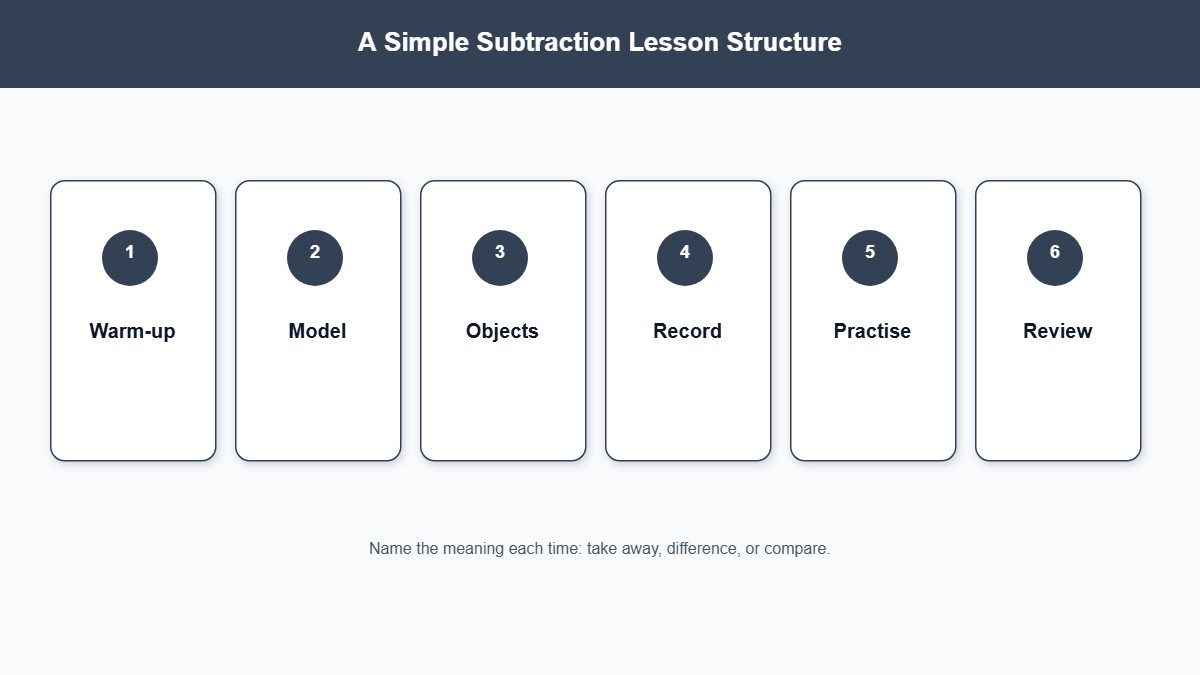
A short lesson can follow this sequence:
- Warm-up — Count back from a number, or two quick related addition/subtraction facts.
- Model — One clear story (take away or compare) with objects or a number line; write the sentence together.
- Guided practice — Two or three problems as a class or in pairs; fix misconceptions immediately.
- Independent practise — A short set from subtraction worksheets or mini whiteboards, matched to today’s meaning.
- Check — One problem solved two ways (e.g. count back and related addition).
- Wrap-up — Children say which meaning of subtraction they used today.
Adapt timing for age. Younger learners need more concrete modelling; older beginners may move sooner into facts and regrouping. Plan fuller sessions with maths lesson plans.
Printable: Subtraction Review
Use a mixed review page for follow-up practice after a lesson.

Subtraction Practice at Home
Home practice works best in short, useful moments.
Ideas: count how many crackers are left after a snack; compare who collected more pinecones on a walk; use a board game score pad to find the difference between two scores; set a timer and ask how many minutes remain until it rings (simple elapsed ideas); sort laundry — ten socks, put four in the drawer, how many still on the bed?
Keep tone light. One careful problem with objects beats a long worksheet fought over at the kitchen table. Share the language you use at school — take away, difference, regroup — so home and class match.
How to Teach Subtraction Step by Step
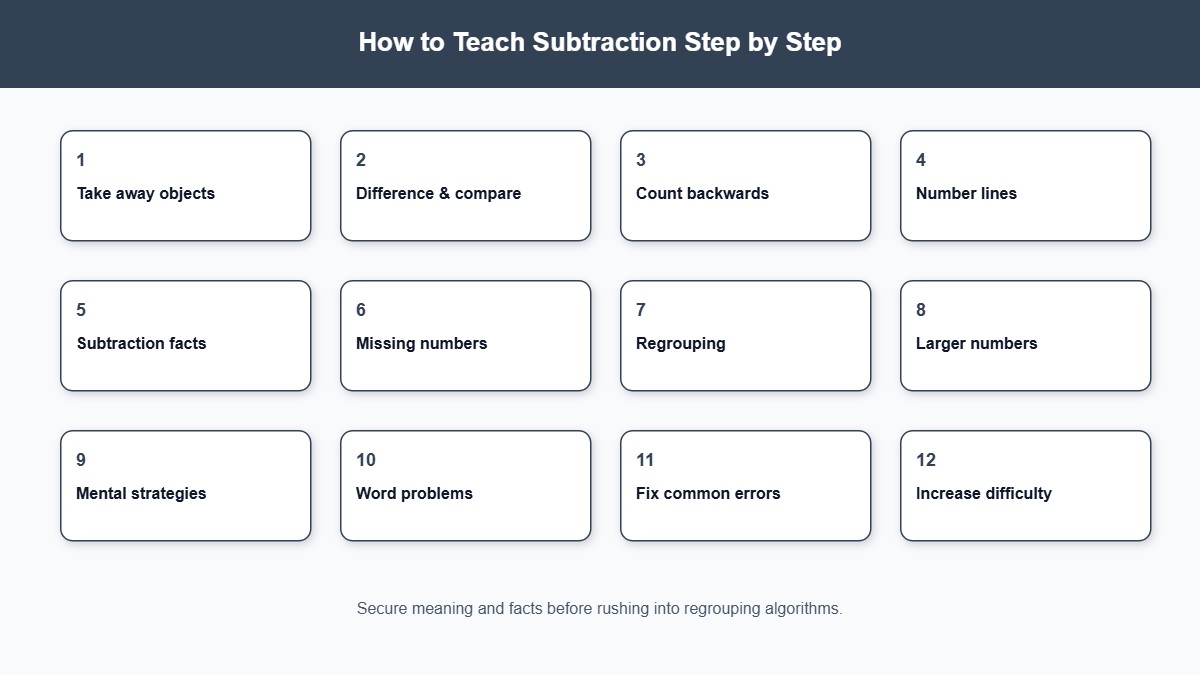
A practical progression looks like this:
- Act out take away with small sets of objects and say the full sentence.
- Show difference and compare with paired towers or lined-up counters.
- Count back for small subtrahends; use number lines for visible jumps.
- Link subtraction to addition families and build facts within 10, then 20.
- Solve missing-number problems with part–whole checks.
- Introduce two-digit subtraction without regrouping, then with regrouping using base-ten materials.
- Add mental strategies and varied word problems.
- Extend to larger numbers and explain chosen methods.
Stay on a step until answers are mostly accurate and the child can show why — not only copy a pattern.
How to Help a Child Who Struggles With Subtraction
First find what is breaking down: counting back, place value, fact recall, understanding the story, or regrouping trades.
Then simplify: smaller numbers, physical objects, one meaning of subtraction at a time, and slower pace. Sit beside them and solve one problem in unison.
Use the inverse often — “If 12 − 5 = 7, then 7 + 5 should make 12.” Related addition can unlock subtraction for children who freeze on take away.
Avoid shaming mistakes on multi-digit work; those errors usually mean an earlier layer needs reteaching. Short successful sessions rebuild confidence. Pair gaps in numeral or quantity knowledge with how to teach numbers, and shaky one-to-one counts with how to teach counting.
Final Thoughts
Teaching subtraction well means teaching several meanings — take away, difference, and compare — then giving children tools: objects, count back, number lines, facts, regrouping, and mental strategies.
Build from concrete stories to written methods, check with addition, and increase difficulty only when accuracy holds. Clear models, varied word problems, and short practice matter more than racing to bigger numbers.
With steady progression and calm correction of common errors, learners gain a subtraction foundation that supports later calculation, including how to teach division and everyday problem solving.
Frequently Asked Questions
Common questions answered for downloading and using our premium printable designs.




Comments (0)
Leave a Reply
Be the first to leave a comment!