
How to Teach Grammar
A practical guide to teaching grammar: nouns, verbs, adjectives, tenses, agreement, punctuation, activities, gentle correction, and age-appropriate progression through examples, reading, speaking, and writing.
 Amanda Williams
Grammar is the set of patterns that help people put words together so meaning is clear. Children do not need long definitions of every part of speech before they can speak and write well. They need clear examples, chances to notice patterns in reading, and short practice in speaking and writing.
Table of Contents
- What Grammar Is (and How to Teach It)
- 1. Teach Nouns Through Naming and Sorting
- Printable: Nouns
- 2. Teach Pronouns to Replace Repeated Nouns
- Printable: Pronouns
- 3. Teach Verbs as the Action or State
- Printable: Verbs
- 4. Teach Adjectives to Describe Nouns
- Printable: Adjectives
- 5. Teach Adverbs to Describe How, When, or Where
- 6. Teach Articles: a, an, and the
- 7. Teach Conjunctions to Join Ideas
- 8. Teach Prepositions for Place and Time
- 9. Teach Tenses: Past, Present, and Future
- Printable: Past Tense
- 10. Teach Sentence Structure Simply
- Printable: Sentence Types
- 11. Teach Subject-Verb Agreement
- 12. Teach Punctuation That Supports Meaning
- Printable: Punctuation and Capitals
- Classroom and Home Activities
- How to Correct Grammar Mistakes Gently
- Common Grammar Mistakes and How to Help
- How to Increase Difficulty
- A Simple Grammar Lesson Structure
- How to Teach Grammar Step by Step
- Final Thoughts
This guide shows how to teach grammar in a practical way: nouns, pronouns, verbs, adjectives, adverbs, articles, conjunctions, prepositions, tenses, sentence structure, subject-verb agreement, and punctuation. Pair it with how to teach sentence writing when learners are building full sentences, with how to teach writing for longer writing tasks, and with how to teach vocabulary when word choice is the main goal. Use grammar worksheets, writing worksheets, and English lesson plans for practice that matches each stage.
Whether you teach in a classroom or at home, keep lessons short, age-appropriate, and rooted in real language. Model first, practise together, then let learners try on their own — and correct mistakes in a way that keeps confidence intact.
What Grammar Is (and How to Teach It)
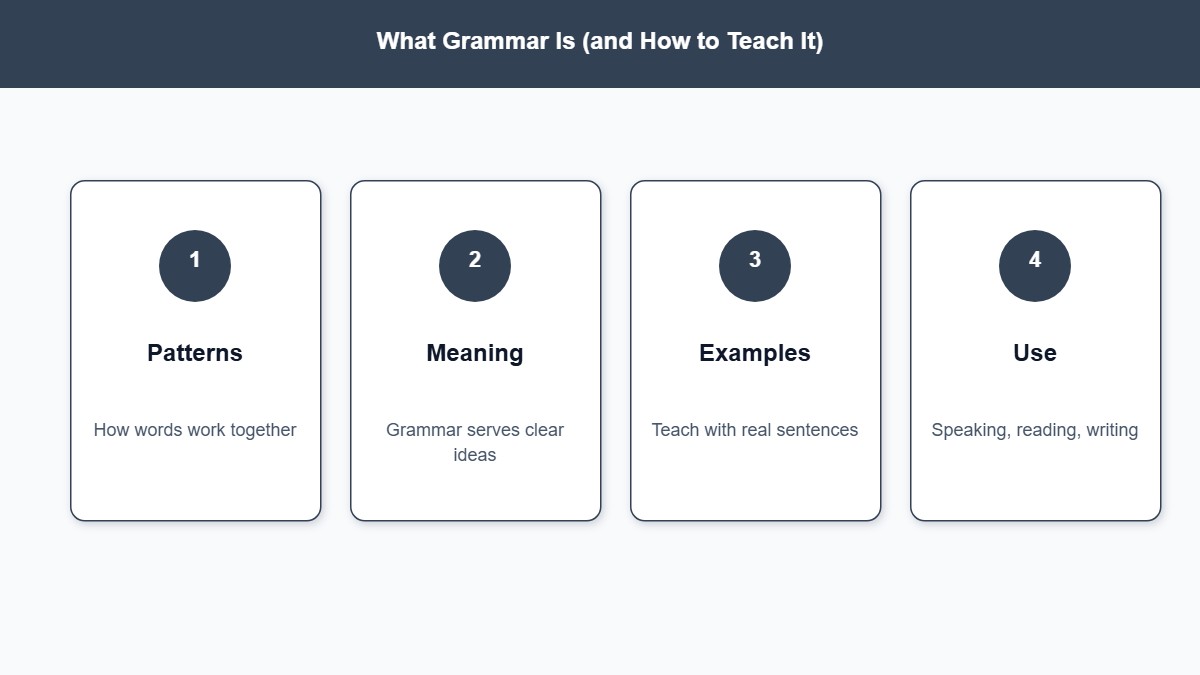
Grammar is not a list of rules to memorise in isolation. It is how words work together: who or what a sentence is about, what happens, when it happens, and how ideas connect.
Strong grammar teaching usually includes:
- Clear examples before labels
- Noticing patterns in shared reading
- Oral practice (say it, then write it)
- Short writing tasks that use the target pattern
- Gentle correction with a better model nearby
Start with what learners already say correctly, then name the pattern. For beginners, "naming words" and "doing words" may come before "noun" and "verb." Formal terms can follow once the idea is secure.
1. Teach Nouns Through Naming and Sorting
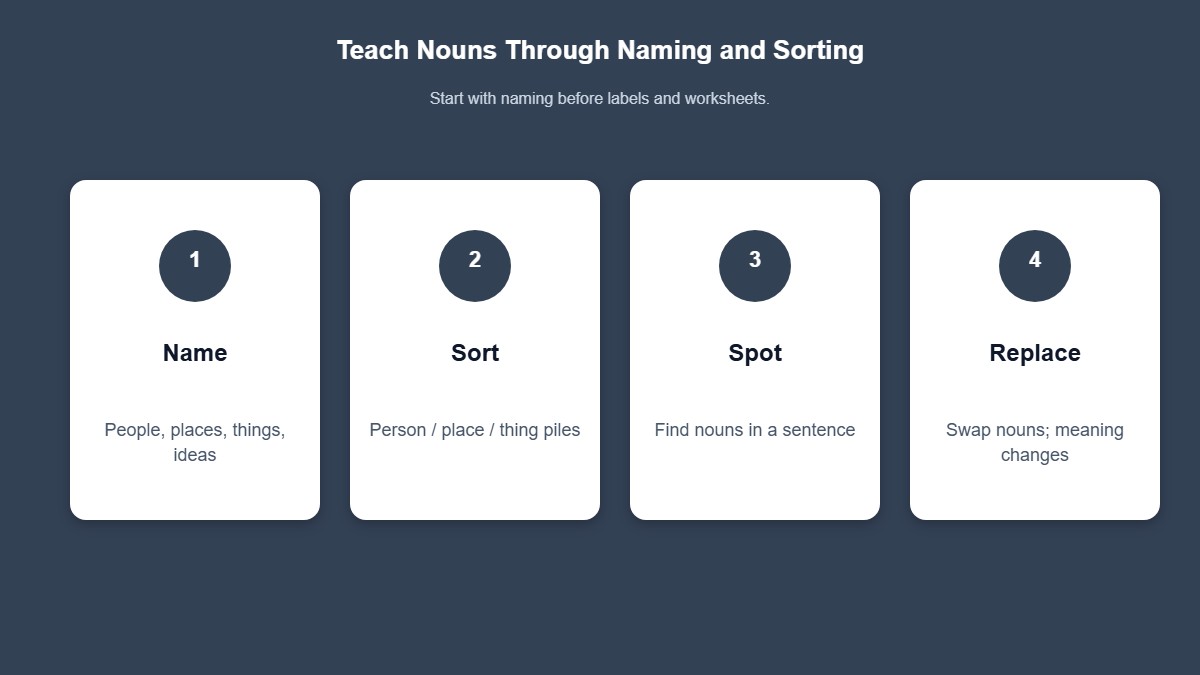
Nouns name people, places, things, and ideas. Begin with concrete nouns children can see and touch.
Walk around the room and name objects: chair, book, door. Sort picture cards into people / places / things. Ask: "Is apple a naming word? Is run a naming word?" Contrast with verbs so the difference is felt, not only defined.
In reading, pause on a sentence and ask which words name something. In writing, have learners list five nouns about a topic (school, zoo, kitchen) before they write a sentence. Common nouns come before abstract ones such as kindness or freedom.
Later, introduce proper nouns with capital letters for names of people and places. Keep the focus on use: "We write Mia with a capital because it is a name."
Printable: Nouns
Sort people, places, and things with a clear noun match sheet.

2. Teach Pronouns to Replace Repeated Nouns
Pronouns stand in for nouns so speech and writing do not repeat the same name every time: he, she, it, they, we, I, you, him, her, them.
Write two versions of a short text: "Sam ate an apple. Sam liked the apple." Then: "Sam ate an apple. He liked it." Ask which sounds smoother and why the pronouns work.
Practise matching: point to a picture of two girls and choose they / she. Oral games help: "I spy… It is red." If a child says "Him went home," model "He went home" and have them repeat the corrected sentence once.
Do not teach every pronoun form in one lesson. Secure subject pronouns in simple sentences before object forms and possessives.
Printable: Pronouns
Match pronouns to the people or groups they replace.

3. Teach Verbs as the Action or State
Verbs tell what someone or something does, or what state they are in (run, eat, is, have).
Act out verbs: jump, clap, whisper. Freeze and ask, "What is the doing word?" Sort cards into naming words and doing words. In a sentence on the board, cover the verb and ask what is missing — the sentence usually falls apart.
Include "being" verbs early with simple frames: "The cat is soft." "We are ready." Linking verbs matter as much as action verbs for later agreement and tense work.
When learners write, ask them to underline the verb in each sentence. If a sentence has no verb, help them add one. That habit supports how to teach sentence writing and everyday how to teach writing.
Printable: Verbs
Practise action words with a simple verb match page.

4. Teach Adjectives to Describe Nouns
Adjectives describe nouns: size, colour, number, feeling, and other qualities.
Start with sensory description. Hold up an object and collect words: small, blue, smooth, noisy. Expand bare noun phrases: "dog" → "hairy dog" → "small hairy dog." Compare weak and stronger choices: "nice cake" versus "sticky chocolate cake."
Reading aloud is ideal — stop and name the describing word. Speaking games: describe a mystery object until the class guesses. Writing: add one adjective to each noun in a short list, then read the improved phrases aloud.
Avoid adjective overload. One or two well-chosen words beat a long string that slows the sentence down.
Printable: Adjectives
Link describing words to clear picture nouns.

5. Teach Adverbs to Describe How, When, or Where
Adverbs often describe verbs — how, when, or where something happens: slowly, yesterday, outside. Many end in -ly, but not all (very, often, well).
Demonstrate: walk across the room normally, then walk slowly. Ask what changed. Build frames: "She spoke ___." "They arrived ___." Sort word cards into adjectives (describe nouns) and adverbs (describe actions) using simple test sentences.
In shared writing, add an adverb to a plain sentence and discuss whether it improves clarity. Keep early work oral and playful so learners feel the difference before memorising the label.
6. Teach Articles: a, an, and the
Articles are small but frequent: a and an for something not specific yet; the for something known or unique in context.
Use real objects: "I need a pencil" (any pencil) versus "Pass me the red pencil" (a particular one). Practise a/an with beginning sounds: a book, an apple, an hour (sound matters more than spelling).
Short oral drills work well: hold up pictures and say the phrase with the correct article. In writing, circle articles in a paragraph and ask why each one fits. English learners often need extra listening practice here because articles may not exist the same way in their first language.
7. Teach Conjunctions to Join Ideas
Conjunctions join words or clauses: and, but, or, so, because, when, if.
Begin with and and but in spoken sentences: "I like apples and bananas." "I wanted to play, but it rained." Show how because answers "why": "She smiled because her friend arrived."
Give two short sentences and ask learners to join them with a suitable conjunction. Compare meaning: "and" adds; "but" contrasts; "so" shows a result. This is a natural bridge into sentence combining in how to teach sentence writing.
Teach one or two conjunctions at a time. Overusing and in a long run-on sentence is a common next problem — model where a full stop is clearer.
8. Teach Prepositions for Place and Time
Prepositions show relationships: in, on, under, next to, between, before, after, during.
Use a box and a small toy. Place the toy in, on, under, and beside the box while saying the phrase. Simon-says style games ("Put your hand on your head") make meaning physical.
For time, use the school day: before lunch, after break, during assembly. In reading, hunt for preposition phrases. In writing, improve vague sentences: "The book is there" → "The book is on the shelf next to the plant."
Prepositions are best learned in chunks (on the table, at 3 o'clock) rather than as an abstract list.
9. Teach Tenses: Past, Present, and Future
Tense shows when something happens. Keep early teaching to clear contrasts: today / yesterday / tomorrow, or is happening / already happened / will happen.
Use the same verb in three frames: "I walk to school." "I walked to school." "I will walk to school." Act out and timeline on the board. Sort sentence strips into past, present, and future.
Focus first on regular past forms (-ed) and high-frequency irregulars (went, saw, was, had). Present progressive (is running) helps describe what is happening now. Save finer tense distinctions for later once the three big time frames are secure.
When learners mix tenses in a story, pick one stretch of writing and ask, "When is this happening?" Then revise verbs together so the timeline stays consistent.
Printable: Past Tense
Match present verbs to their past-tense forms.

10. Teach Sentence Structure Simply
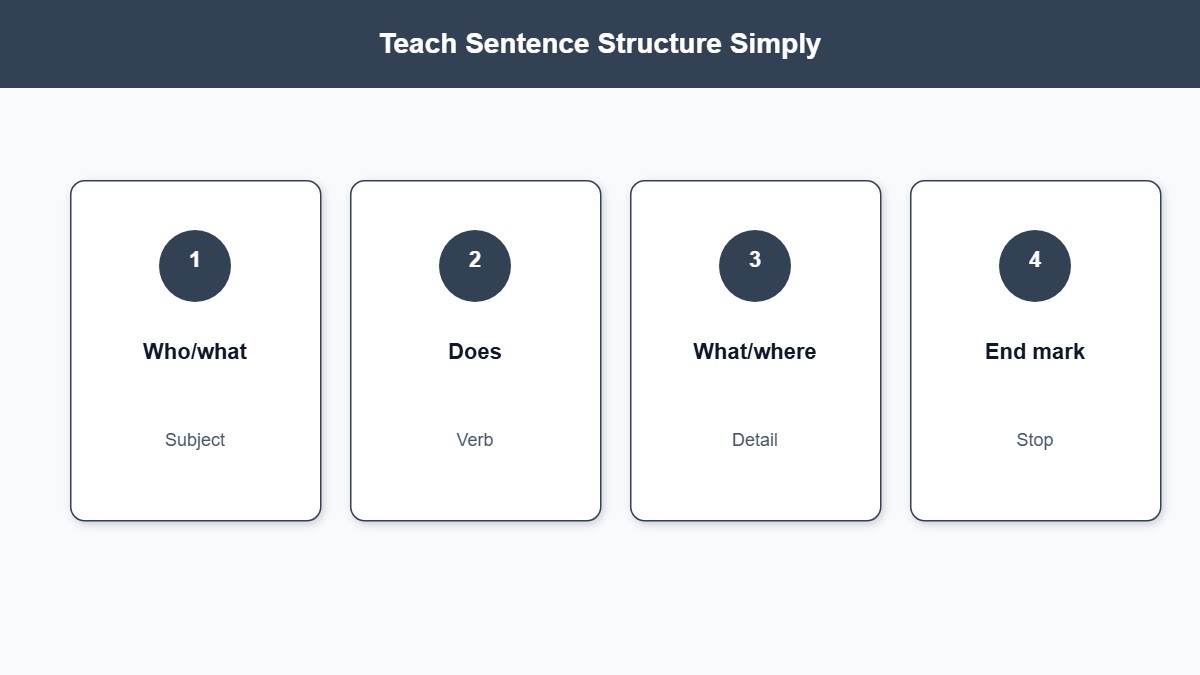
A basic sentence needs a who/what (subject) and a what happens (predicate with a verb). Capitals and end punctuation belong with structure from the start.
Build sentences from cards: subject card + verb card + optional detail. Expand: "Birds fly." → "Birds fly over the lake." Identify fragments ("Running down the hill") and help turn them into full sentences.
Subject and predicate language can stay simple: "Who is the sentence about? What are they doing?" Deeper work on clauses can wait. For step-by-step sentence building, use how to teach sentence writing; for paragraphs and longer pieces, move into how to teach writing.
Printable: Sentence Types
Recognise statements, questions, commands, and exclamations.

11. Teach Subject-Verb Agreement
Subject-verb agreement means the verb form matches the subject: "The dog runs" / "The dogs run"; "She is" / "They are."
Teach with contrast pairs side by side. Change only the subject and adjust the verb: "My friend likes rice." "My friends like rice." Clap or highlight the -s on present-tense verbs with he/she/it.
Common traps: there is / there are; collective ideas; phrases between subject and verb ("The box of pencils is full"). When a mistake appears, return to the true subject: ask "Who or what is this about — one or more?" then choose the verb.
Short daily oral fixes beat long worksheets alone. Follow with a few written items from grammar worksheets once the ear is tuned.
12. Teach Punctuation That Supports Meaning
Punctuation shows where ideas start and stop and what kind of sentence you are reading: capital letters, full stops, question marks, exclamation marks, and later commas and speech marks.
Read the same words aloud with different end marks and discuss the change in voice. Edit a paragraph with missing stops so learners "hear" the run-on. Practise question vs statement pairs: "You are ready." / "Are you ready?"
Introduce commas for lists when learners are already writing longer sentences. Speech marks can wait until dialogue appears in reading and writing. Keep the rule practical: punctuation helps the reader, so read work aloud when checking.
Printable: Punctuation and Capitals
Practise end marks and capital letters that support clear meaning.


Classroom and Home Activities
Mix noticing, speaking, and writing so grammar stays tied to real language.
Classroom ideas:
- Sentence surgery: fix one agreement or tense error on the board together
- Word-sort races: noun / verb / adjective cards
- Expand-the-sentence challenges with adjectives, adverbs, or prepositional phrases
- Partner reading: spot pronouns or conjunctions in a short paragraph
- Quick oral drills (a/an, is/are, was/were) before writing time
Home ideas:
- Describe dinner with two adjectives each
- Retell the day in past tense at bedtime
- Label rooms with sticky-note prepositions (on the fridge, under the table)
- Rewrite a text message as a full sentence with a capital and full stop
- Play "finish my sentence" with because, but, or so
Printable practice from grammar worksheets and short writing prompts from writing worksheets work well after a modelled mini-lesson.
How to Correct Grammar Mistakes Gently
Correct in ways that teach the pattern, not only the error.
Recast: if a child says "She go home," reply "Yes — she goes home," then ask them to say it once. Ask a focusing question: "One friend or many friends?" so they choose likes / like. Show a correct model beside the child's sentence and highlight the changed word.
Choose one target per piece of writing. Marking every error at once overwhelms learners and hides progress. Praise a correct structure you recently taught so they notice success.
For persistent errors, collect three of the child's own sentences and revise them together. Personal examples stick better than anonymous workbook lines.
Common Grammar Mistakes and How to Help
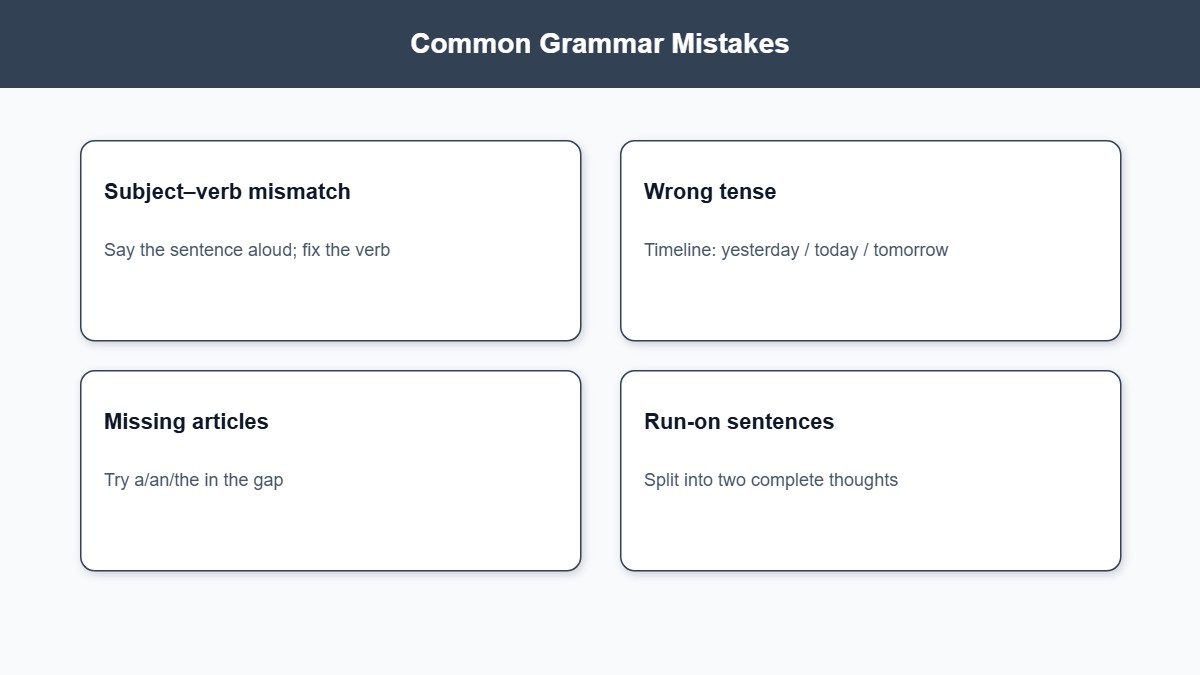
Subject-verb disagreement: Return to singular/plural and practise contrast pairs aloud daily.
Tense hopping in stories: Draw a simple timeline; revise verbs in one paragraph to match.
Missing articles or wrong a/an: Oral phrase practice with pictures; stress beginning sounds for a/an.
Pronoun confusion (him/he, them/they): Act out who is doing the action versus receiving it; model the full corrected sentence.
Run-ons and fragments: Read aloud; check for a clear subject and verb; split or join with a suitable conjunction or full stop.
Adjective/adverb mix-ups: Ask "Does this word describe a thing or an action?" and test in a frame sentence.
If vocabulary gaps block grammar practice, strengthen word knowledge with how to teach vocabulary alongside the grammar focus.
How to Increase Difficulty
Raise challenge when basic patterns are accurate in speech and short writing:
- Move from identifying parts of speech to using them in original sentences
- Combine sentences with a wider range of conjunctions
- Add adjectives, adverbs, and prepositional phrases for detail
- Contrast regular and irregular past forms
- Edit longer paragraphs for agreement, tense, and punctuation
- Introduce commas in lists, then simple speech punctuation
- Compare formal written grammar with casual spoken English where helpful
If accuracy drops, return to oral models and shorter sentences before pushing complexity.
A Simple Grammar Lesson Structure
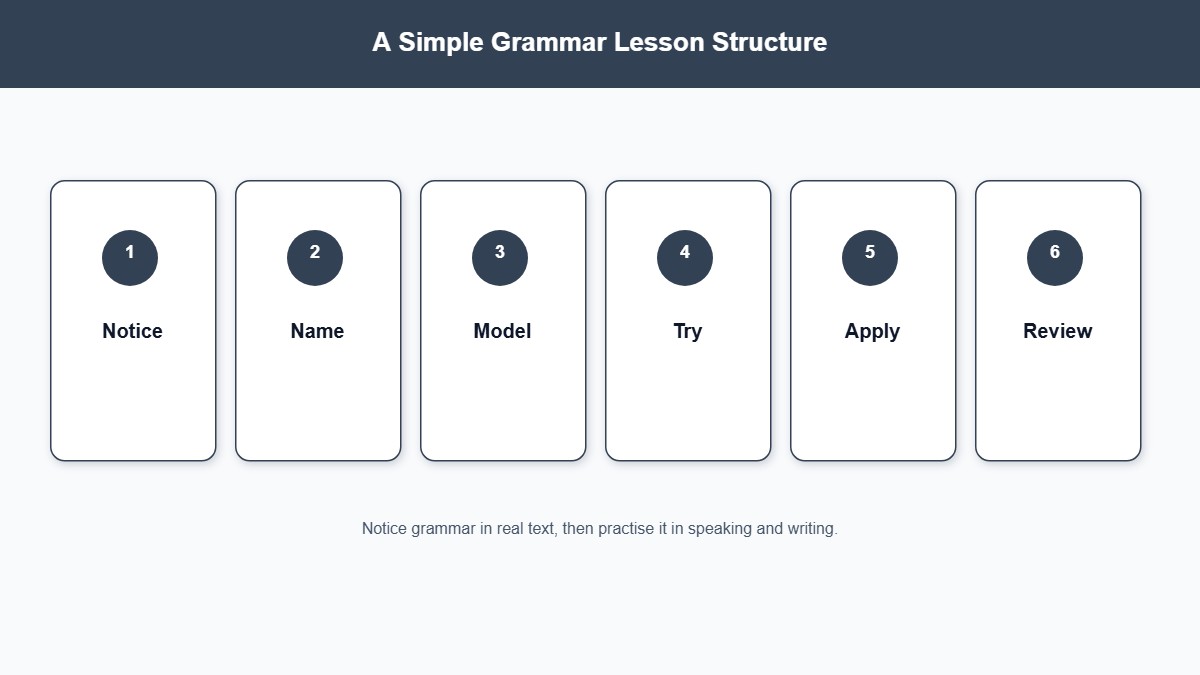
A short grammar lesson can follow this sequence:
- Warm-up — Two or three oral examples of the target pattern (say it together).
- Notice — Find the pattern in a sentence from shared reading or the board.
- Model — Think aloud while building or fixing one example.
- Guided practice — Class or pairs complete two or three items; correct together.
- Independent practise — A short speaking task, then two written sentences or a brief grammar worksheets activity.
- Apply — Use the pattern in a tiny writing task linked to writing worksheets or class topic.
- Wrap-up — Learners share one correct sentence; note one tip for next time.
Keep mini-lessons brief. Younger learners need more speaking and sorting; older learners can move faster into editing. Plan fuller sessions with English lesson plans.
How to Teach Grammar Step by Step
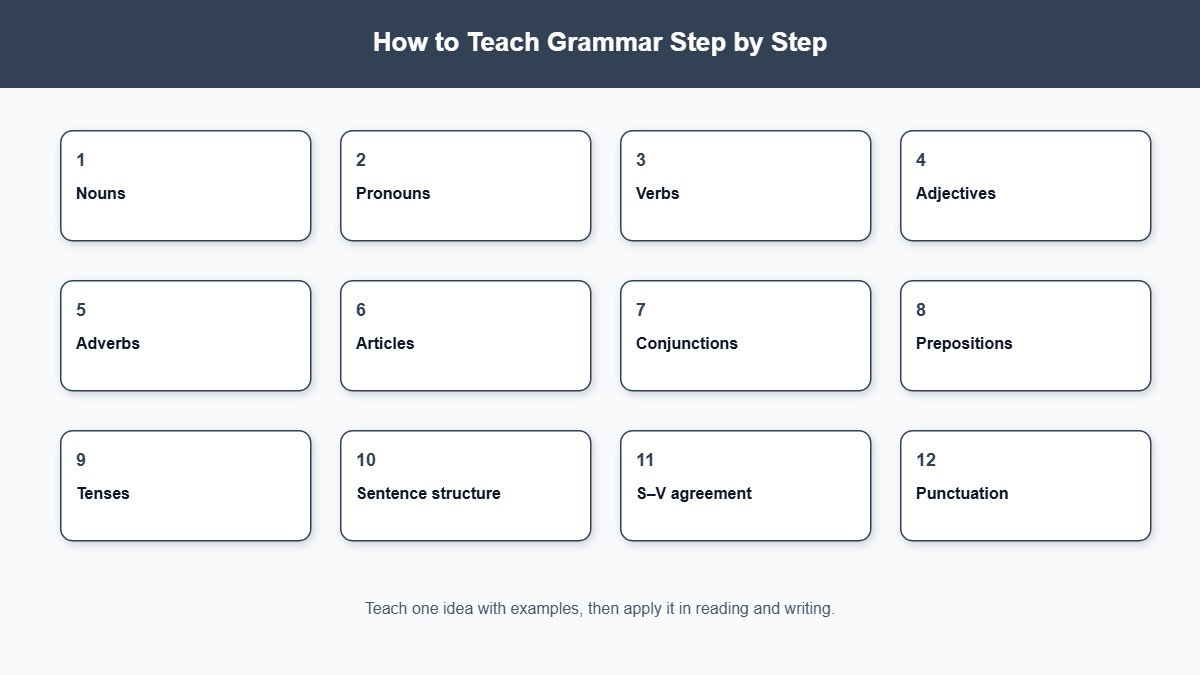
A practical progression looks like this:
- Build awareness with examples in listening and reading — not definitions first.
- Teach nouns and verbs with sorting, acting, and simple sentence frames.
- Add adjectives, then adverbs, to expand meaning.
- Secure articles and basic pronouns in oral phrases and short sentences.
- Join ideas with and, but, because; place and time with common prepositions.
- Contrast past, present, and future with timelines and the same verb.
- Practise subject-verb agreement with clear singular/plural pairs.
- Strengthen capitals, end marks, and simple comma use for lists.
- Edit short pieces of writing for one grammar focus at a time.
- Increase sentence complexity and apply patterns in longer how to teach writing tasks.
Adapt the pace to age and language background. English learners may need more oral repetition; confident writers may need sharper editing goals.
Final Thoughts
Teaching grammar well means teaching patterns through examples, reading, speaking, and writing — not only through labels and worksheets. Name the idea when learners can already hear and use it.
Work from nouns and verbs toward description, joining words, tense, agreement, and punctuation. Correct gently, practise little and often, and keep tasks age-appropriate.
When grammar is taught as a tool for clear communication, it supports stronger how to teach sentence writing, richer how to teach vocabulary, and more confident how to teach writing. Short modelled lessons, real examples, and regular application matter more than covering every rule at once.
Frequently Asked Questions
Common questions answered for downloading and using our premium printable designs.





Comments (0)
Leave a Reply
Be the first to leave a comment!