
How to Teach Sentence Writing
A practical guide to teaching sentence writing: complete thoughts, capitals, spaces, punctuation, subject and predicate, building, expanding, combining, editing, and helping stuck writers.
 Amanda Williams
Sentence writing is the bridge between knowing words and producing real writing. Once children can form letters and spell simple words, they need to learn how to turn those words into a complete thought that someone else can read and understand.
This guide focuses on how to teach sentence writing itself: what a sentence is, capitals and spaces, basic punctuation, subject and predicate, building and expanding sentences, and checking work. For the wider writing journey — handwriting, spelling, paragraphs, and longer pieces — see how to teach writing. Pair sentence practice with how to teach handwriting, how to teach grammar, and how to teach vocabulary when those skills need support.
Whether you teach in a classroom or at home, the same approach works well: model a clear sentence, practise one feature at a time, show weak and stronger examples, and only raise the challenge when short sentences are accurate.
What a Sentence Is
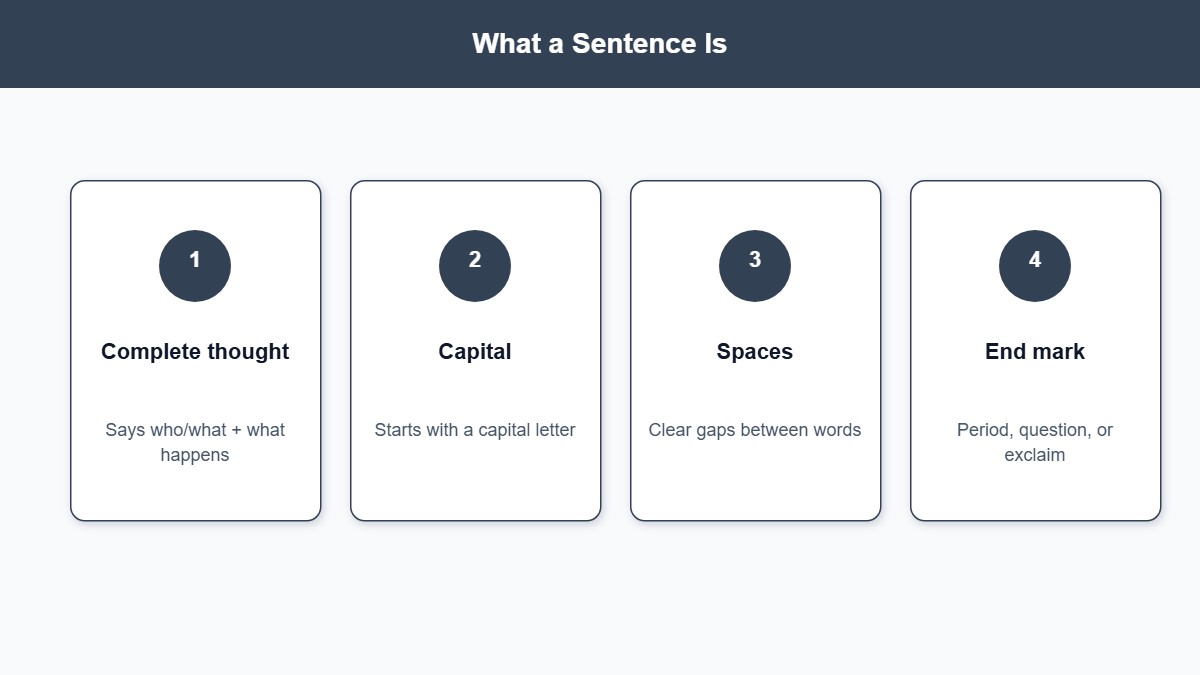
A sentence is a group of words that expresses a complete idea. In early writing, that usually means it names who or what the sentence is about and tells what happens or what is true.
Compare:
- Not a sentence: the big dog
- Not a sentence: runs in the park
- A sentence: The big dog runs in the park.
Young writers often produce fragments ("Went to the shop") or run-ons ("I like cats I like dogs"). Teach them to ask: Does this make sense on its own? Who or what is it about? What is happening?
Keep early definitions practical. Children do not need formal grammar labels on day one, but they do need to hear and write complete thoughts. Deeper parts of speech and sentence types belong with how to teach grammar once basic sentences are secure.
1. Teach Capitals at the Start
Every sentence begins with a capital letter. This is one of the first habits to lock in.
Model writing a sentence on the board and deliberately start with a capital: "The cat sat on the mat." Point to the first letter and say why it is capital.
Give fix-it practice: show a sentence that starts with a lowercase letter and ask the learner to correct it. Then ask them to write one new sentence and check the first letter before they move on.
Also teach capitals for names (Tom, London) so children do not think "capital" only means "first word." Keep the main focus for beginners on starting each sentence correctly.
Printable: Capital Letters
Practise matching and fixing capitals in early sentences.

2. Teach Spaces Between Words
Spaces make writing readable. Without them, even a correct sentence looks like a jumble.
Show the difference clearly:
- Ilovemyredbike.
- I love my red bike.
Use a finger space, a popsicle stick, or a small counter between words while children write. Have them read their line aloud and tap each word — if they cannot hear where one word ends, the spacing probably needs work.
If letter formation is still shaky and words collide, strengthen how to teach handwriting in short sessions, then return to spaced sentence copying.
3. Teach Basic Punctuation
Start with three end marks: full stop (.), question mark (?), and exclamation mark (!).
Teach what each one signals:
- Full stop — a statement: The bird is blue.
- Question mark — a question: Is the bird blue?
- Exclamation mark — strong feeling or surprise: The bird is huge!
Read the same words with different end marks so children hear the change. Ask them to sort sentence cards by punctuation, then write one of each type.
Leave commas, speech marks, and apostrophes for later unless your curriculum requires them. Early success with clear end punctuation matters more than covering every mark. Extra practice sits well with grammar worksheets.
Printable: End Marks and Sentence Types
Match periods, questions, and exclamations to the right sentence type.


4. Introduce Subject and Predicate Simply
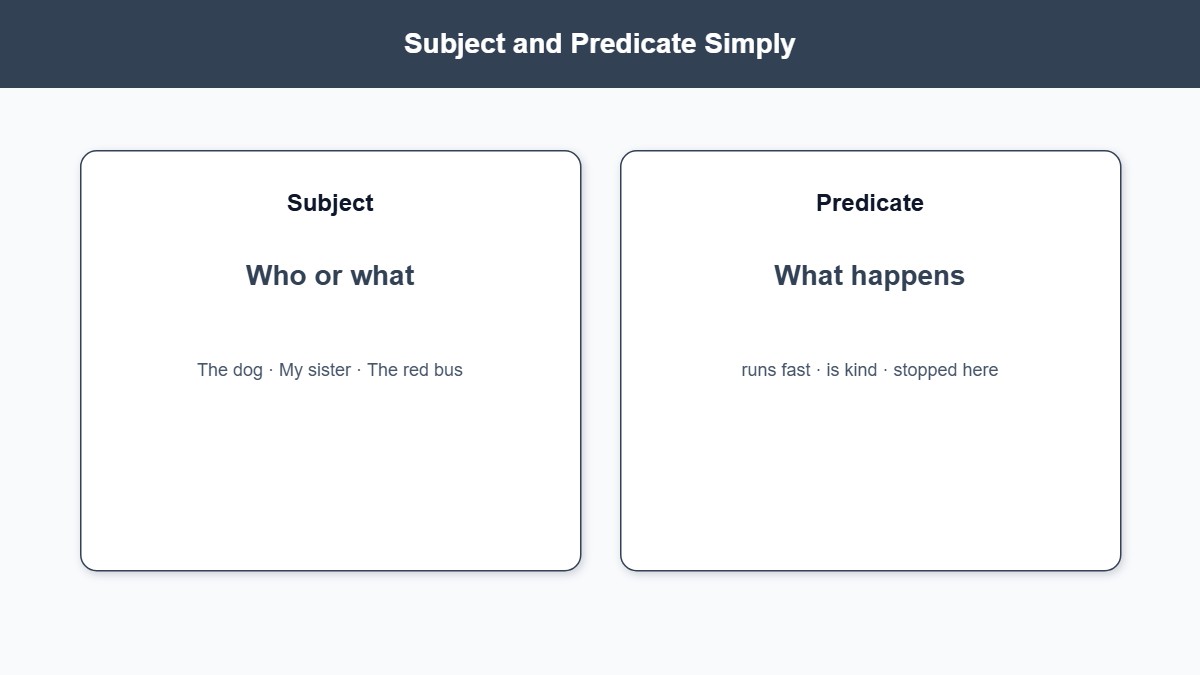
You do not need heavy terminology, but the idea helps children build complete sentences.
Explain in plain language:
- Subject — who or what the sentence is about
- Predicate — what the subject does or is
Example: The puppy (subject) chased the ball (predicate).
Oral games work well before writing. You say a subject ("The teacher…") and children finish with a predicate ("…wrote on the board."). Swap roles. Then write a few of the best ones together.
When a child writes a fragment, ask which part is missing: the who/what, or the what happens. That question is often enough to fix the sentence.
5. Build Sentences From Words and Pictures
Sentence-building activities show how words fit together.
Useful tasks:
- Unscramble word cards into a sensible sentence
- Match a picture to a sentence, then copy it
- Fill a frame: The ____ is ____.
- Choose a subject card and a verb card, then add a detail
Begin with three- or four-word sentences: "Sam kicks the ball." Add colour, place, or time only when the base sentence is correct.
Printable building and rewrite pages are available in sentence writing worksheets and among other writing worksheets.
Printable: Sentence Building
Build complete sentences with clear starters and handwriting lines.


6. Use Sentence Starters
Starters reduce blank-page fear and keep structure consistent while children learn.
Examples:
- I can…
- I like…
- Today I…
- My favourite…
- In the morning…
- The boy / The girl / The dog…
Model finishing one starter aloud, write it together, then let children finish two more independently. Change starters when the pattern becomes automatic so they do not rely on the same opening forever.
For richer word choice inside those sentences, draw on how to teach vocabulary — a stronger verb or clearer noun often improves a starter sentence more than adding length.
Printable: Sentence Writing Prompts
Give beginners a ready starter so they can focus on a full sentence.


7. Expand Simple Sentences
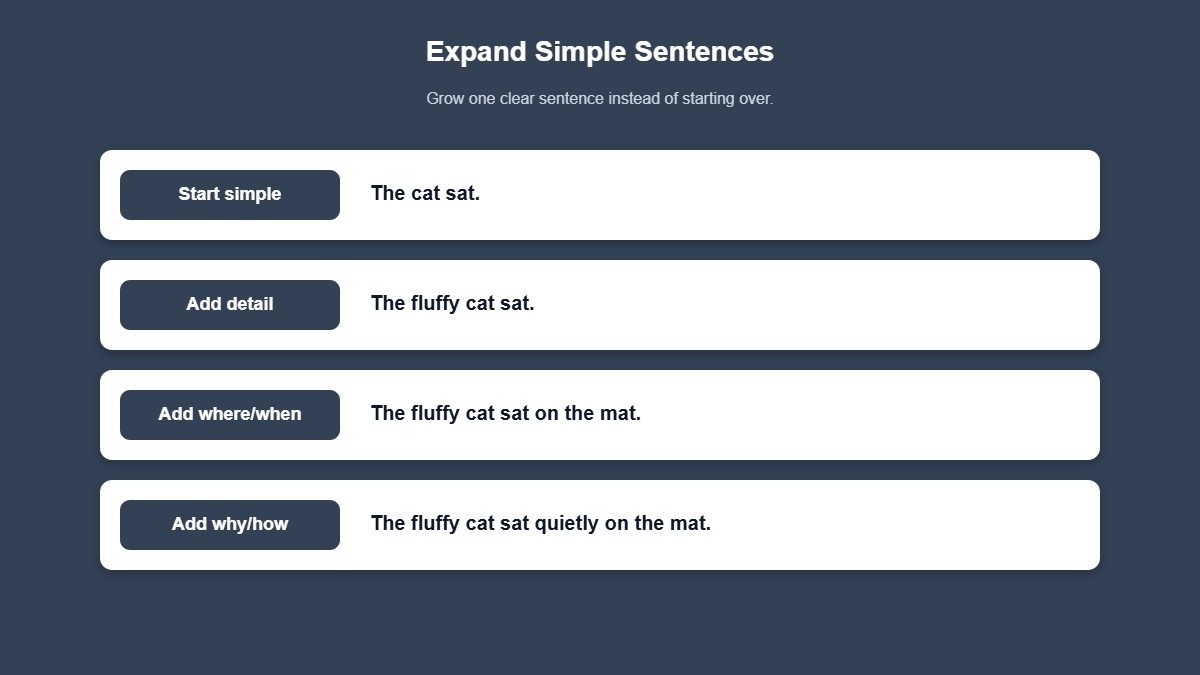
Once short sentences are accurate, teach children to add useful detail — not random extra words.
Take a base sentence: The dog ran.
Expand step by step:
- The brown dog ran.
- The brown dog ran quickly.
- The brown dog ran quickly across the field.
Ask guided questions: Which dog? How did it run? Where? When? Children answer orally first, then rewrite.
Show that expansion should still make sense. "The brown dog ran quickly across the field yesterday with a stick because happy" is overloaded. Prefer one or two clear additions at a time.
8. Combine Sentences
Combining helps writing sound smoother and prepares children for longer text.
Start with two related short sentences:
- Mia packed her bag. Mia walked to school.
- Combined: Mia packed her bag and walked to school.
Teach simple linking words: and, but, so, because. Model choosing the link that fits the meaning.
Weak combine: Mia packed her bag and she walked to school and she saw a bird and she was late.
Improved: Mia packed her bag and walked to school, but she was late.
Keep early combining to two sentences. Longer chains come later with more how to teach grammar support.
9. Move Toward Independent Sentence Writing
Independence grows when support is removed gradually.
A useful sequence:
- Copy a correct model sentence
- Finish a starter or frame
- Write from a picture with word bank support
- Write from a picture without a word bank
- Answer a question in a full sentence
- Write two or three related sentences on one topic
Give a clear expectation: "Write two sentences about the park. Each one needs a capital, spaces, and an end mark." Specific goals beat "Write something nice."
Short daily practice beats rare long tasks. Three careful sentences teach more than a rushed page.
Printable: Independent Sentences
Stretch into school-day and because sentences with less scaffolding.


10. Teach Checking and Editing
Children should expect to reread their sentences, not treat the first try as finished.
A simple checklist:
- Does it make sense?
- Capital at the start?
- Spaces between words?
- End mark?
- Does it say who/what and what happens?
Teach them to point under each word as they read aloud. Hearing the sentence often reveals a missing word or a fragment.
Peer check can work with a partner reading the sentence to the writer. Keep feedback kind and specific: "You need an end mark," not "This is wrong."
Weak Sentences vs Improved Examples
Showing contrast teaches faster than rules alone.
Weak: went park
Improved: We went to the park.
Weak: i like pizza it is cheese
Improved: I like pizza. It has cheese.
Weak: The dog.
Improved: The dog barked at the gate.
Weak: My mum cooked dinner it was nice we ate it fast
Improved: My mum cooked dinner. It was nice, so we ate it quickly.
Weak: The thing was good.
Improved: The story was exciting.
Ask: What was missing — a capital, an end mark, a complete idea, or clearer words? Then have children rewrite one weak example themselves.
11. Help Writers Who Get Stuck
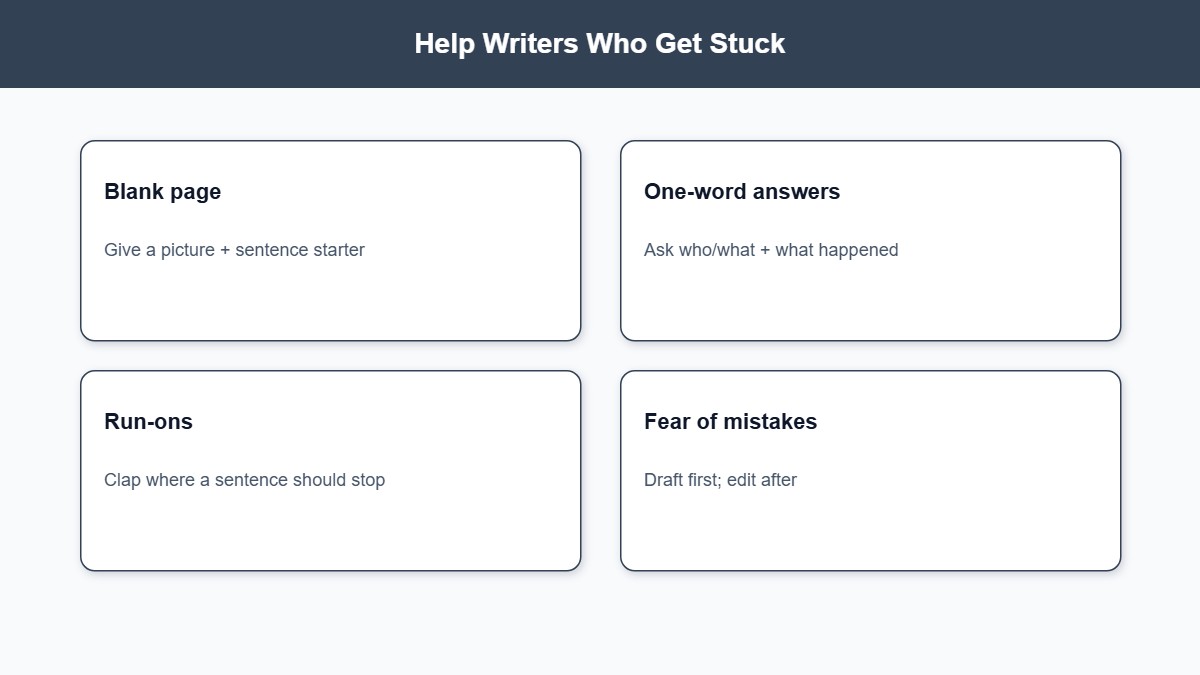
Stuck writers often know more than they can get onto the page. Lower the demand, then build back up.
Try:
- Talk first: "Tell me your sentence out loud" — then help them write what they said
- Give a picture and three useful words
- Offer a starter and let them finish only the ending
- Scribe the first sentence for them, then ask them to write the second
- Allow drawing, then one sentence under the picture
If the block is physical effort, check how to teach handwriting and shorten the writing demand. If the block is "I don't know what to say," build oral sentences before pencil work. If spelling fear freezes them, allow approximate spelling for content words while you keep capitals, spaces, and end marks non-negotiable.
Praise a complete, correct short sentence more than a long messy one.
12. How to Increase Difficulty
Raise challenge only when basics are steady:
- Longer sentences with one clear detail
- Questions and exclamations as well as statements
- Two linked sentences on the same topic
- Combining with and / but / so / because
- Writing without starters or word banks
- Replacing vague words (thing, nice, went) with clearer choices
- Writing answers in full sentences instead of one-word replies
If capitals, spaces, or completeness slip, return to shorter sentences before pushing variety.
A Simple Sentence Writing Lesson
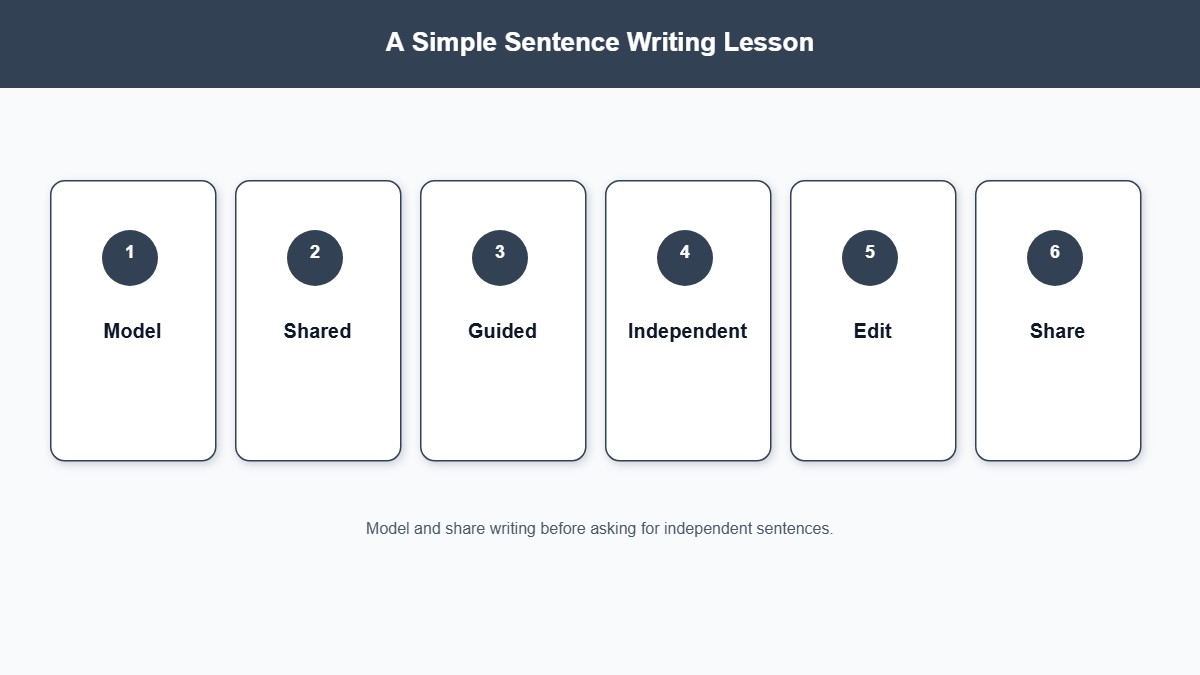
A short lesson can follow this structure:
- Warm-up — Read two sentences aloud; children spot capital and end mark.
- Model — Think aloud while writing one strong sentence from a picture.
- Shared write — Build a second sentence together (subject + predicate + one detail).
- Guided practice — Children write one sentence with a starter or word bank.
- Independent practice — Write one or two sentences; use the checklist.
- Share — Read one improved sentence; note what made it clearer.
Adapt timing for age. Beginners may need more shared writing; confident writers can spend longer on expanding and combining. Plan fuller sessions with English lesson plans.
Printable: Extra Sentence Practice
Use a follow-up sentence-building sheet after the main lesson.

Sentence Writing at Home
Home practice works best when it is short and real.
Ideas:
- Write one sentence about the day at dinner time
- Label a drawing with a full sentence
- Reply to a family question in a complete sentence
- Rewrite a weak fridge note into a proper sentence
- Keep a mini book: one sentence and one picture per page
Parents can ask: "Does it start with a capital? Can I hear spaces when you read it? Does it sound finished?" Avoid rewriting the child's whole sentence for them — help them fix one thing at a time.
How to Teach Sentence Writing Step by Step
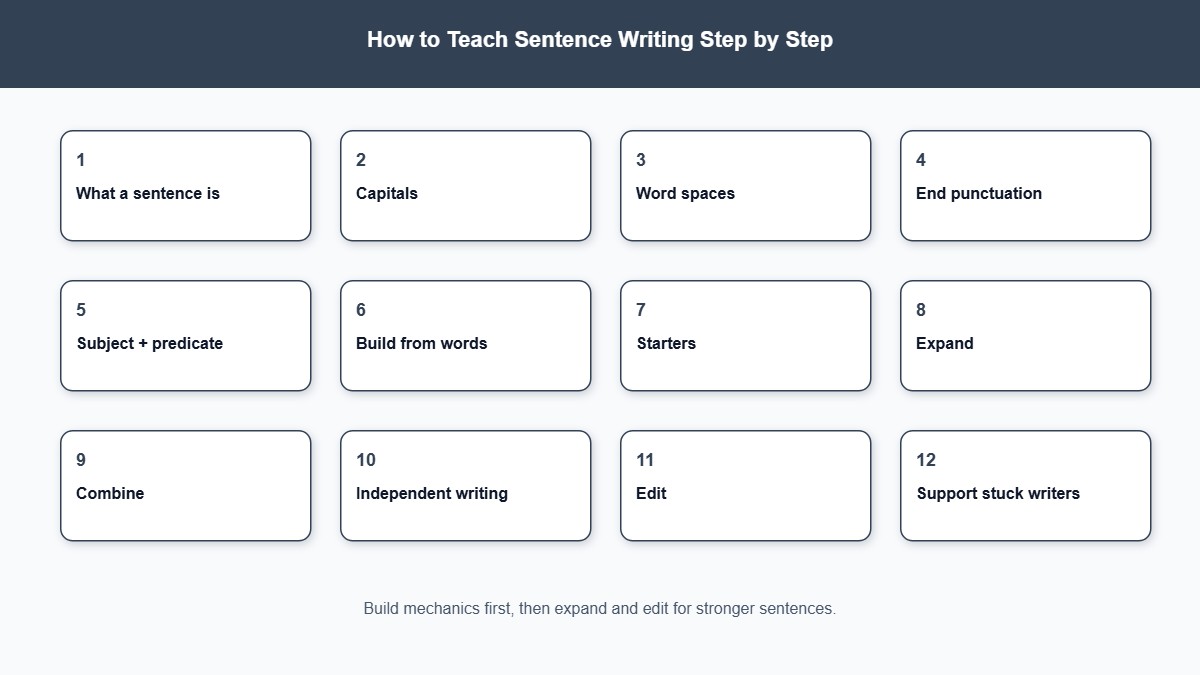
A practical progression looks like this:
- Hear and recognise complete sentences versus fragments.
- Copy short model sentences with capitals, spaces, and end marks.
- Build sentences from word cards or frames.
- Write simple subject + predicate sentences from pictures.
- Use starters to write independently.
- Add one detail (describe, where, when, how).
- Write questions and exclamations as well as statements.
- Combine two short sentences with a linking word.
- Edit with a checklist; compare weak and improved examples.
- Write two or three related sentences without heavy support.
Stay on each step until accuracy is reliable. Speed and length come after clarity.
Final Thoughts
Teaching sentence writing well means teaching a complete thought on the page: a capital start, spaced words, a clear who/what and what happens, and an end mark. Starters, picture prompts, and building games make practice manageable; expanding and combining come once the basics hold.
Use weak-versus-improved examples often, keep editing simple, and help stuck writers talk before they write. When short sentences are strong, children are ready for the wider skills in how to teach writing — paragraphs, planning, and longer independent pieces — without leaving sentence craft behind.
Clear models, short daily practice, and kind, specific feedback matter more than racing into complicated structures.
Frequently Asked Questions
Common questions answered for downloading and using our premium printable designs.




Comments (0)
Leave a Reply
Be the first to leave a comment!