
How to Teach Writing
A step-by-step guide to teaching writing: handwriting, letter formation, spelling, sentences, paragraphs, planning, editing, and independent writing practice.
 Amanda Williams
Learning to write is a gradual process. Before students can write paragraphs and essays, they need to develop smaller skills such as holding a pencil, forming letters, spelling words, constructing sentences, and expressing ideas clearly.
Table of Contents
- What Does Someone Need to Learn to Write?
- 1. Start With Handwriting Skills
- Printable: Handwriting Practice
- 2. Teach Letter Formation
- Printable: More Letter Formation
- 3. Teach Uppercase and Lowercase Letters
- 4. Connect Writing With Phonics
- 5. Start With Simple Words
- Printable: Write Simple Words
- 6. Teach Spelling Gradually
- 7. Teach Word Spacing
- 8. Start With Simple Sentences
- Printable: Sentence Writing Prompts
- 9. Teach Capital Letters
- 10. Teach Punctuation
- 11. Use Sentence-Building Activities
- Printable: Sentence Building
- 12. Teach Different Types of Sentences
- Printable: Sentence Types
- 13. Give Students Something to Write About
- Printable: Writing Prompts
- 14. Use Pictures as Writing Prompts
- 15. Teach Students How to Build a Paragraph
- 16. Teach Planning Before Writing
- 17. Model Writing for Students
- 18. Write Together
- 19. Let Students Write Independently
- 20. Teach Students How to Edit
- 21. Teach Students to Improve Their Writing
- 22. Build Vocabulary
- 23. Encourage Reading
- 24. Give Specific Feedback
- 25. Don't Correct Everything at Once
- 26. Make Writing Relevant
- 27. Practise Writing Regularly
- More Printable Writing Practice
- A Simple Writing Lesson Structure
- How to Teach Writing Step by Step
- How to Teach a Child to Write at Home
- How to Help a Student Who Struggles With Writing
- How Long Does It Take to Learn to Write?
- Final Thoughts
Teaching writing therefore involves much more than asking students to "write something." Learners need to be shown how writing works, given opportunities to practise individual skills, and supported as they gradually become more independent writers.
Whether you are teaching a young child who is learning to write letters or an older student who needs help writing paragraphs and essays, the basic approach is similar: teach one skill at a time, model good writing, practise together, and gradually give the learner more independence. This guide pairs well with how to teach handwriting, sentence writing, how to teach spelling, and how to teach grammar.
What Does Someone Need to Learn to Write?
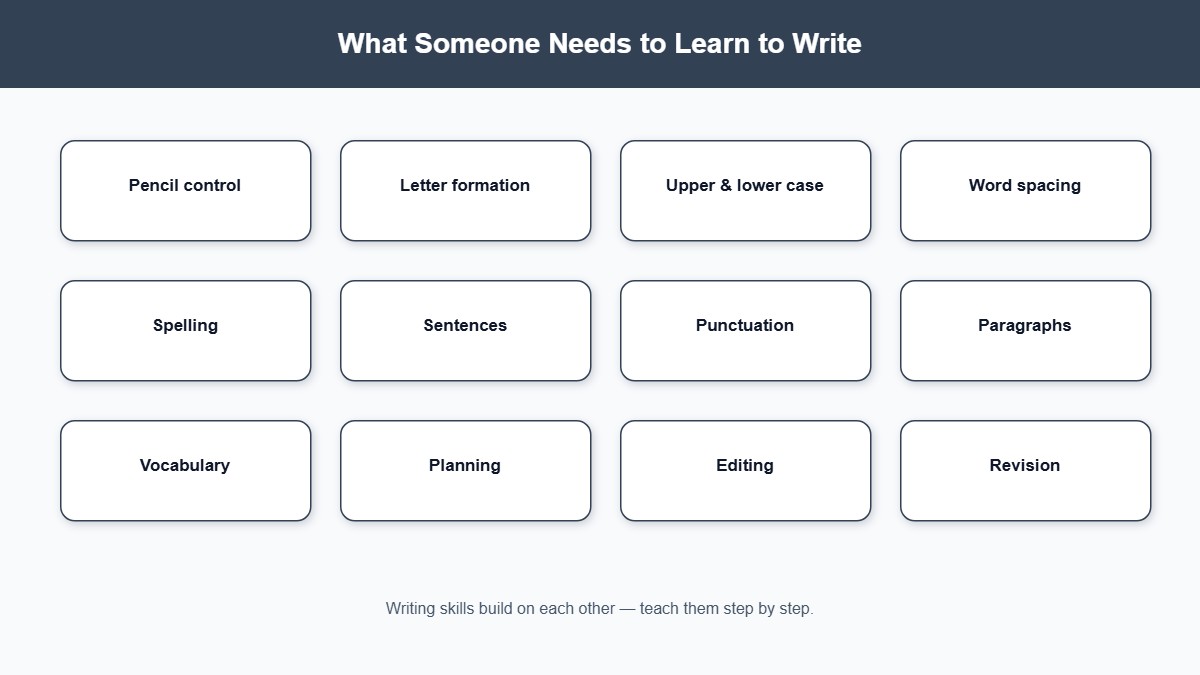
Writing involves several different skills that develop over time. Depending on the learner's age and ability, they may need to learn how to:
- Hold and control a pencil
- Form letters correctly
- Write uppercase and lowercase letters
- Leave spaces between words
- Spell words
- Write sentences
- Use punctuation
- Organise ideas
- Build paragraphs
- Choose appropriate vocabulary
- Write for different purposes
- Edit their work
- Improve their writing
Young learners will generally begin with handwriting and simple words, while older students can work on paragraphs, essays, reports, stories, and other forms of writing. Browse writing worksheets for printable practice at each stage.
1. Start With Handwriting Skills
For beginners, writing starts with being able to physically form letters and control a writing tool.
Give learners opportunities to practise lines, curves, shapes, and basic letter formations before expecting them to write long sentences.
Start with simple activities such as drawing lines, tracing shapes, drawing circles, tracing letters, copying letters, writing their name, and writing simple words.
The aim is to help the learner become comfortable with the physical process of writing. See how to teach handwriting and handwriting worksheets for structured practice.
Printable: Handwriting Practice
Trace letters, practise your name, and build early pencil control with these handwriting sheets.


2. Teach Letter Formation
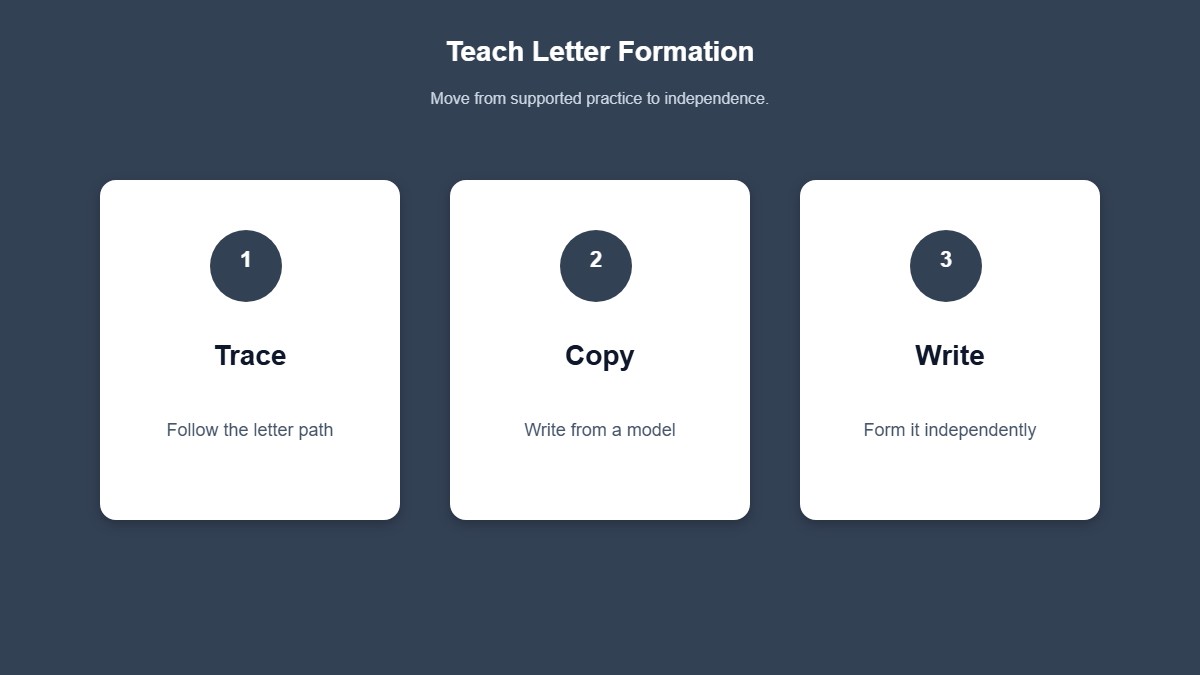
Show learners how to form letters correctly.
For example, when teaching the letter a, demonstrate where to start, which direction to move, and how to complete the letter.
Let the learner watch you write it before asking them to try.
You can use: Trace → Copy → Write independently.
This gives learners a gradual transition from supported practice to independent writing.
Printable: More Letter Formation
Continue letter practice across the alphabet.


3. Teach Uppercase and Lowercase Letters
Students need to recognise and write both uppercase and lowercase letters.
For example: A a, B b, C c.
Teach students where each form is normally used.
Explain that uppercase letters are commonly used at the beginning of sentences and for proper nouns, while lowercase letters are used for most other letters within words.
4. Connect Writing With Phonics
Writing and phonics work closely together.
When learners know the sounds represented by letters, they can begin using those sounds to write words.
For example: /c/ /a/ /t/ can be written as cat.
Ask learners to listen carefully to the sounds in a word and identify which letters represent those sounds.
This helps connect what they hear with what they write. Pair this with how to teach phonics and how to teach someone to read for stronger early literacy.
5. Start With Simple Words
Once learners know some letter sounds, begin with simple words.
CVC words are useful for early writing practice. Examples include: cat, dog, sun, map, pen, sit, bed, hat.
You can say a word and ask the learner to identify the sounds and write the corresponding letters.
Gradually introduce more complex words as the learner develops their spelling skills.
Printable: Write Simple Words
Practise writing CVC and high-frequency words on handwriting lines.


6. Teach Spelling Gradually
Spelling develops over time.
Rather than expecting learners to memorise large lists of words, teach spelling patterns and allow them to practise using the patterns in different words.
For example, once students understand the -at pattern, they can practise: cat, bat, hat, mat, sat.
Later, introduce more complicated patterns such as digraphs, vowel teams, and word endings. See how to teach spelling and spelling worksheets for pattern-based practice.
7. Teach Word Spacing
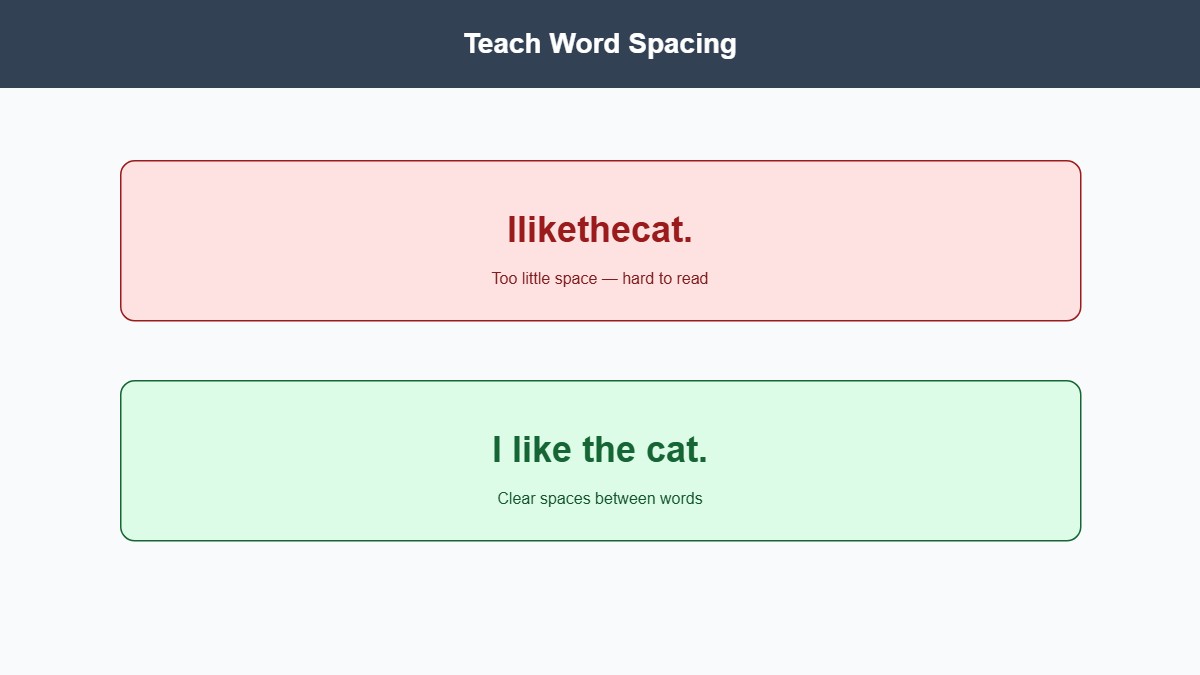
Young writers often need to learn that words need spaces between them.
For example: Ilikethecat. needs to become: I like the cat.
You can use simple activities where learners copy sentences and deliberately practise leaving spaces between each word.
A finger, spacing tool, or visual prompt can also help younger learners understand how much space to leave.
8. Start With Simple Sentences
Once learners can write words, teach them to combine those words into sentences.
Start with simple sentence structures. For example: The dog runs.
Then gradually introduce longer sentences: The brown dog runs in the garden.
Focus on making sure the learner understands that a sentence communicates a complete idea. Continue with sentence writing and sentence writing worksheets.
Printable: Sentence Writing Prompts
Give beginners a clear starting point for short sentences.


9. Teach Capital Letters
Students need to know when to use capital letters.
Begin with the most important rules. Teach learners to use a capital letter at the beginning of a sentence, for people's names, for places, for countries, for days and months, and for other proper nouns.
For example: sam lives in durban. should become: Sam lives in Durban.
Give students plenty of opportunities to identify and correct missing capital letters.
10. Teach Punctuation
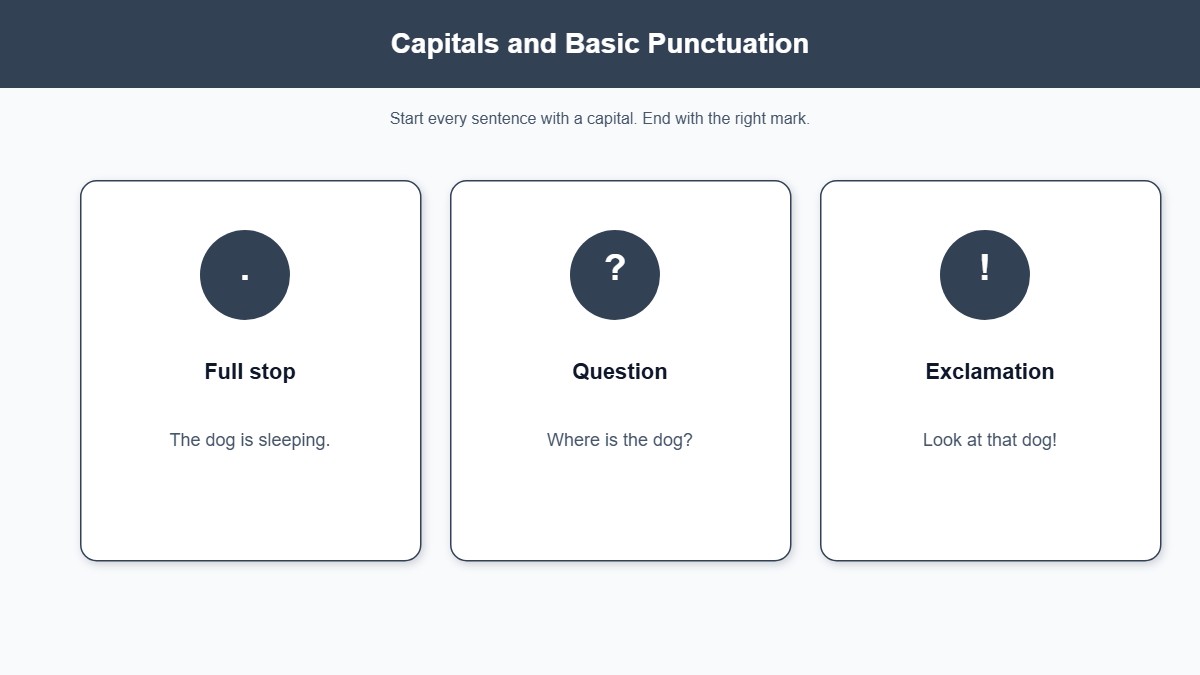
Punctuation helps readers understand writing.
Start with basic punctuation marks: full stop (.), question mark (?), and exclamation mark (!).
Teach students what each one does. For example: The dog is sleeping. Where is the dog? Look at that dog!
Once students understand these basic marks, introduce commas, quotation marks, apostrophes, and other punctuation as appropriate for their level. Related practice is available in grammar worksheets.
11. Use Sentence-Building Activities
Sentence-building activities can help students understand how words work together.
Give learners a group of words and ask them to arrange them into a sentence.
For example: school / goes / Sarah / to becomes: Sarah goes to school.
You can gradually make the activity more difficult by adding adjectives, adverbs, conjunctions, and other sentence elements.
Printable: Sentence Building
Arrange words into complete sentences and build confidence with sentence structure.


12. Teach Different Types of Sentences
As students become more confident, introduce different sentence structures.
They should learn to recognise and use statements, questions, commands, and exclamations.
Later, introduce simple sentences, compound sentences, and complex sentences.
This gives students more ways to express their ideas. See how to teach grammar for deeper sentence and grammar support.
Printable: Sentence Types
Practise recognising statements, questions, commands, and exclamations.

13. Give Students Something to Write About
One of the biggest challenges for young writers is simply not knowing what to write.
Give students clear topics and prompts. For example: "Write about your favourite animal." "Describe your classroom." "What did you do during the weekend?" "Write a story about a character who finds something unusual."
A specific prompt gives the learner somewhere to start.
Printable: Writing Prompts
Ready-to-use prompts for independent writing practice.


14. Use Pictures as Writing Prompts
Pictures can be useful writing prompts, especially for younger learners.
Show students a picture and ask questions such as: What can you see? Who is in the picture? Where are they? What are they doing? What happened before this? What might happen next?
Students can then use their answers to create sentences or a short story.
15. Teach Students How to Build a Paragraph
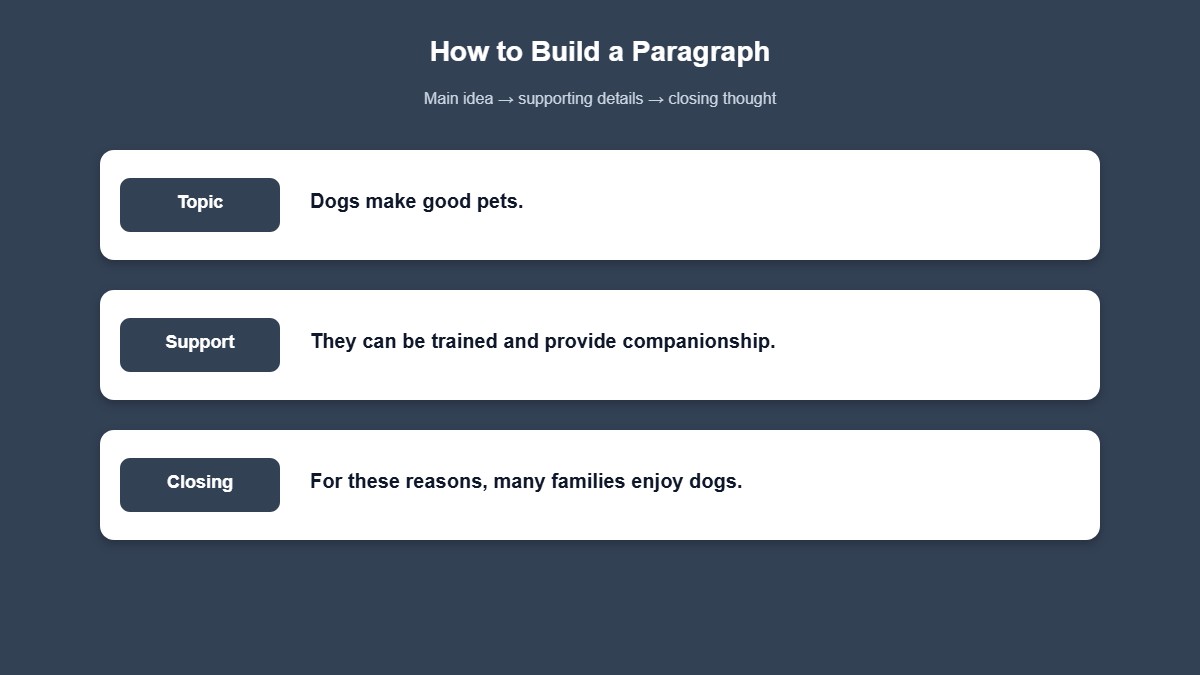
Older learners need to understand that a paragraph is more than several unrelated sentences.
Teach students to start with a main idea and then add information that supports or explains it.
For example:
- Topic sentence: Dogs make good pets.
- Supporting sentences: They can be trained to follow commands. They can also provide companionship and enjoy spending time with people.
- Closing sentence: For these reasons, many families enjoy having dogs as pets.
Start with short paragraphs and gradually increase their complexity.
16. Teach Planning Before Writing
Students do not always need to start writing immediately.
Teach them to think about what they want to say before they begin.
Simple planning methods include lists, mind maps, spider diagrams, question prompts, storyboards, and outlines.
For example, before writing about a holiday, students could make a list of: Where I went → Who I went with → What I did → What I enjoyed → How I felt.
They can then turn those ideas into sentences and paragraphs.
17. Model Writing for Students
One of the best ways to teach writing is to show students how you do it.
Write an example in front of them and explain your thinking.
For example: "I want to start my paragraph with the main idea, so I am going to write..."
Then demonstrate how you choose words, construct sentences, and correct mistakes.
This allows students to see the writing process rather than only seeing the finished product. A classroom posters visual of the writing process can reinforce the steps.
18. Write Together
After modelling writing, allow students to help create a piece of writing with you.
Ask questions such as: "What should we write next?" "Which word would describe this?" "How should we start the sentence?" "What punctuation do we need?"
This gives students guided practice before they are expected to write independently.
19. Let Students Write Independently
Once students have had enough guided practice, give them opportunities to write independently.
The task should match their ability. A beginner might write: "I like dogs." A more advanced student might write several paragraphs explaining why dogs make good pets.
Independent writing allows you to see what the student can actually do without assistance.
20. Teach Students How to Edit
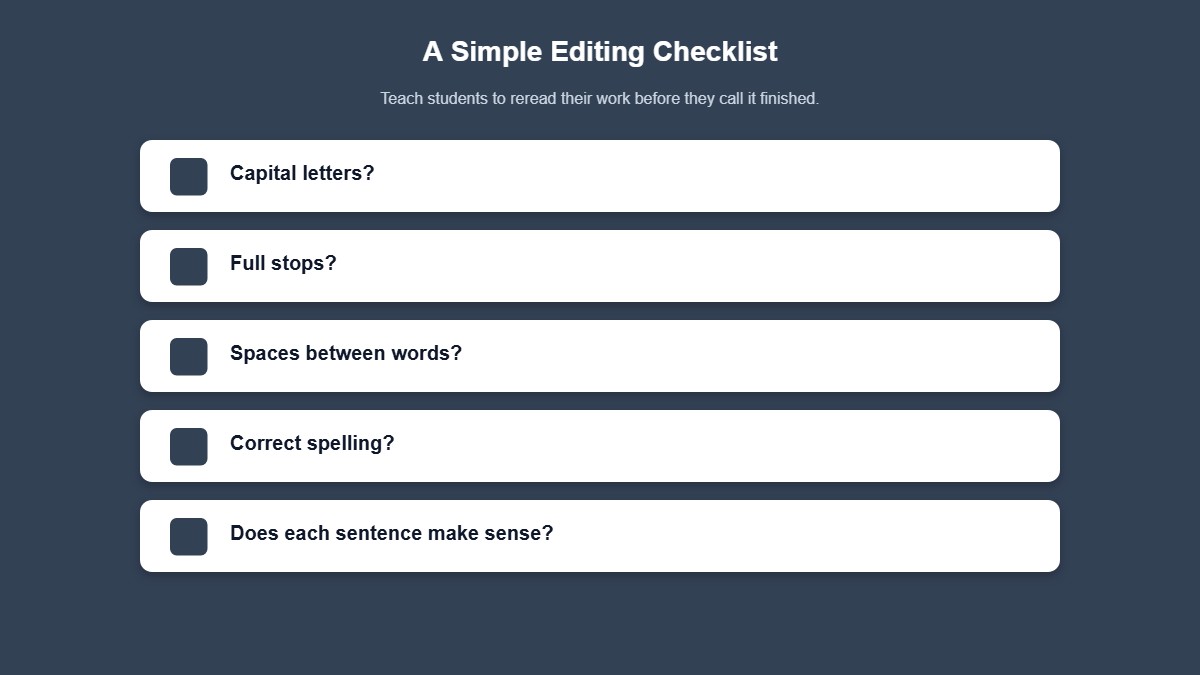
Writing does not necessarily become finished when the last sentence is written.
Teach students to read their work again and look for mistakes.
A simple editing checklist could include: Capital letters? Full stops? Spaces between words? Correct spelling? Does each sentence make sense?
Older students can use more detailed checklists covering grammar, paragraph structure, vocabulary, and clarity.
21. Teach Students to Improve Their Writing
Editing and improving are not exactly the same thing.
Editing often focuses on correcting mistakes, while revising involves making the writing better.
Ask students: Can I make this sentence clearer? Can I replace a repeated word? Can I add more detail? Can I remove unnecessary information? Can I improve the beginning? Can I make the ending stronger?
This helps students understand that good writing often develops through multiple drafts.
22. Build Vocabulary
Students need vocabulary to express their ideas.
Reading is one of the best ways to expose students to new words, but teachers can also deliberately introduce vocabulary related to the writing topic.
For example, if students are writing about weather, they could learn words such as: storm, cloudy, temperature, windy, humid, rainfall.
Encourage students to use new vocabulary in their own sentences. See how to teach vocabulary for classroom strategies.
23. Encourage Reading
Reading and writing support each other.
Students who regularly read different types of texts are exposed to vocabulary, sentence structures, punctuation, and different ways of organising ideas.
Read stories, articles, poems, informational texts, and other age-appropriate material with students.
Discuss how the author has written the text and ask students to notice interesting words or sentences. Connecting writing with how to teach someone to read strengthens both skills.
24. Give Specific Feedback
Students need to know what they are doing well and what they should work on next.
Instead of simply writing "Good," give specific feedback.
For example: "Your opening sentence clearly introduces the topic. Next, try adding more detail to your second paragraph."
Specific feedback gives students something they can actually use to improve their writing.
25. Don't Correct Everything at Once
When a learner is still developing basic writing skills, correcting every single mistake can become overwhelming.
Choose the most important skills to focus on.
For a beginner, you might focus on capital letters, spaces, and full stops. Later, you can focus on spelling, sentence structure, and vocabulary. Eventually, move to paragraph organisation, grammar, style, and clarity.
This allows students to improve progressively.
26. Make Writing Relevant
Writing becomes more meaningful when students have a reason to write.
Give them opportunities to write stories, letters, descriptions, lists, instructions, reports, reviews, poems, personal reflections, and essays.
Different types of writing teach students that writing is used for different purposes.
27. Practise Writing Regularly
Students need regular opportunities to write.
Writing does not have to mean completing a long essay every time.
A short daily writing activity could involve writing three sentences, describing a picture, answering a question, completing a story, writing a short journal entry, or summarising something they read.
Short, regular practice can help students become more comfortable with writing. Use writing worksheets and sentence writing worksheets for quick, focused tasks.
More Printable Writing Practice
Extra prompts, sentence sheets, and a writing-process poster for regular practice.


A Simple Writing Lesson Structure
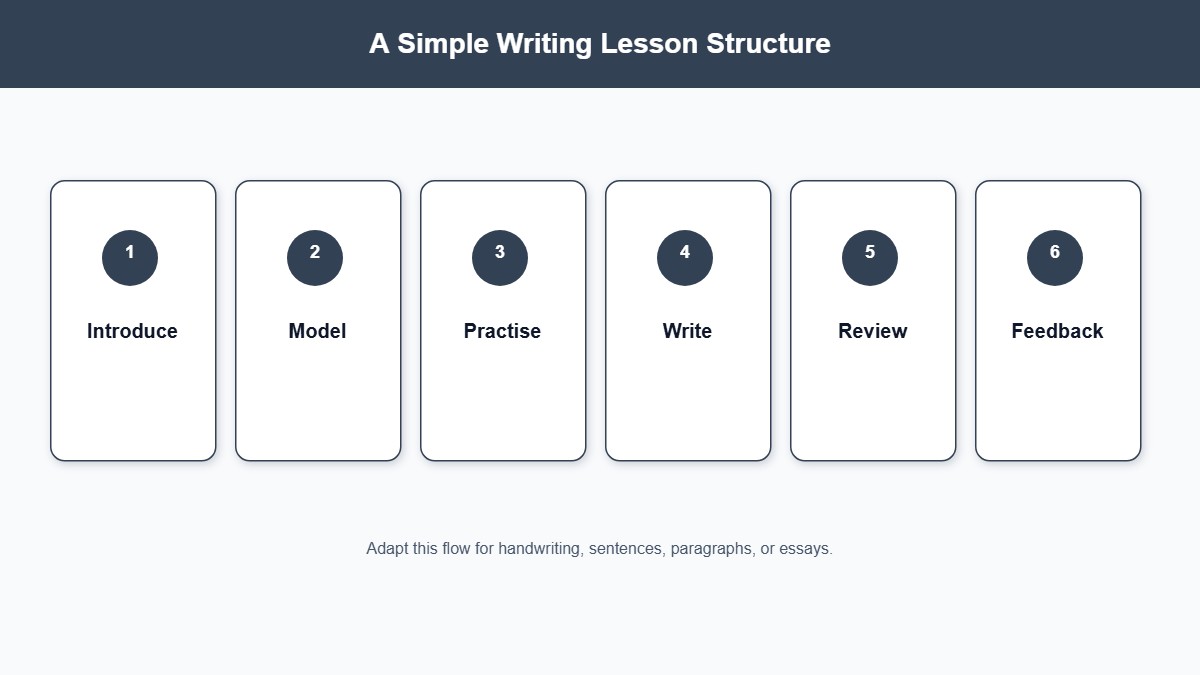
A writing lesson can follow a straightforward sequence:
- Introduce the skill — Explain what students are going to learn.
- Model — Show students an example and demonstrate how to complete the task.
- Practise together — Work through an example as a class or with a small group.
- Independent writing — Allow students to complete their own writing.
- Review — Ask students to read their work and identify areas that need improvement.
- Feedback — Provide specific feedback and help students understand what they can improve next time.
This structure can be adapted for handwriting, sentence writing, creative writing, paragraphs, and essays. More classroom ideas live in our teaching strategies guides and English lesson plans.
How to Teach Writing Step by Step
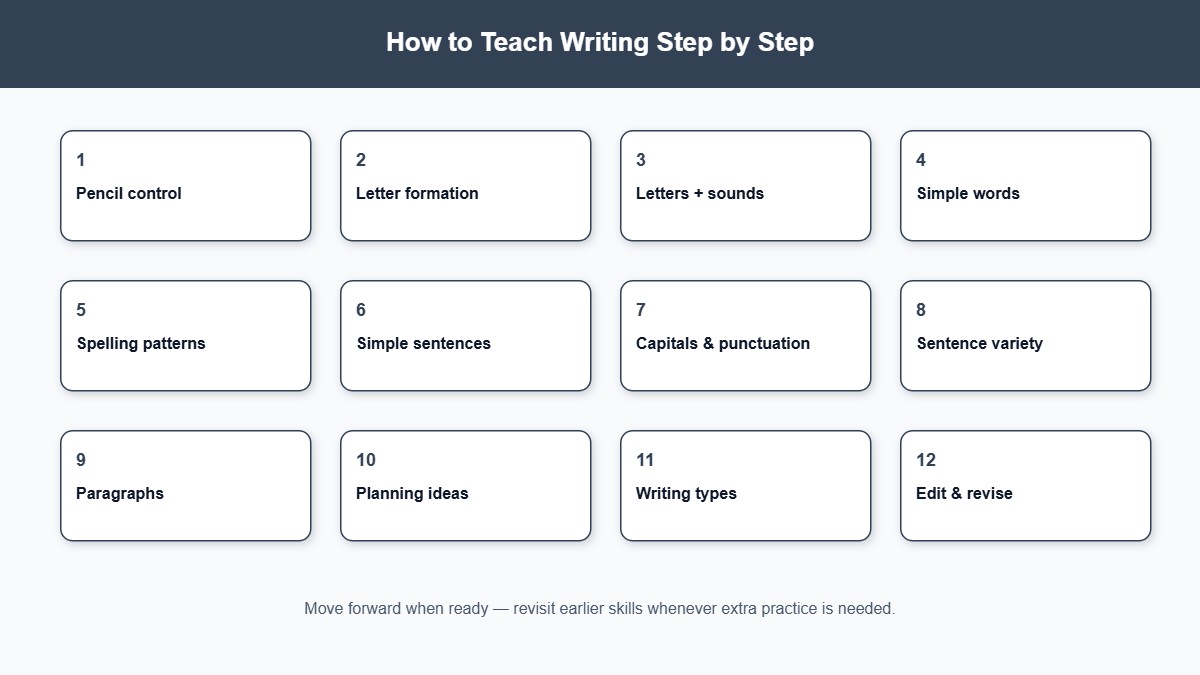
For a beginner, you can think of writing development as a gradual progression:
- Develop pencil control and handwriting skills.
- Teach letter formation.
- Connect letters with sounds.
- Practise writing simple words.
- Teach spelling patterns.
- Build simple sentences.
- Teach capital letters and punctuation.
- Introduce sentence variety.
- Teach paragraph structure.
- Teach planning and organising ideas.
- Introduce different types of writing.
- Teach editing and revision.
The progression will vary depending on the learner. Some students may need to spend more time developing handwriting and spelling, while others may quickly move into sentence and paragraph writing.
How to Teach a Child to Write at Home
Parents can support writing development through simple everyday activities.
Encourage children to write shopping lists, labels, short notes, stories, birthday messages, and descriptions of pictures.
You can also read a story together and ask the child to write a sentence about a character or draw a picture and describe it in writing.
Keep activities appropriate for the child's current ability. A beginner should not be expected to write a full page when they are still learning how to form letters and simple words.
How to Help a Student Who Struggles With Writing
If a student is struggling with writing, identify the specific skill causing the difficulty.
For example, the problem might be handwriting, spelling, letter sounds, vocabulary, sentence construction, organising ideas, grammar, confidence, or understanding the writing task.
Once you identify the problem, break the task into smaller steps.
Instead of asking a student to "write a paragraph about animals," you could first ask them to list three animals, choose one, and write three facts about it. Those facts can then be developed into sentences and eventually a paragraph.
Breaking writing into manageable stages can make the task much easier.
How Long Does It Take to Learn to Write?
There is no fixed amount of time required to learn to write.
Writing development depends on the learner's age, language skills, handwriting ability, reading ability, spelling knowledge, and previous instruction.
Young children may spend a long period developing basic handwriting and sentence skills, while older learners may already have these skills and instead need help with essays, grammar, or organising ideas.
Regular practice and appropriate instruction are more important than trying to follow a specific timetable.
Final Thoughts
Teaching writing is a gradual process. Start with the skills the learner needs most and build from there.
Young learners may begin with pencil control, letters, sounds, and simple words. As they develop, they can move into sentences, punctuation, paragraphs, and different forms of writing. Older students can continue developing their vocabulary, organisation, grammar, editing, and ability to communicate complex ideas.
The most important thing is to give students clear examples, guided practice, and regular opportunities to write independently. Encourage them to improve their work rather than expecting the first version to be perfect.
Frequently Asked Questions
Common questions answered for downloading and using our premium printable designs.





Comments (0)
Leave a Reply
Be the first to leave a comment!