
How to Teach Vocabulary
Practical strategies for teaching vocabulary: choose useful words, teach in context, use examples, games, reading, writing, and regular review.
 Amanda Williams
Teaching vocabulary is an important part of helping students become stronger readers, writers, speakers, and listeners. Knowing more words allows students to understand what they read, express their ideas more clearly, and communicate with greater confidence.
However, simply giving students a list of words to memorise is not always enough. Students need opportunities to hear new words, understand their meanings, see how the words are used, and practise using them themselves.
Whether you are teaching young children, primary school students, or high school learners, vocabulary can be taught through direct instruction, reading, discussion, games, writing activities, and regular review. It also connects closely with how to teach phonics, how to teach sight words, reading comprehension, how to teach writing, and how to teach spelling.
What Is Vocabulary?
Vocabulary is the collection of words a person knows and understands. It includes words that students can recognise when they hear or read them as well as words they can use when speaking and writing.
Students develop vocabulary naturally through conversations, reading, classroom instruction, and everyday experiences. Teachers can support this development by deliberately introducing new words and giving students repeated opportunities to use them.
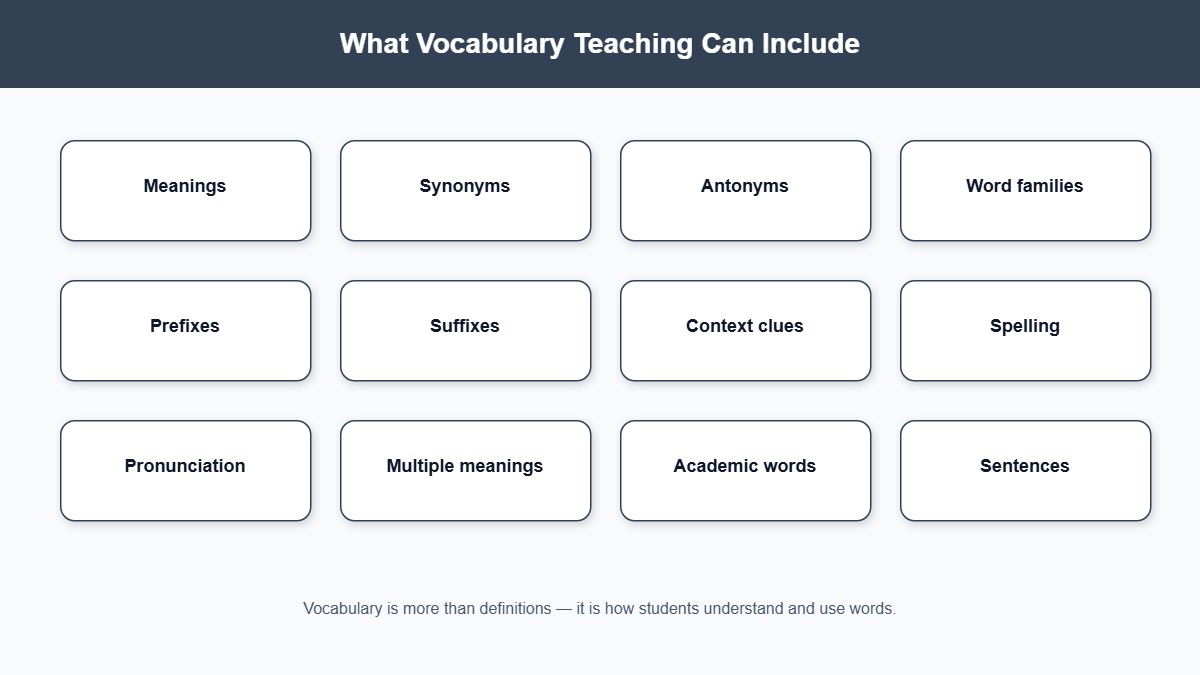
Vocabulary teaching can include:
- Word meanings
- Synonyms and antonyms
- Word families
- Prefixes and suffixes
- Context clues
- Spelling
- Pronunciation
- Multiple meanings
- Academic vocabulary
- Subject-specific vocabulary
- Using words in sentences
Why Is Vocabulary Important?
Vocabulary affects how well students understand language.
A student who knows the meaning of the words in a text is more likely to understand what they are reading. Vocabulary also helps students communicate their own ideas and write more effectively—skills that support reading comprehension and how to teach writing.
For this reason, vocabulary should not only be taught as a list of definitions. Students should learn how words work in different contexts and have opportunities to use them.
1. Choose the Right Words
You cannot teach every unfamiliar word that students encounter.
Choose words that are useful, important to the lesson, or likely to appear again in students' reading and writing.
For example, if students are learning about weather, you might introduce words such as:
- Temperature
- Forecast
- Climate
- Humidity
- Precipitation
- Storm
- Drought
The words should match the students' age and current level of understanding. For early English learners, see also teaching English to beginners.
2. Introduce Words in Context
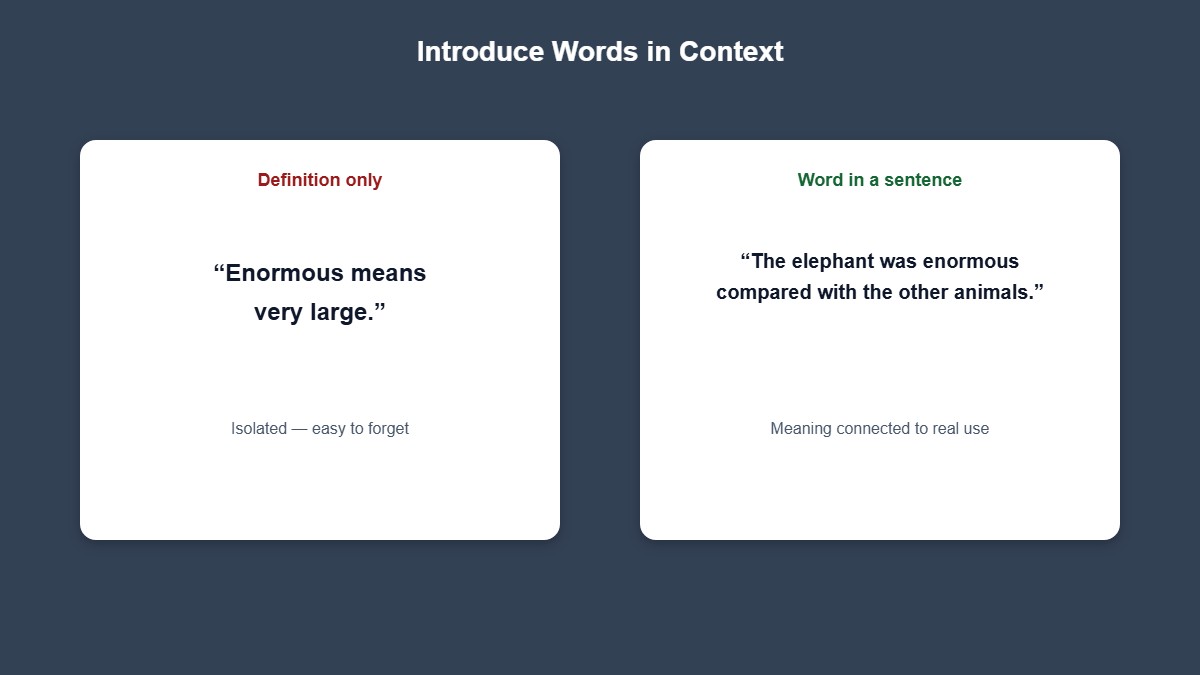
One of the most effective ways to introduce vocabulary is to show students how a word is used.
Instead of only saying "Enormous means very large," give students a sentence: "The elephant was enormous compared with the other animals."
Then discuss what the word means in that sentence.
Context helps students understand that vocabulary is connected to real communication rather than being a collection of isolated definitions.
3. Explain the Meaning Clearly
When introducing a new word, give students a simple explanation that they can understand.
You can also provide:
- A definition
- An example
- A non-example
- A picture
- A synonym
- A sentence
- A demonstration
For younger students, visual examples can be particularly useful.
For example, when teaching the word fragile, you could explain that something fragile can easily break and show examples of objects that are fragile and objects that are not.
4. Use Examples and Non-Examples
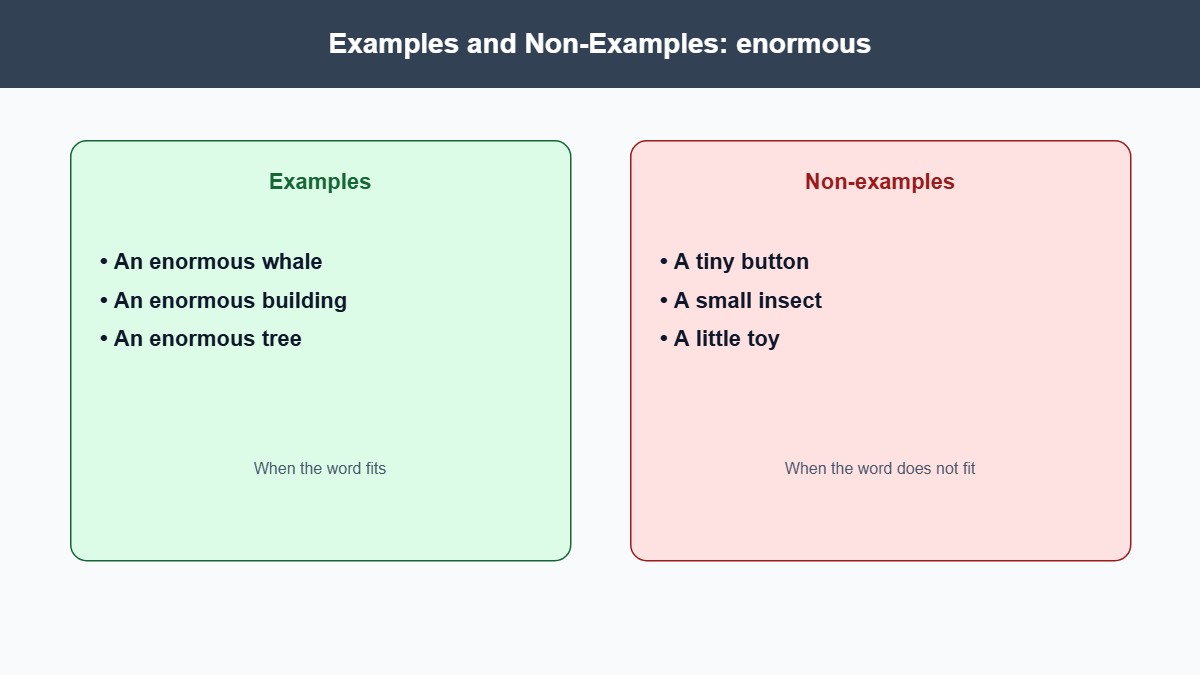
Examples show students when a word applies, while non-examples show when it does not.
Suppose you are teaching the word enormous.
You could give examples such as:
- An enormous whale
- An enormous building
- An enormous tree
Then compare them with:
- A tiny button
- A small insect
- A little toy
This helps students develop a clearer understanding of the word.
5. Use Pictures and Visual Resources
Pictures can make vocabulary easier to understand, particularly for younger learners and students who are learning English.
For concrete words, a picture can immediately connect the word with its meaning.
For example, when teaching animal vocabulary, students can see a picture of a lion, elephant, zebra, or giraffe while learning the words.
For abstract vocabulary, teachers can use diagrams, situations, examples, and short stories to help communicate the meaning. Classroom vocabulary worksheets and other English worksheets can support this when you want printable practice, but discussion and visuals matter first.
6. Teach Students How to Use Context Clues
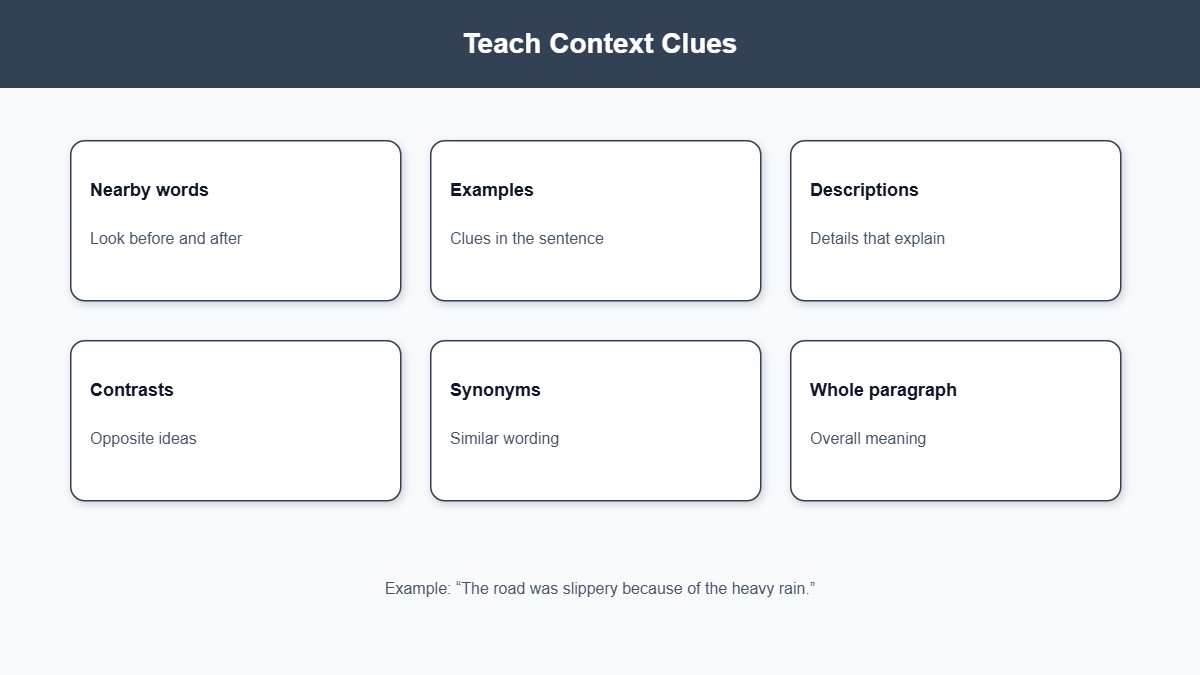
Students will encounter unfamiliar words throughout their education. They therefore need to learn how to work out possible meanings from the surrounding text—an important skill for reading comprehension.
Teach students to look at:
- The words before and after the unfamiliar word
- Examples in the sentence
- Descriptions
- Contrasting information
- Synonyms
- The overall meaning of the paragraph
For example: "The road was slippery because of the heavy rain."
Even if a student does not know exactly what slippery means, the surrounding information can help them work out that the road was difficult to walk or drive on safely.
Printable: Context Clues Practice
Read each sentence, work out the bold word’s meaning, and note the clue words that helped.

7. Teach Synonyms and Antonyms
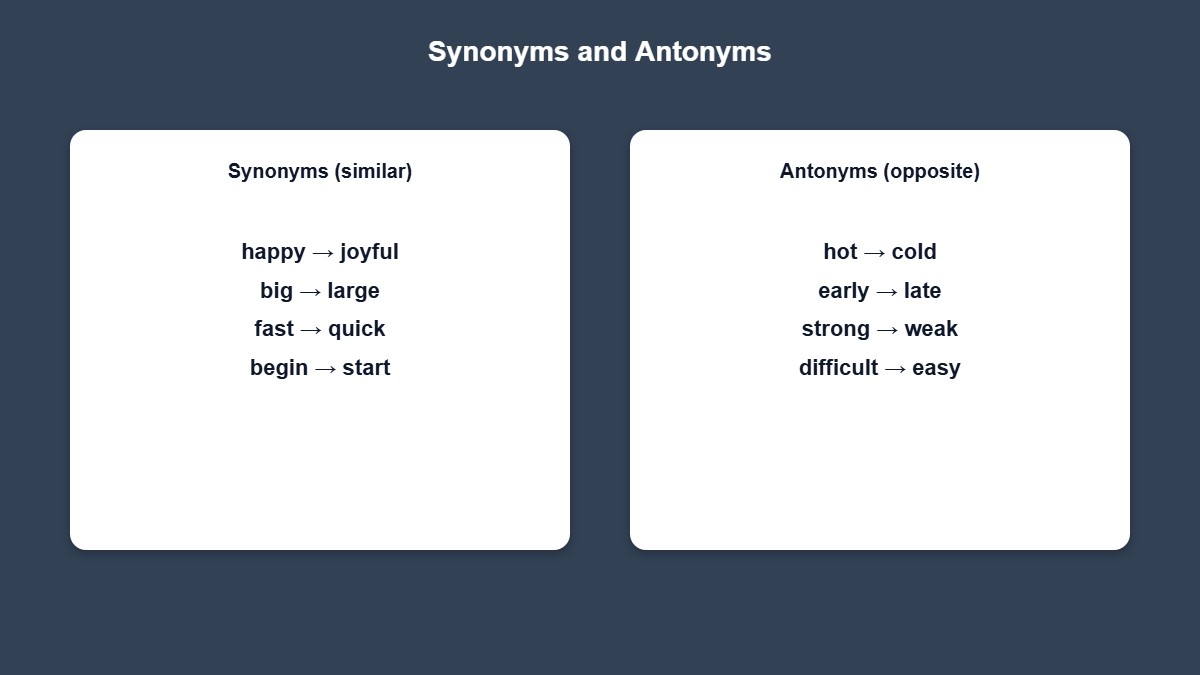
Synonyms and antonyms can help students develop stronger vocabulary.
A synonym is a word with a similar meaning. Examples: happy — joyful; big — large; fast — quick; begin — start.
An antonym is a word with an opposite meaning. Examples: hot — cold; early — late; strong — weak; difficult — easy.
Students can compare these words to understand how their meanings are related. This pairs well with how to teach grammar and how to teach writing lessons.
Printable: Synonyms and Antonyms
Match similar and opposite meanings using the word banks, then try the short writing challenge.

8. Teach Word Families
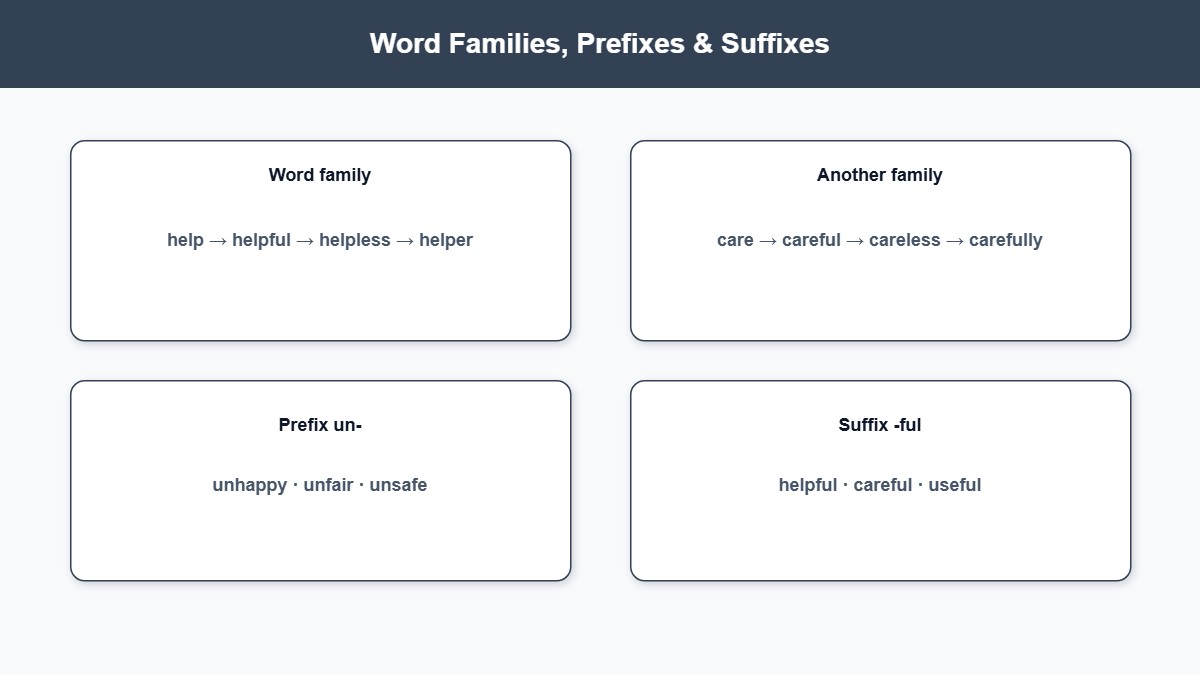
Word families help students see connections between words.
For example: help → helpful → helpless → helper
Or: care → careful → careless → carefully
Students can identify the root word and explore how prefixes and suffixes change its meaning or grammatical use.
This approach can help students build several related words rather than learning each word completely separately. It also supports how to teach spelling and how to teach phonics awareness.
Printable: Word Families
Build related words from a root, then write a sentence for each family.

9. Teach Prefixes and Suffixes
Prefixes and suffixes can give students useful clues about unfamiliar words.
For example, un- can indicate the opposite of something: unhappy, unfair, unsafe.
The suffix -ful can describe something that has a particular quality: helpful, careful, useful.
Teaching common prefixes and suffixes gives students another strategy for understanding unfamiliar vocabulary.
Printable: Prefixes and Suffixes
Split each word into prefix or suffix, base word, and meaning.

10. Get Students to Use New Words
Students need to use new vocabulary rather than simply recognise it.
After introducing a word, ask students to:
- Say the word
- Explain the meaning
- Use it in a sentence
- Draw a picture
- Find a synonym
- Find an antonym
- Use it in a question
- Write a short paragraph using the word
The more opportunities students have to use a word meaningfully, the more familiar it can become. sentence writing practice is a natural next step.
Printable: Use New Words in Sentences
Explain five useful words in your own words, then write an original sentence for each.

11. Use Vocabulary Games
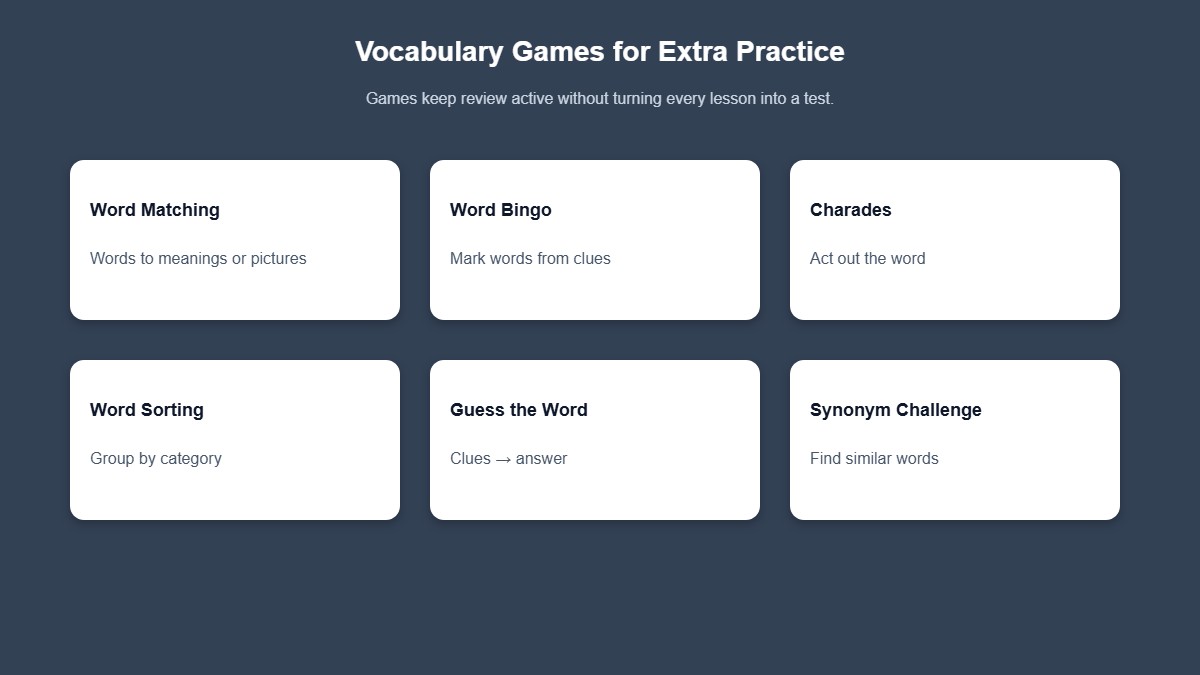
Vocabulary games can provide additional practice without making every activity feel like a test.
Some simple vocabulary games include:
Word Matching
Students match words with definitions, pictures, or examples.
Word Bingo
Students have vocabulary words on their cards and mark them when they hear the corresponding word or definition.
Charades
Students act out words while their classmates try to identify them.
Word Sorting
Students sort words into groups such as animals, places, objects, actions, or emotions.
Guess the Word
Give students clues about a word and allow them to guess the answer.
Synonym Challenge
Give students a word and ask them to find as many synonyms as possible.
Printable: Vocabulary Bingo
A bingo board plus calling cards with meaning clues — cover the matching word.

12. Use Reading to Build Vocabulary
Reading is an important way for students to encounter vocabulary in meaningful contexts.
Choose texts that are appropriate for the students' reading level while still introducing useful new words.
Before reading, introduce a few important words. During reading, discuss unfamiliar vocabulary when necessary. After reading, ask students to use the new words in discussion or writing.
This connects vocabulary learning to reading comprehension rather than treating vocabulary as a completely separate activity.
13. Create a Word Wall
A classroom word wall can keep important vocabulary visible.
Words can be organised alphabetically or by topic.
For example, during a science unit about plants, the word wall might include: roots, stem, leaves, flower, seed, photosynthesis, germination.
Encourage students to use the words during discussions and written activities.
14. Review Vocabulary Regularly
Introducing a word once does not mean students have learned it.
Review vocabulary regularly through short activities and classroom conversations.
You can revisit words by asking students to define them, use them in sentences, identify them in a text, match them with meanings, find related words, or explain the difference between similar words.
Regular review gives students additional opportunities to remember and use vocabulary—consistent with the habits in how to be a good teacher.
15. Teach Multiple Meanings
Some English words have more than one meaning.
For example, bank can refer to a financial institution or the side of a river. Bark can refer to the outer covering of a tree or the sound made by a dog.
Teaching multiple meanings helps students understand why context matters when reading and listening.
Printable: Multiple-Meaning Words
Match each sentence to the correct meaning of bank, bark, and bat.

16. Teach Vocabulary Through Writing
Writing gives students an opportunity to use vocabulary independently.
After teaching a group of words, ask students to write sentences, a paragraph, or a short story using some of the new vocabulary.
You can provide a specific challenge, such as: "Write five sentences using five of this week's vocabulary words."
For older students, ask them to use academic or subject-specific vocabulary in a longer piece of writing. Pair this with how to teach writing and sentence writing practice.
17. Ask Questions About New Words
Questions can help students think more deeply about vocabulary.
Instead of only asking "What does this word mean?" ask:
- Can you use the word in a sentence?
- What is a synonym for this word?
- What is an opposite of this word?
- Where might you hear this word?
- Can this word have another meaning?
- What clues helped you understand the word?
- What other words are related to it?
These questions encourage students to think about vocabulary from different angles.
18. Connect New Words to What Students Already Know
New vocabulary is easier to understand when students can connect it to existing knowledge.
For example, before teaching the word enormous, ask students to think about things they have seen that are very large.
You could ask: "What is the biggest animal you have ever seen?"
Then introduce the word enormous and connect it to their answers.
This makes the new vocabulary part of something students already understand.
19. Adapt Vocabulary Teaching for Different Students
Students do not all have the same vocabulary knowledge.
Some students may already know many of the words you introduce, while others may need additional support.
You can provide pictures, simple definitions, sentence starters, word banks, additional examples, pronunciation practice, extra reading, or more challenging vocabulary for advanced students.
The goal is to give students the level of support they need while still challenging them to develop their vocabulary.
20. Make Vocabulary Part of Everyday Teaching
Vocabulary does not need to be limited to a dedicated vocabulary lesson.
Teachers can introduce and reinforce vocabulary during reading, writing, science, maths, history, geography, and classroom discussions.
For example, a geography lesson might naturally introduce words such as population, climate, migration, and environment. A science lesson might introduce organism, energy, habitat, and adaptation.
This helps students develop both general vocabulary and the specialised vocabulary they need for different subjects. More classroom ideas live in our teaching strategies guides.
A Simple Vocabulary Lesson Structure
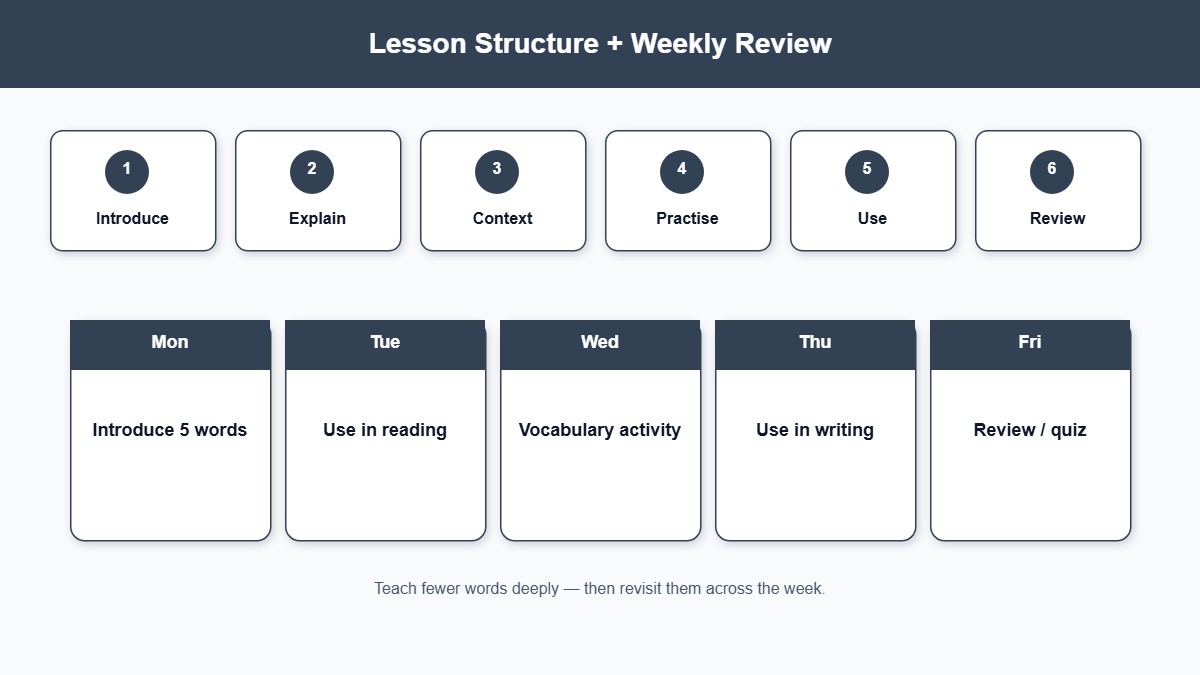
If you are unsure how to structure a vocabulary lesson, you can use a simple sequence:
- Introduce the words — Choose a small group of useful words.
- Explain the meanings — Give clear definitions and examples.
- Show the words in context — Use sentences, stories, or short texts.
- Practise together — Use matching, sorting, questioning, or other guided activities.
- Let students use the words — Ask students to speak or write using the vocabulary.
- Review — Return to the words later and check whether students remember them.
This structure can be adapted for different ages, subjects, and classroom settings.
How to Help Students Remember New Vocabulary
Students are more likely to remember vocabulary when they encounter and use words repeatedly.
Instead of introducing twenty words and moving on immediately, consider teaching a smaller number of useful words and revisiting them throughout the week.
For example:
- Monday: Introduce five words
- Tuesday: Use the words in reading
- Wednesday: Complete a vocabulary activity
- Thursday: Use the words in writing
- Friday: Review the words with questions or a short quiz
This gives students several opportunities to interact with the same vocabulary.
Final Thoughts
Teaching vocabulary is not simply about asking students to memorise definitions. Students need to understand words, see them in context, hear them, discuss them, and use them in their own speaking and writing.
Teachers can make vocabulary instruction more effective by choosing useful words, explaining them clearly, using examples and visual resources, teaching context clues, encouraging reading, and providing regular opportunities for practice.
Most importantly, vocabulary development takes time. Keep introducing useful words, keep revisiting them, and give students plenty of opportunities to use them in meaningful situations.
Frequently Asked Questions
Common questions answered for downloading and using our premium printable designs.






Comments (0)
Leave a Reply
Be the first to leave a comment!