
How to Teach Phonics Blends
A practical guide to teaching phonics blends: blends vs digraphs, listening, one blend at a time, reading and spelling, pictures, sorts, games, sentences, and fixing common mistakes.
 Amanda Williams
Phonics blends (also called consonant clusters) are two or three consonants that appear side by side, where you can still hear each sound. In flag, you hear /f/ and /l/ glide into the vowel; in stop, you hear /s/ and /t/. Children who only know single-letter sounds often freeze when words start with bl, st, or tr — not because the idea is hard, but because nobody has taught them to hold two sounds together smoothly.
Table of Contents
- What Phonics Blends Are
- 1. Know the Difference Between Blends and Digraphs
- 2. Start by Listening for Blends
- Printable: Hear and Blend Sounds
- 3. Introduce Common Blends One at a Time
- Printable: Common Beginning Blends
- 4. Teach Reading Words With Blends
- Printable: Read Blend Words
- 5. Teach Spelling Words With Blends
- 6. Use Picture Activities
- 7. Practise Word Sorting
- Printable: Blend Sorting
- 8. Play Blend Games
- Printable: Blend Games
- 9. Move Into Simple Sentences
- Printable: Blend Sentences
- 10. Common Difficulties and How to Help
- 11. How to Increase Difficulty
- A Simple Phonics Blends Lesson Structure
- Home Practice That Helps
- How to Teach Phonics Blends Step by Step
- Final Thoughts
This guide shows how to teach phonics blends step by step: what blends are, how they differ from digraphs, listening first, introducing one blend at a time, reading and spelling blend words, picture cues, sorting, games, and simple sentences. It sits after CVC decoding in a wider how to teach phonics sequence and pairs with oral sound work from how to teach phonemic awareness. For the bigger reading journey, see how to teach someone to read. Use blends worksheets, phonics worksheets, phonics flashcards, and English lesson plans for practice that matches each stage.
Whether you teach in a classroom or at home, keep the same rhythm: hear the blend, say the blend, read short words with that blend, then spell and use the words in speech and writing.
What Phonics Blends Are
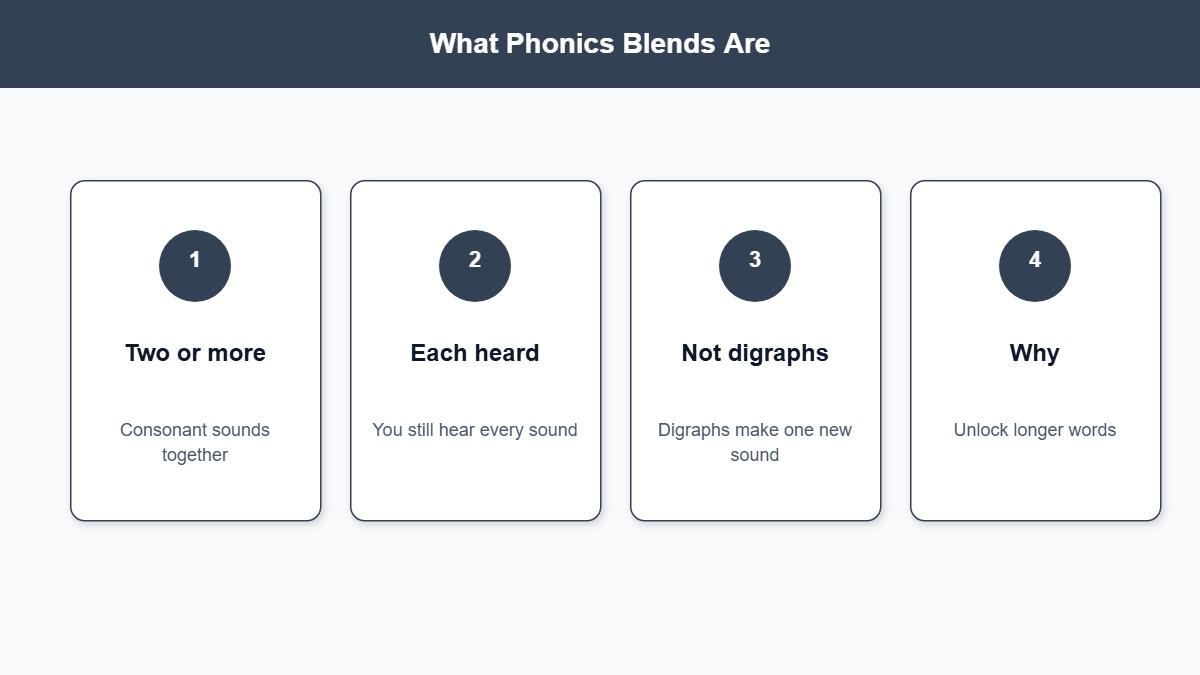
A blend is a group of consonants where each letter keeps its own sound. The letters work as neighbours, not as a new single sound.
- Beginning blends: bl (blue), cl (clap), fl (flip), br (brush), cr (crab), dr (drum), st (stem), sp (spin), sl (sled), tr (trip)
- Other useful starters: sc, sk, sm, sn, sw, tw, pl, gl, pr, gr
- Ending blends: nd (hand), nt (tent), mp (lamp), st (nest), lk (milk), lt (belt)
- Three-letter blends later: str (string), spr (spring), spl (splash), scr (scrap)
Blends matter because so many early reader words use them. Without blend practice, children guess from the first letter or insert an extra vowel ("buh-lue" for blue).
1. Know the Difference Between Blends and Digraphs
Teachers and parents often mix these up. The distinction helps you choose the right practice.
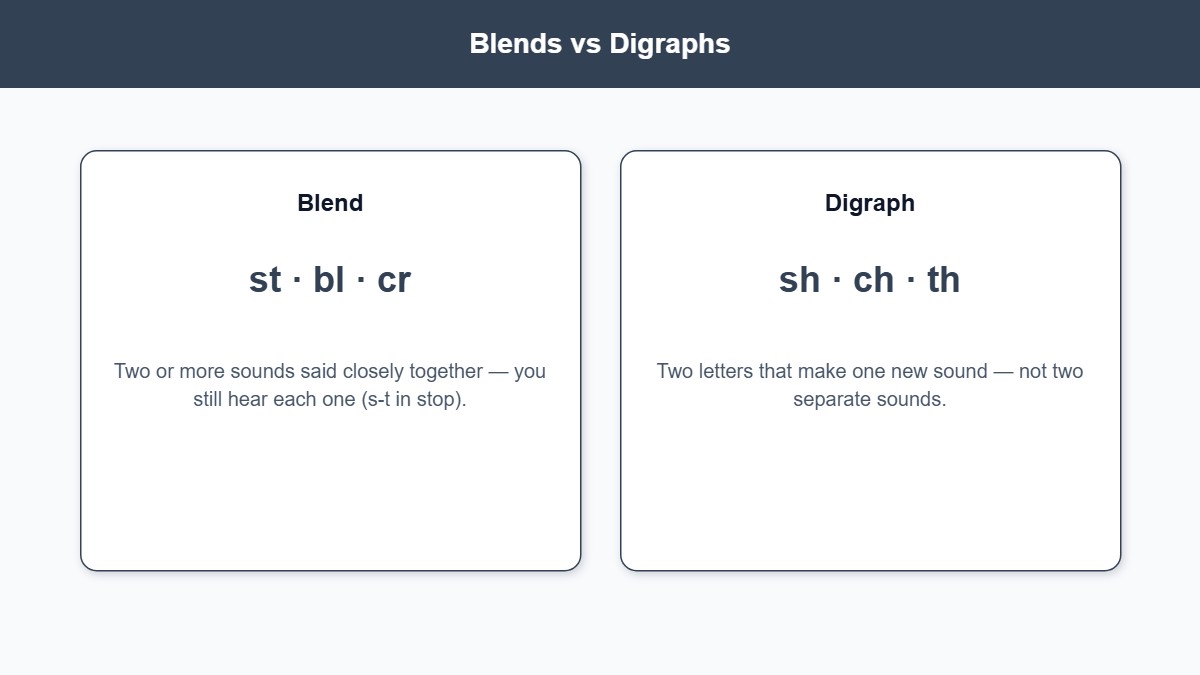
Blend: two (or three) consonants, and you can hear each sound — /s/+/t/ in stop, /b/+/l/ in block.
Digraph: two letters that make one sound — sh in ship, ch in chop, th in thin, wh in when. You do not say /s/ then /h/ for sh.
A quick check: stretch the word slowly. If both consonant sounds stay audible, it is a blend. If the pair collapses into one new sound, it is a digraph. Teach digraphs and blends as separate skills so children do not treat sh like st.
Keep digraph review available in your wider how to teach phonics plan, but when the lesson target is blends, use blend words only.
2. Start by Listening for Blends
Before print, train the ear. Many blend errors are listening errors — children drop the second consonant or invent a vowel between the two sounds.
Say a word slowly and ask which "starter pair" they hear: "Is frog a /f/ word or a /fr/ word?" Offer two choices so the task is clear. Clap once for each sound in clap: /c/ /l/ /a/ /p/ — four sounds, with /c/ and /l/ still separate.
Contrast pairs: sip vs slip, top vs stop, lock vs block. Ask, "What extra sound did you hear at the start?" This oral work links tightly to how to teach phonemic awareness skills such as segmenting and blending sounds without letters.
Only move to letters once children can hear that slip has an /l/ that sip does not.
Printable: Hear and Blend Sounds
Warm up with sound-blending practice before print words.

3. Introduce Common Blends One at a Time
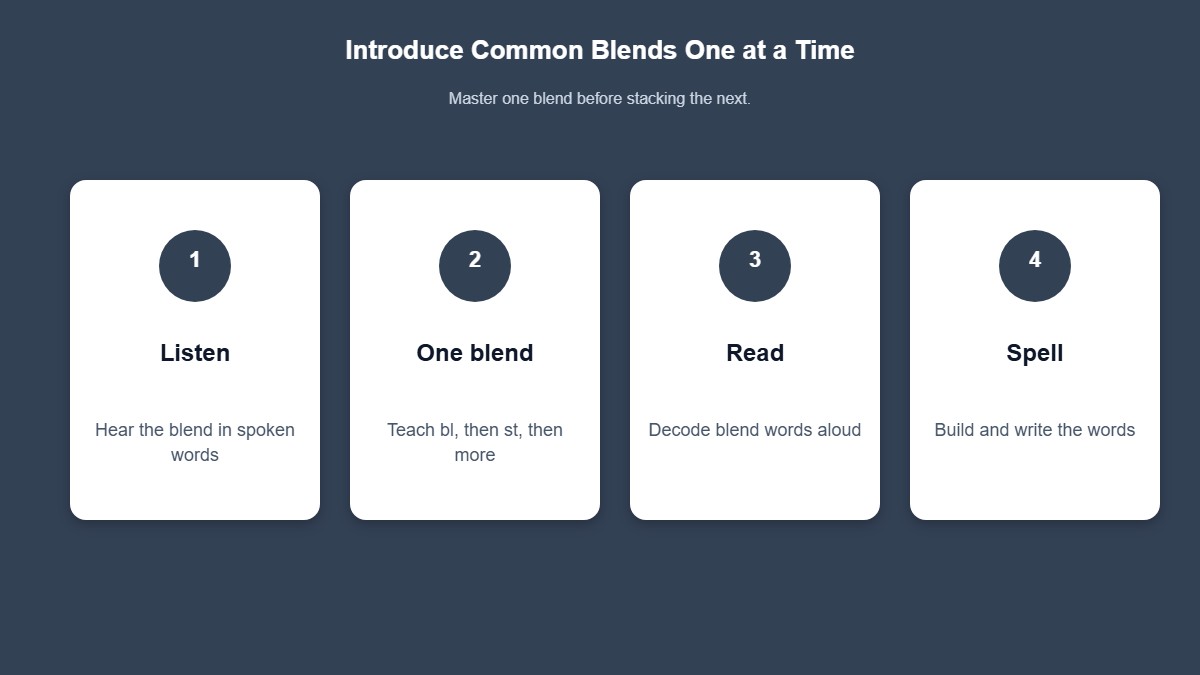
Do not dump a whole blend chart in week one. Pick one blend, teach it thoroughly, then add the next.
A sensible early set: st, sp, sl, then bl, cl, fl, then br, cr, dr, tr. Those cover many decodable words and keep mouth positions manageable.
For each blend:
- Show the two letters and say both sounds smoothly: /s/…/t/ → "st"
- Give three or four clear example words (stem, stop, step, stir if /ir/ is known — or stick to short vowels)
- Practise reading and building only that blend for a few short sessions
When the child reads st words with little prompting, introduce the next blend and briefly revise the old one. phonics flashcards with one blend per card keep visual clutter low.
Printable: Common Beginning Blends
Practise bl, cl, and fl words one blend family at a time.


4. Teach Reading Words With Blends
Reading blends is about sliding sounds, not naming letters.
Model "stretch and stick": for flag, say /f/…/l/ (hold them close), then /a/, then /g/, then blend through the whole word. Discourage "fuh-lag" — the schwa vowel between consonants is a common habit; show continuous airflow from /f/ into /l/.
Start with CCVC or CVCC patterns the child can already decode vowel-wise: stop, spin, sled, clap, drum, trip, hand, lamp. Keep vowels short and familiar at first.
Finger-track under each grapheme. If the child reads trap as tap, cover the r, read tap, uncover r, and rebuild: /t/ /r/ /a/ /p/. Targeted pages from blends worksheets work well once the oral model is clear.
Printable: Read Blend Words
Decode blend words with beginning-blend pages and word ladders.


5. Teach Spelling Words With Blends
Spelling reveals whether the child truly hears both consonants.
Say the word, segment aloud together, then write. For crab: "/c/ /r/ /a/ /b/ — four sounds, four letters." If they write cab, ask them to tap sounds on their arm and find the missing /r/.
Dictation in tiny sets beats long lists: three cl words one day (clap, clip, club), three tr words the next. Have children say the blend as a pair before they write the rest of the word.
When endings are ready, include nd, mp, and nt so blends are not only "front of the word" skills.
6. Use Picture Activities
Pictures help meaning — but the decoding must still do the work.
Show a picture of a drum and three printed choices: drum, gum, dug. The child reads each option before matching. Or give a blend card (fl) and a small set of pictures (flag, flute, leaf, frog); they keep only the pictures whose names start with that blend.
Say-it-then-find: you say "/bl/ — block," children find the block picture and the word card. Avoid asking them to guess the word from the picture alone; always return to sounding out.
Printable picture-and-word grids in blends worksheets and broader phonics worksheets save prep time when you want a quick centre.
7. Practise Word Sorting
Sorting makes the pattern visible.
Give a mixed pack of words and two or three headers, for example st / sp / sl: stop, spin, sled, stem, spot, slip. Children read each word aloud, then place it under the correct blend.
Harder sorts: beginning blend vs ending blend (stop vs nest), or blend vs digraph (ship vs slip) once both skills are known. Oral sorts work too: you say the word, they point to the header before they see print.
Correct mis-sorts by re-reading the first two sounds together, not by saying "wrong pile."
Printable: Blend Sorting
Sort words and pictures by blend pattern.

8. Play Blend Games
Short games give the repetitions blends need without turning into a worksheet grind.
Ideas:
- Blend bingo — boards with words like crab, flag, stop; call a word or a blend sound
- Blend hunt — find classroom objects or picture cards that start with today's blend
- Build-a-blend — letter tiles: fix st, swap the ending (stop, stem, step)
- Odd one out — clap, clip, crab (which does not belong?)
- Relay read — pairs take turns reading a short blend-word list against a timer for accuracy, not speed
Keep one teaching focus per game. A mixed bag of every blend at once overwhelms beginners.
Printable: Blend Games
Keep practice playful with blend-train and roll-and-read activities.


9. Move Into Simple Sentences
When single words are steady, put blend words into short decodable sentences.
Examples: "The crab hid in the sand." "Stan can flip the flat mat." "She will drop the drum." Underline the blend words and have children read those first, then the whole sentence.
Ask a quick meaning check after decoding: "Where did the crab hide?" so reading is not empty sounding-out. For shared writing, invent one sentence together using two words with the same blend: "We stop at the step."
Sentence reading is a natural bridge toward connected text in how to teach someone to read, while still keeping blends as the phonics target.
Printable: Blend Sentences
Read short phonics sentences that include blend words in connected text.

10. Common Difficulties and How to Help
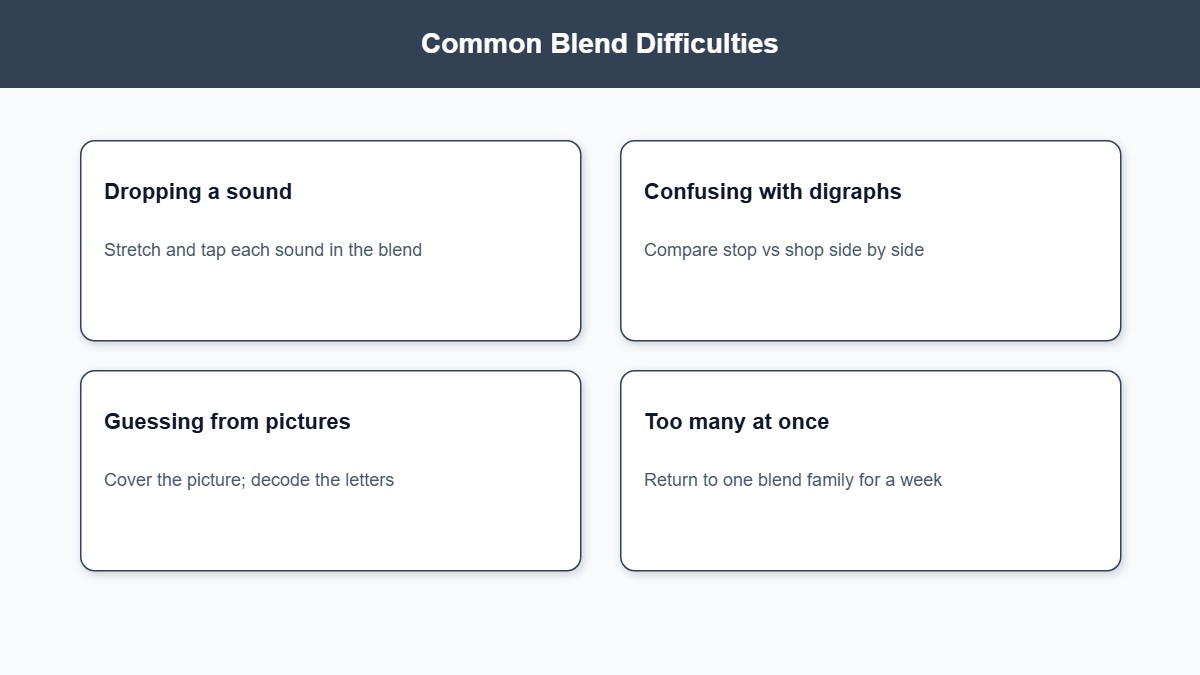
Dropping the second consonant:frog becomes fog. Cover the second letter, then uncover it; practise "add the middle sound" with oral contrasts (fog/frog).
Inserting a vowel: "suh-top" for stop. Model a continuous glide; have the child whisper the blend as one smooth unit before the vowel.
Confusing blends with digraphs: reading chip as /c/ /h/ /i/ /p/. Pause and reteach "one sound" vs "two sounds" with side-by-side cards.
Knowing the blend in isolation but not in words: reduce to two or three words, finger-segment every sound, and reread the same set across days.
Overwhelm: too many new blends at once. Return to one blend family for a week.
Struggling readers often need more oral how to teach phonemic awareness practice before more print. Slow the lesson; do not skip the listening stage.
11. How to Increase Difficulty
Raise challenge only when current blend words are read and spelled accurately:
- New blend families (from st to br/tr, then endings like nd/mp)
- Three-letter blends (str, spl, spr)
- Longer words and two-syllable words with a blend (plastic, trumpet) when syllable skills are ready
- Mixed lists and mixed sentences instead of single-blend pages
- Less picture support; more dictation and connected text
- Blends plus known digraphs in the same sentence
If accuracy falls, shrink back to one blend and short vowels before pushing on.
A Simple Phonics Blends Lesson Structure
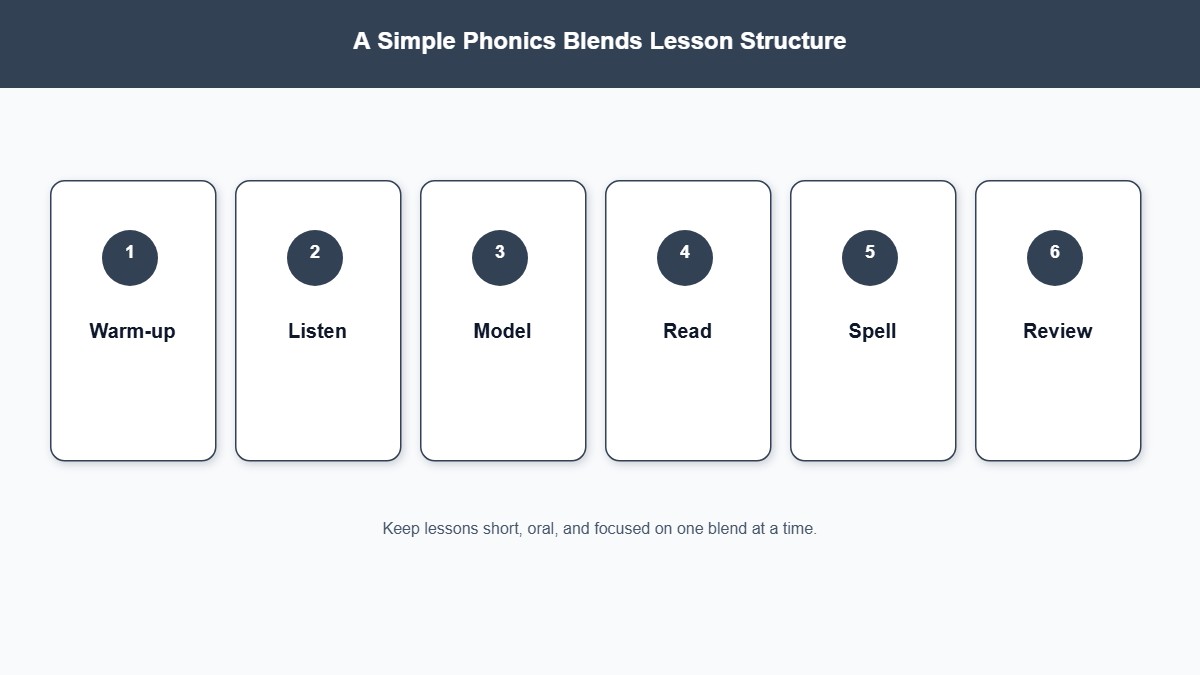
A short blends lesson can follow this sequence:
- Warm-up — Oral contrast: lock/block or tap sounds in a known blend word.
- Teach — Introduce or revise one blend; say both sounds; show 3–4 example words.
- Guided reading — Read a small set together; fix dropped consonants in the moment.
- Guided spelling — Segment and write two words with that blend.
- Practice — Sort, match pictures, or a quick game; use blends worksheets or phonics flashcards as needed.
- Wrap-up — One sentence containing today’s blend; children spot and read the blend words.
Ten to twenty focused minutes beat a long, mixed phonics block. Plan fuller sessions with English lesson plans when you want a complete English slot.
Home Practice That Helps
At home, keep practice short and specific: one blend, a handful of words, then stop on a success.
Useful routines: read a mini list stuck on the fridge (spin, spot, spun); play "I spy something that starts with /tr/"; write two blend words in a notebook after dinner; hunt blend words in a simple decodable book and list them.
Parents should model the smooth blend sound rather than letter names alone. Praise careful sounding-out, not guessing from pictures. A few pages from phonics worksheets or blends worksheets each week is enough if the child reads the words aloud to an adult.
How to Teach Phonics Blends Step by Step
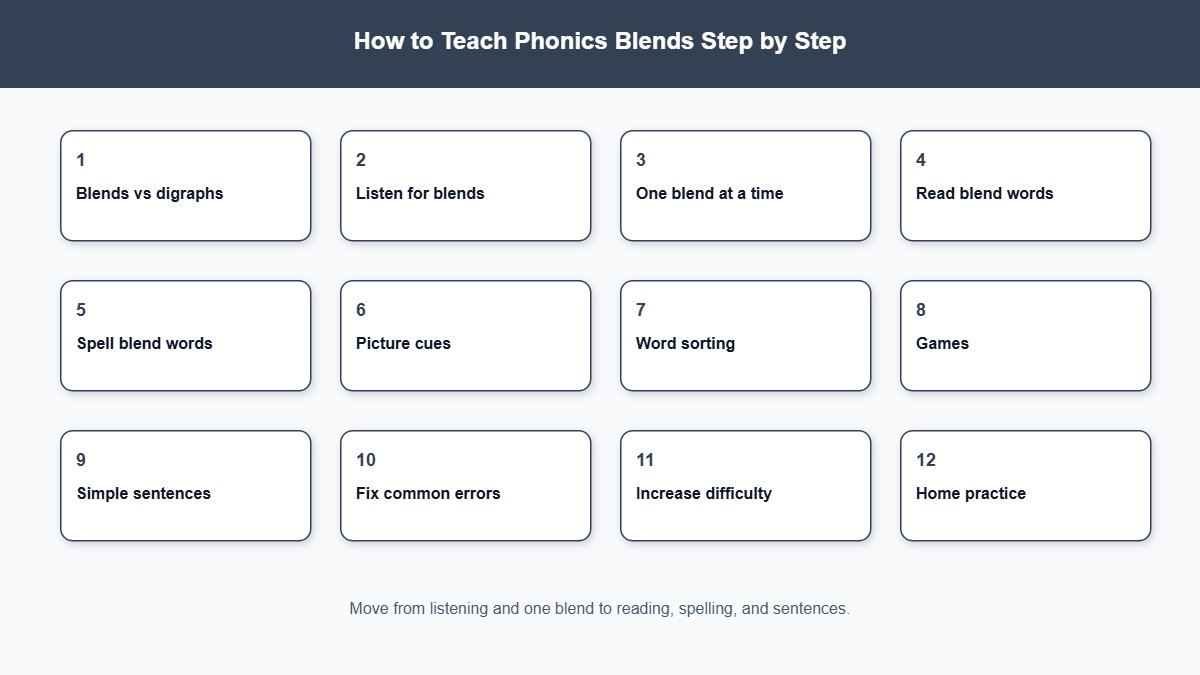
A practical progression looks like this:
- Confirm CVC decoding and basic letter sounds are secure.
- Teach blend vs digraph in simple language with clear examples.
- Build listening: hear the extra consonant in pairs like top/stop.
- Introduce one beginning blend; read and spell a small word set.
- Add related blends in the same family (st/sp/sl, then l-blends, then r-blends).
- Use pictures, sorts, and games for fluency with that set.
- Move into short sentences with the target blends.
- Add ending blends, then three-letter blends when ready.
- Mix review so older blends stay sharp while new ones appear.
- Connect blend reading to wider decodable books and how to teach someone to read goals.
Stay on a step until the child can read and write the current blend words without dropping sounds.
Final Thoughts
Teaching phonics blends well means teaching children to hear and say two (or three) consonant sounds in a row, then map them to letters in real words. Clear contrasts with digraphs, one-blend-at-a-time lessons, and lots of reading-plus-spelling practice prevent the usual traps of skipped consonants and extra vowels.
Build from listening to letters, from single words to sorts and games, then to sentences. When blends are firm, children tackle a much larger share of early texts with confidence — and the rest of your how to teach phonics programme has a stronger foundation.
Keep sets small, correct gently, and practise a little every day. Smooth blending, accurate spelling, and short successes matter more than covering every cluster on a wall chart in one week.
Frequently Asked Questions
Common questions answered for downloading and using our premium printable designs.




Comments (0)
Leave a Reply
Be the first to leave a comment!