
How to Teach Someone to Read
A step-by-step guide to teaching reading: letter sounds, phonemic awareness, blending, CVC words, digraphs, sight words, fluency, and comprehension.
 Amanda Williams

Learning to read is a gradual process. A beginner reader needs to understand that written letters represent sounds, learn how those sounds can be combined to form words, build a bank of familiar words, and eventually develop enough fluency to focus on understanding what they are reading.
The best approach will depend on the learner's age, current reading ability, and previous experience with language. A child who is just learning letter sounds will need a different approach from a student who can read simple words but struggles with longer texts.
Whether you are a teacher helping students in the classroom or a parent supporting reading at home, the key is to provide clear instruction, regular practice, and plenty of opportunities to read. This guide pairs well with how to teach phonics, phonemic awareness, how to teach sight words, and reading comprehension.
What Does Someone Need to Learn to Read?
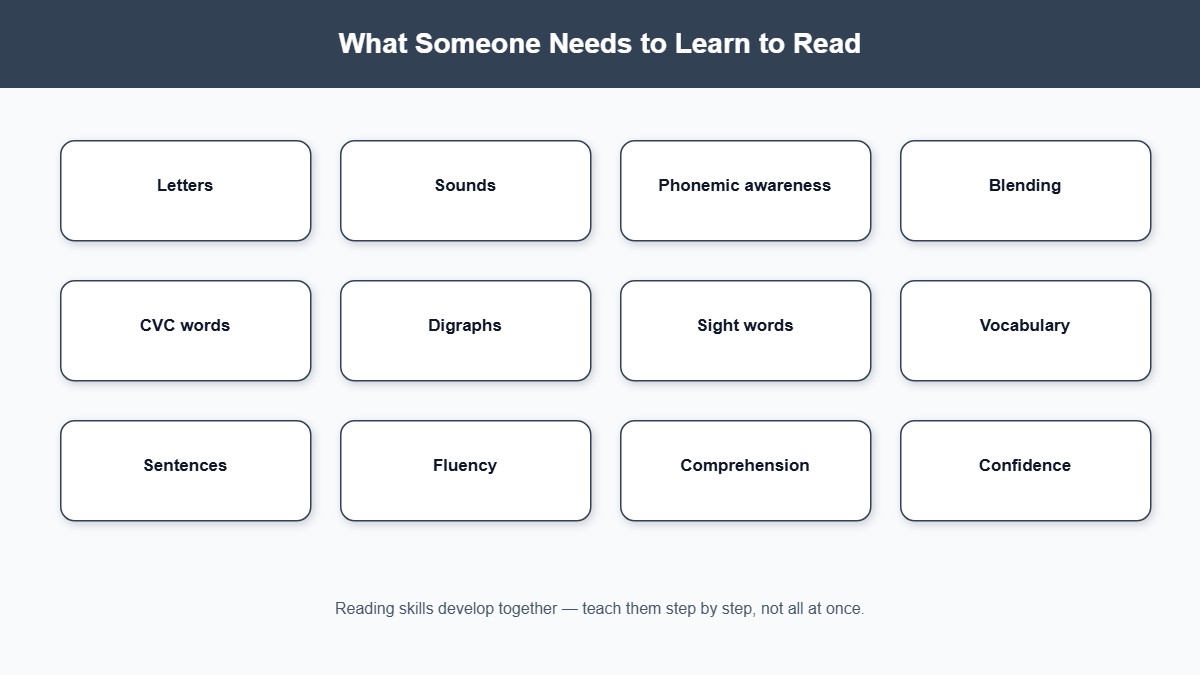
Reading involves several skills that develop together. A beginner reader generally needs to learn how to:
- Recognise letters
- Know letter sounds
- Hear and identify sounds in spoken words
- Blend sounds together
- Break words into individual sounds
- Recognise common words
- Build vocabulary
- Read sentences
- Develop reading fluency
- Understand what they read
Reading is therefore more than memorising words. Learners need to understand how written language works and develop strategies for working out unfamiliar words.
1. Start With Spoken Language
Before focusing heavily on written words, make sure the learner has plenty of opportunities to listen and speak.
Talk about everyday objects, people, places, and experiences. Ask questions and encourage the learner to describe what they see and what they are doing.
For example: "What is this?" "What sound does the dog make?" "What happened in the story?"
Strong spoken language gives learners words and ideas that they can later connect to written language. This is especially important when teaching preschoolers or supporting early talk at home.
2. Teach Letter Recognition
A beginner reader needs to recognise letters and understand that letters have names and sounds.
Start by introducing letters gradually rather than expecting a learner to memorise the entire alphabet at once. See also letter recognition for focused practice ideas.
Practise recognising both uppercase and lowercase forms: A a, B b, C c.
Use different activities to reinforce recognition, such as matching uppercase and lowercase letters, finding a particular letter in a book, or identifying letters on cards.
3. Teach Letter Sounds
After learners begin recognising letters, teach the sounds that the letters represent.
For example: m → /m/, s → /s/, t → /t/, p → /p/.
The goal is for the learner to see a letter and quickly connect it with its sound.
Don't worry about making every activity complicated. Short, regular practice can be very effective. Browse letter sounds worksheets and phonics flashcards for printable practice.
Printable: Letter Sounds Practice
Trace, match, and review letter–sound connections with these phonics sheets.


4. Develop Phonemic Awareness
Phonemic awareness is the ability to hear and work with individual sounds in spoken words.
This is different from simply recognising letters because learners are working with sounds they hear rather than written symbols. Our phonemic awareness guide covers this skill in more depth.
For example, ask: "What sounds do you hear in the word sun?" The learner can identify /s/ /u/ /n/.
You can also ask learners to identify the first or last sound in a word: "What sound does 'fish' start with?" → /f/.
Activities involving rhyming, identifying sounds, blending spoken sounds, and separating words into sounds can help develop these skills.
5. Teach Blending
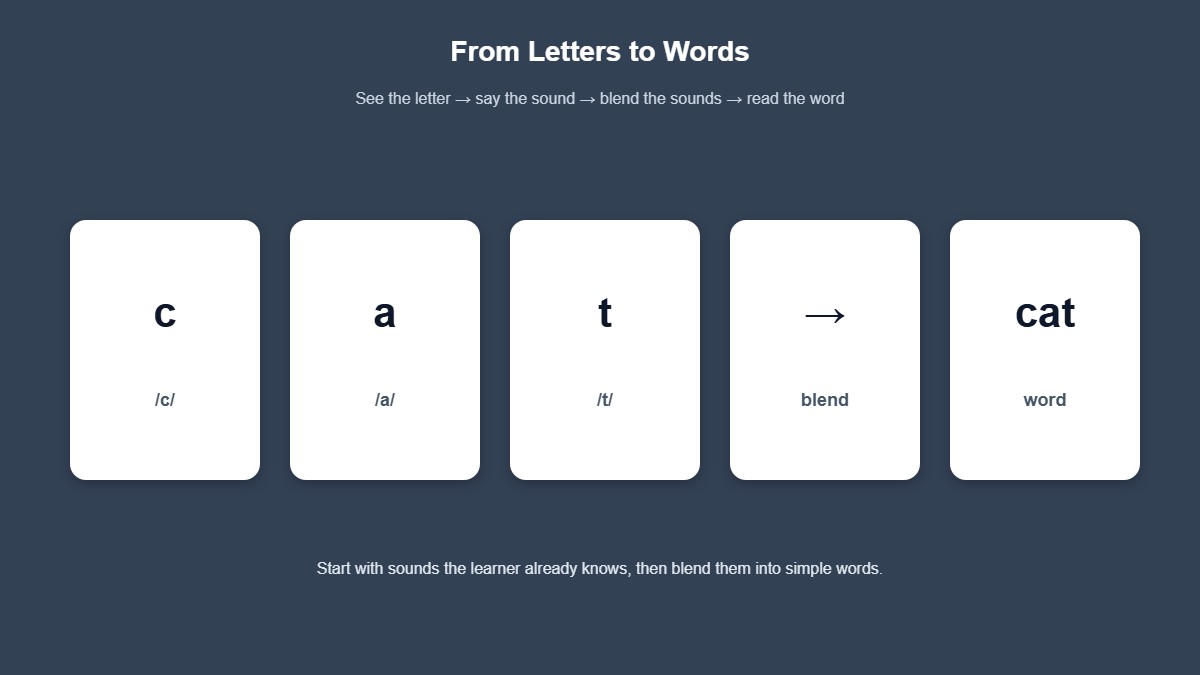
Blending is one of the most important skills for beginner readers.
Once learners know some letter sounds, teach them how to put those sounds together to make a word.
For example: c → /c/, a → /a/, t → /t/. Then blend them: c-a-t → cat.
Start with simple words containing sounds the learner already knows.
As the learner becomes more confident, introduce more words and increasingly complex sound patterns. Use blending worksheets for guided practice.
Printable: Blending Practice
Practise putting sounds together to read whole words.


6. Start With Simple Words
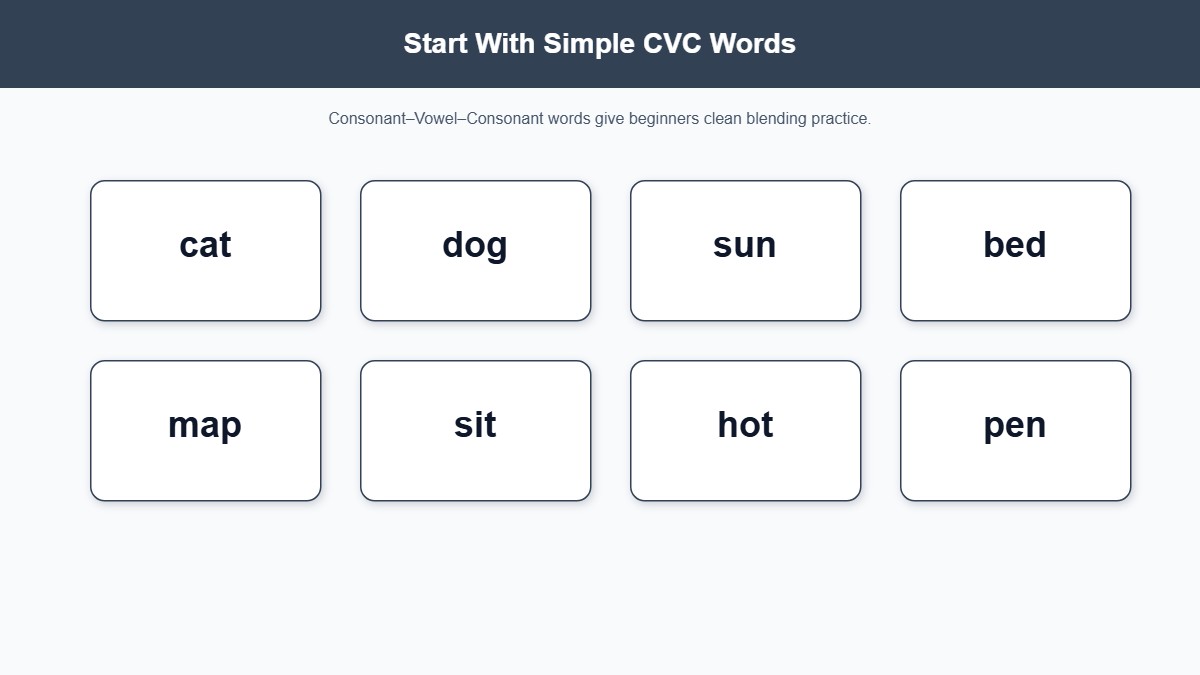
CVC words are often useful for early reading practice.
CVC means consonant-vowel-consonant. Examples include: cat, dog, sun, bed, map, sit, hot, pen.
These words allow beginners to practise connecting individual letter sounds and blending them together.
You can gradually introduce more complex words as the learner develops their decoding skills. Explore CVC words worksheets for printable practice.
Printable: CVC Words
Build, match, and read simple consonant–vowel–consonant words.


7. Teach Digraphs
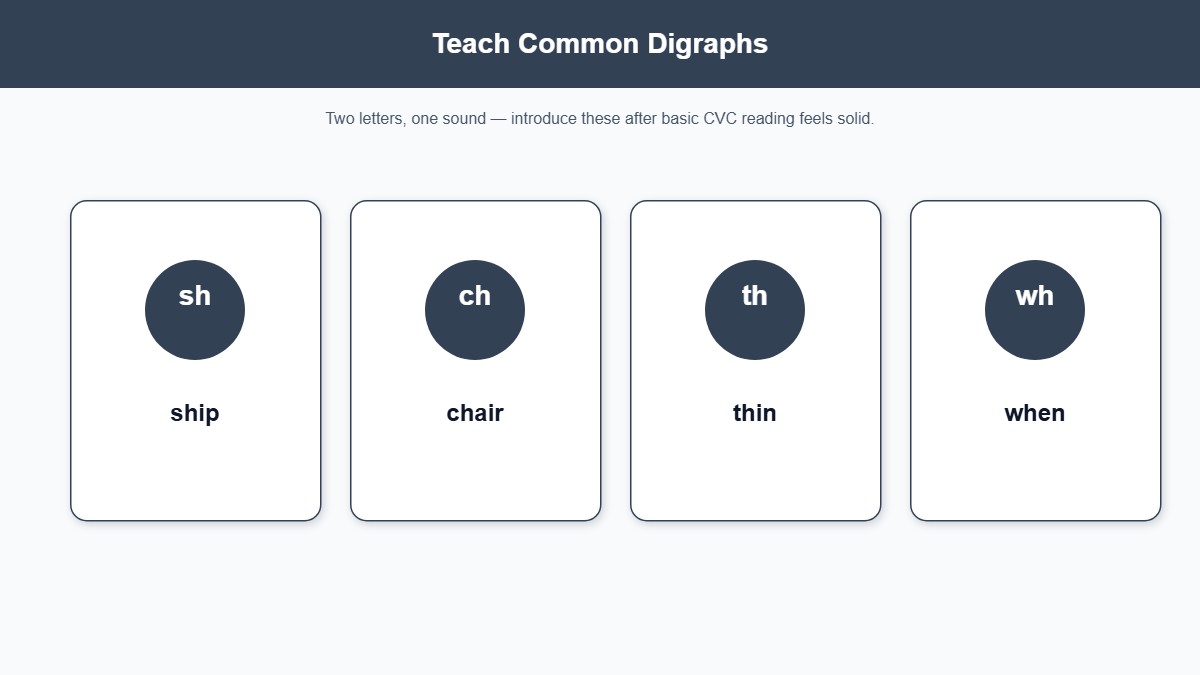
Once learners are comfortable with basic letter sounds and simple words, introduce common digraphs.
A digraph is a combination of two letters representing one sound. Examples include: sh – ship, ch – chair, th – thin, wh – when.
Give learners plenty of opportunities to identify these sound patterns in words and practise reading them. See digraph worksheets and the full how to teach phonics sequence for next steps.
Printable: Digraph Practice
Practise common two-letter sounds such as sh, ch, and th.


8. Teach Common Vowel Patterns
Vowels can become more complicated as learners progress.
After learners are comfortable with simple short-vowel words, introduce different vowel patterns and sounds.
For example: ai – rain, ee – tree, oa – boat, igh – night.
Teach these patterns gradually and give learners opportunities to read words containing them. Related patterns such as phonics blends come later for many learners.
Printable: Short and Long Vowels
Compare short and long vowel patterns after CVC reading feels solid.


9. Teach Sight Words When Appropriate
Some frequently used words can be difficult for beginners to decode using basic phonics patterns.
Examples include words such as: the, said, was, one, they, are.
These words can be taught through repeated exposure, reading practice, and activities that help learners recognise them quickly. See how to teach sight words for practical strategies.
However, sight-word instruction should work alongside phonics rather than replacing systematic instruction in decoding.
10. Read Together
Reading together gives beginners an opportunity to practise their skills while receiving support.
You can read a sentence and ask the learner to read it back. You can also alternate sentences or read a book together.
If the learner gets stuck, give them time to look at the word and use the strategies they have learned.
Avoid immediately giving them every answer. Instead, ask: "What sound does this letter make?" "Can you sound out the word?" "Does that word make sense in the sentence?"
11. Let the Learner Read Every Day
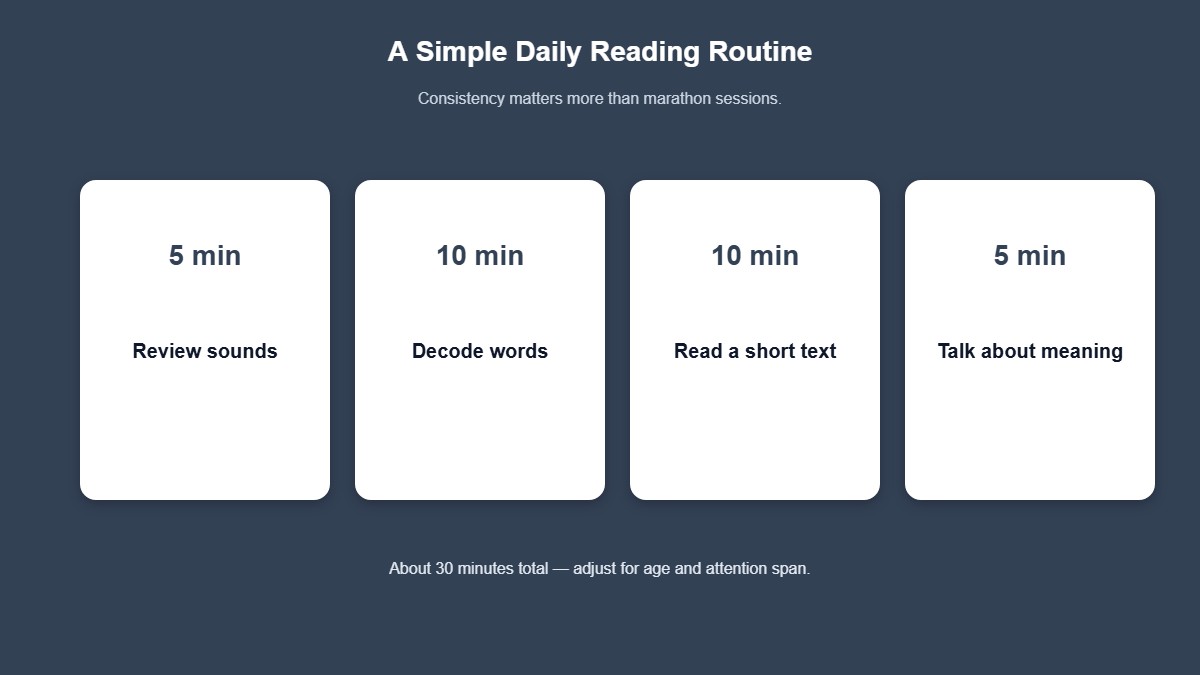
Regular practice is important.
Even a short reading session can provide useful practice. The exact amount of time will depend on the learner's age, ability, and attention span.
A simple routine could be:
- 5 minutes: Review letter sounds or vocabulary
- 10 minutes: Practise decoding words
- 10 minutes: Read a short book or passage
- 5 minutes: Talk about what was read
The important thing is consistency rather than making every session very long. This works well for teaching kindergarten and early primary learners.
12. Choose Books at the Right Level
Books should provide an appropriate level of challenge.
If a learner cannot read most of the words on the page, the book may be too difficult for independent reading.
Choose texts that allow the learner to practise skills they already know while introducing a manageable amount of new material.
You can also read more difficult books aloud to learners. A child does not need to be able to independently read every book they enjoy.
13. Ask Questions About What They Read
Reading the words is only part of reading.
Learners also need to understand the meaning of what they read.
After reading a story, ask questions such as:
- Who was in the story?
- Where did the story happen?
- What happened first?
- What happened next?
- Why did the character do that?
- What was the problem?
- How was the problem solved?
- What do you think will happen next?
These questions help develop reading comprehension.
14. Build Vocabulary
A learner may be able to decode a word but still not understand what it means.
For example, a student might successfully read the word enormous but not know that it means very large.
When you encounter unfamiliar vocabulary, stop and discuss it.
You can explain the meaning, give an example, use the word in another sentence, or ask the learner to describe what they think it means from the context. See how to teach vocabulary for classroom strategies.
15. Teach Learners to Use Context
Context can help readers understand unfamiliar words and sentences.
Teach learners to look at the words around an unfamiliar word and think about what would make sense.
For example: "The boy was exhausted after running the race." Even if the learner does not know the word exhausted, the rest of the sentence provides clues that the boy was very tired.
Context should support decoding rather than replace it. Encourage learners to look carefully at the letters and sounds in unfamiliar words while also considering whether the word makes sense in the sentence.
16. Practise Reading Fluency
Once learners can decode words, they need to become more fluent.
Fluency means reading with appropriate accuracy, speed, and expression rather than stopping at every word.
You can develop fluency through repeated reading, reading short passages, reading aloud, reading familiar stories, echo reading, and paired reading.
For example, you can read a sentence first and have the learner read the same sentence afterwards. Explore reading fluency for more ideas.
17. Encourage Reading Aloud
Reading aloud gives you an opportunity to hear how the learner is reading.
You can notice whether they are struggling with particular sounds, guessing words, skipping words, replacing words, reading very slowly, struggling with punctuation, or having difficulty understanding what they read.
Use this information to decide what they need to practise next.
18. Don't Make Every Mistake a Problem
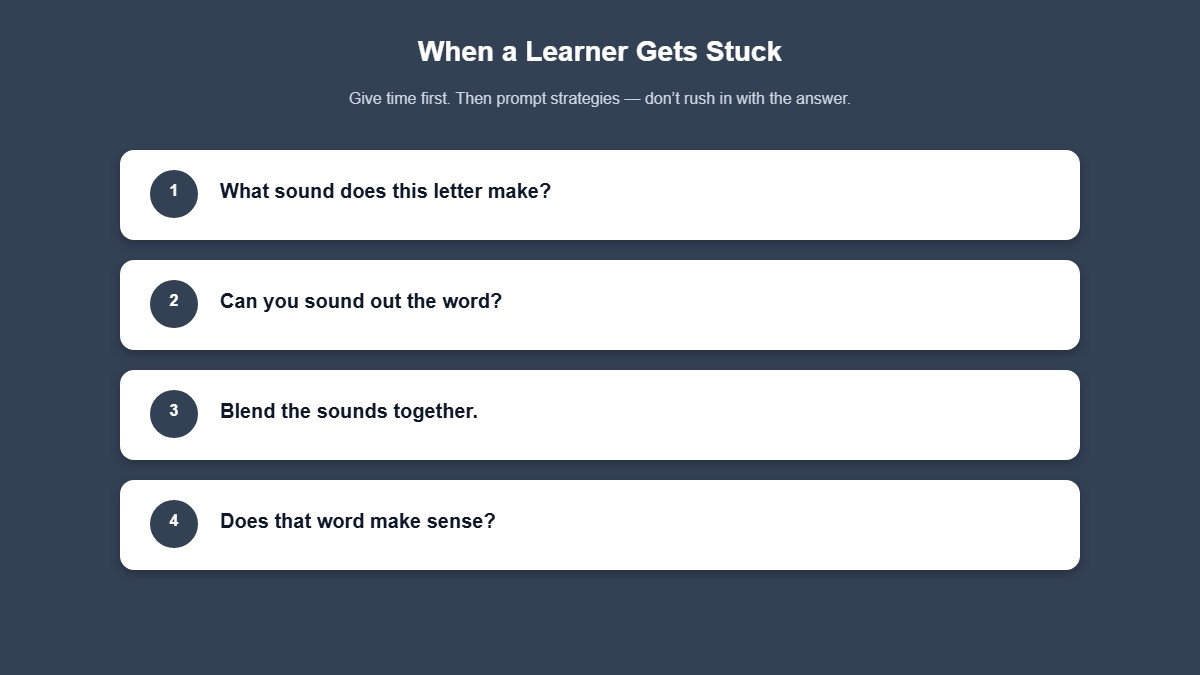
Mistakes are a normal part of learning to read.
If a learner misreads a word, stay calm and help them work through it.
You could say: "Let's look at the word again." Then ask them to identify the sounds and blend them.
If the learner reads a word incorrectly but the sentence no longer makes sense, you can also ask: "Does that make sense?"
The goal is to help the learner develop strategies for solving reading problems rather than becoming afraid of making mistakes.
19. Make Reading Interesting
Reading practice should not always feel like a test.
Let learners read about topics they are interested in — animals, sports, space, dinosaurs, stories, science, nature, cars, history, or hobbies.
Interest can encourage learners to spend more time reading and give them a reason to want to understand the text.
20. Use Phonics Worksheets and Activities
Worksheets can provide additional practice for specific reading skills.
For example, a learner working on CVC words might complete activities where they match pictures with words, identify beginning sounds, blend sounds, complete missing letters, read simple words, or match words with pictures.
As the learner progresses, worksheets can focus on digraphs, blends, vowel patterns, sight words, reading comprehension, and other skills.
The key is to make sure the activity matches the skill the learner is currently developing. Start with phonics worksheets, letter sounds worksheets, CVC words worksheets, blending worksheets, and digraph worksheets.
More Printable Reading Activities
Extra phonics activities for review, games, and connected reading practice.


21. Keep Practising Difficult Skills
If a learner consistently struggles with a particular skill, give them additional opportunities to practise it.
For example, if they have difficulty with sh, don't simply move on after one lesson.
Return to the sound through word reading, picture matching, phonics flashcards, short sentences, reading passages, and writing activities.
Repeated practice can help the skill become more automatic.
22. Gradually Increase the Difficulty
Don't move from simple three-letter words directly to long paragraphs.
Increase difficulty gradually.
A learner might progress through something like: letters → sounds → CVC words → digraphs → blends → simple sentences → short stories → longer texts.
The exact progression will vary between learners, but the general principle is to build new skills on top of skills they already understand. The how to teach phonics sequence is a useful roadmap.
23. Be Patient
Learning to read takes time.
Some learners progress quickly, while others need much more repetition and support.
Avoid comparing one learner's progress with another's. Focus on whether the learner is improving and identify the skills they need to work on next.
Keep practice positive and celebrate genuine progress.
A Simple Reading Lesson Structure
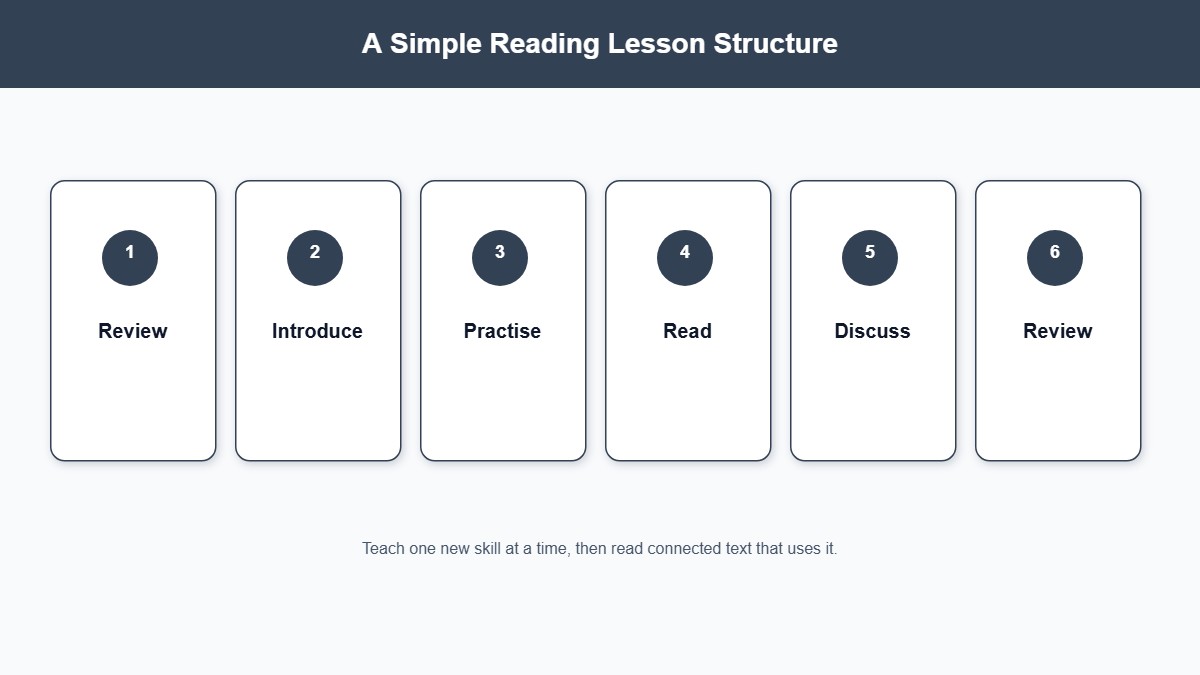
If you are teaching a beginner to read, you can use a simple structure like this:
- Review — Review previously learned letter sounds and words.
- Introduce a new skill — Teach one new sound, word pattern, or reading concept.
- Practise — Use words, flashcards, or a worksheet to practise the new skill.
- Read — Have the learner read words, sentences, or a short passage containing the skill.
- Discuss — Ask questions about what they read and explain any unfamiliar vocabulary.
- Review — Finish by returning to the new skill and checking what the learner remembers.
This structure can be adjusted depending on the learner's age and reading ability. More classroom ideas live in our teaching strategies guides.
How to Teach Someone to Read Step by Step
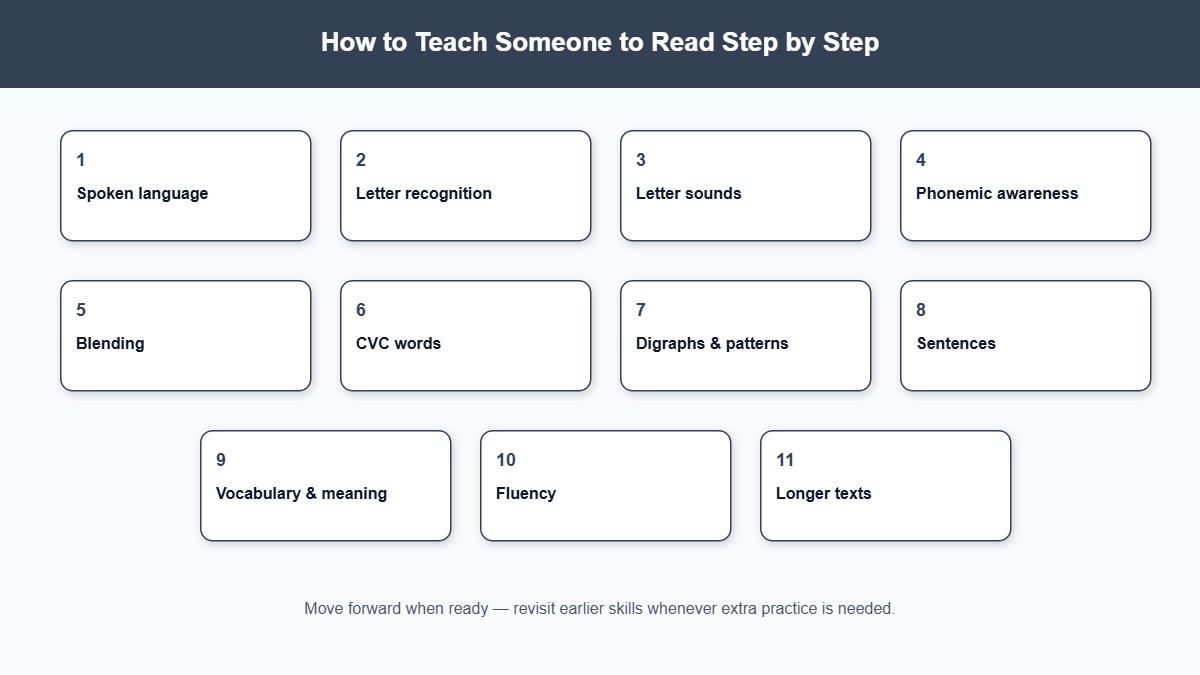
For a complete beginner, a practical progression could look like this:
- Develop spoken language and listening skills.
- Teach letter recognition.
- Teach common letter sounds.
- Develop phonemic awareness.
- Teach learners to blend sounds.
- Introduce simple CVC words.
- Introduce digraphs, blends, and more complex sound patterns.
- Practise reading sentences.
- Build vocabulary and comprehension.
- Develop reading fluency through regular reading.
- Gradually introduce more complex texts.
This process should not be treated as a strict timetable. Move forward when the learner is ready and revisit earlier skills when additional practice is needed.
How to Teach a Child to Read at Home
Parents can support reading development at home through short, regular activities.
Read stories together, talk about new words, practise sounds, allow the child to attempt words independently, and ask questions about stories.
You can also make reading part of everyday life. Read signs, labels, instructions, menus, and other simple texts together.
Most importantly, make sure reading is not always associated with correction and testing. Reading stories for enjoyment is also valuable.
How Long Does It Take to Teach Someone to Read?
There is no single amount of time required to learn to read.
Reading development depends on factors such as the learner's age, language development, previous instruction, learning needs, and how regularly they practise.
Some learners may make rapid progress, while others require longer periods of structured instruction and additional support.
Rather than focusing only on how quickly someone learns, focus on whether they are developing the individual skills needed for successful reading.
Final Thoughts
Teaching someone to read involves much more than teaching them to memorise words. Learners need to understand letters and sounds, develop phonemic awareness, blend sounds, recognise common words, build vocabulary, read fluently, and understand what they are reading.
Start with the skills the learner currently needs, provide clear instruction, and give them plenty of opportunities to practise. Read together regularly, use interesting books and activities, and gradually increase the difficulty as their skills develop.
With consistent instruction, practice, and encouragement, learners can develop the skills and confidence they need to become independent readers.
Frequently Asked Questions
Common questions answered for downloading and using our premium printable designs.




Comments (0)
Leave a Reply
Be the first to leave a comment!