
How to Teach Reading Fluency
A practical guide to teaching reading fluency: accuracy, rate, phrasing, expression, punctuation, repeated and paired reading, text choice, confidence, activities, and lesson structure.
 Amanda Williams
Reading fluency is the bridge between decoding words and understanding text. When reading is slow, choppy, or flat, meaning gets lost — even if the child can sound out most of the words. Fluency is not the same as reading as fast as possible. It means reading accurately, at a comfortable pace, with phrasing and expression that match the text.
This guide shows how to teach reading fluency step by step: accuracy first, then rate, phrasing, punctuation cues, and expression. You will find classroom and home methods, including repeated reading, echo reading, paired reading, and reading aloud. Pair fluency work with how to teach someone to read, how to teach phonics, how to teach reading comprehension, and how to teach sight words. Use reading worksheets, phonics worksheets, and English lesson plans for practice that fits each stage.
Whether you teach a class or support one child at home, keep the same priorities: choose texts they can mostly decode, practise in short bursts, and build confidence without racing the clock.
What Reading Fluency Really Means
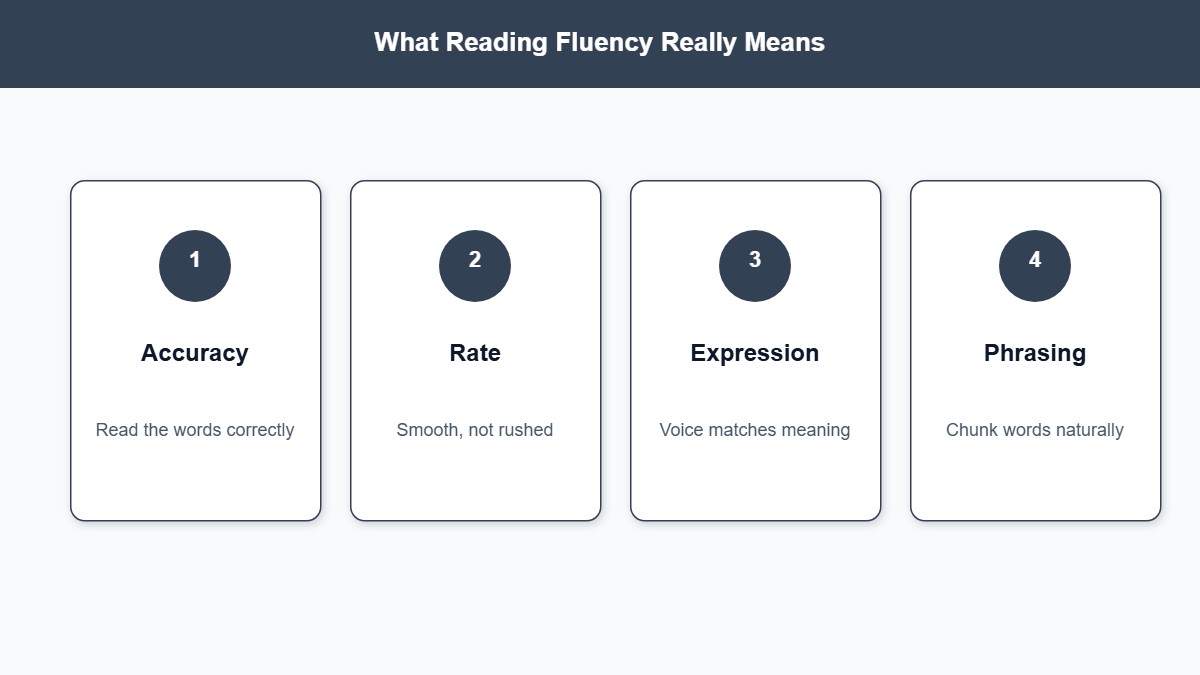
Fluent reading has several parts that work together:
- Accuracy — reading the words correctly
- Rate — a pace that is neither painfully slow nor rushed
- Phrasing — grouping words into meaningful chunks, not one word at a time
- Expression — voice that fits the meaning (questions, dialogue, emphasis)
- Punctuation awareness — pausing at commas and full stops, lifting the voice for questions
A child who races through a page but misreads key words is not fluent. A child who reads every word correctly but sounds robotic still needs fluency support. Accuracy and understanding come before speed goals.
1. Build Accuracy Before Speed
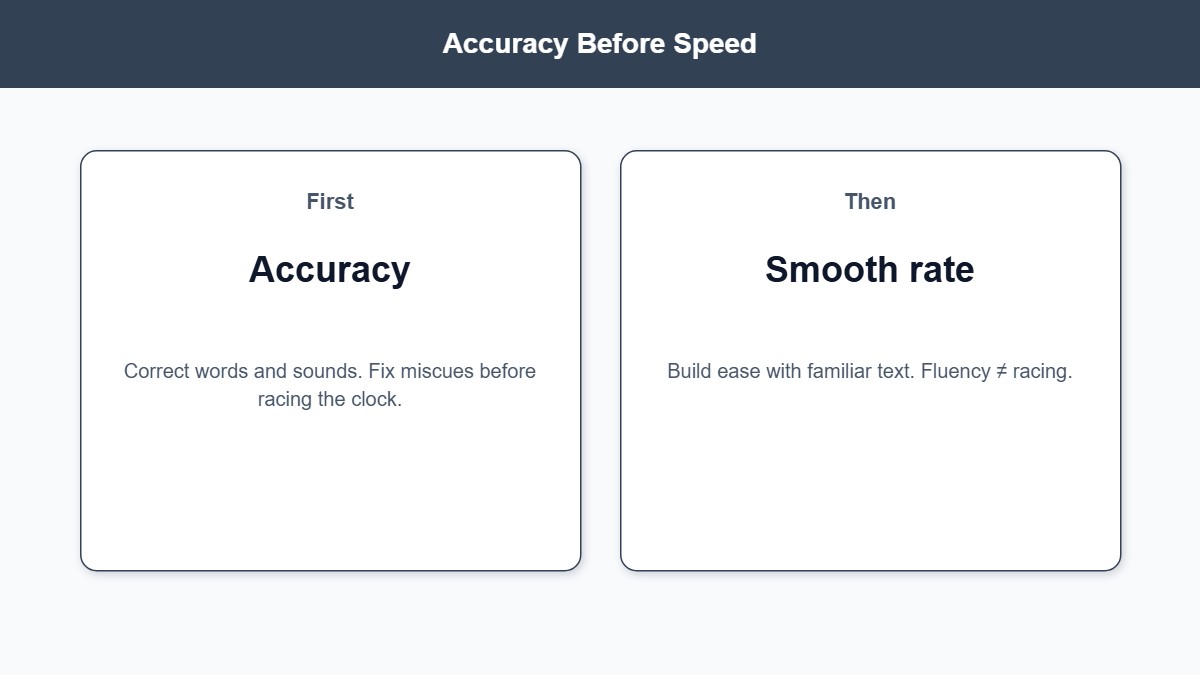
If decoding is fragile, fluency practice will only practise mistakes. Check that the child can read most of the words in the chosen text with little help.
A useful rule of thumb: texts for fluency practice should feel mostly readable — the child should recognise or decode nearly all words without constant stopping. If they stumble on many words, drop to an easier level or strengthen decoding with how to teach phonics and phonics worksheets first.
High-frequency words that appear often also support smooth reading. Targeted how to teach sight words practice can free attention for phrasing and meaning.
Correct errors gently: supply the word if needed, have them reread the phrase, then move on. Do not turn every fluency session into a long phonics lesson, but do not ignore repeated decoding gaps either.
Printable: High-Frequency Words
Strengthen automatic word reading with early sight-word sets before racing for speed.


2. Teach Rate Without Racing
Rate means a natural speaking-like pace for the text — not a contest.
Model the difference: read a sentence too slowly (word… by… word), then too fast (blurred and breathless), then at a clear, comfortable pace. Ask which version was easiest to understand.
Avoid stopwatches as the main message for young or anxious readers. Timed readings can help older learners track growth, but only after accuracy is solid and the child understands that the goal is smooth, understandable reading — not beating a number.
If a child rushes, ask them to “read so a listener can picture the story.” If they crawl, practise short phrases and reread familiar lines until the flow improves.
3. Teach Phrasing and Chunking
Phrasing means reading groups of words that belong together: “the little dog” rather than “the / little / dog.”
Scoop under phrases with a finger or pencil as you model. Mark phrase breaks lightly in a practice copy for beginners (for example: The cat / sat on / the mat.). Remove the marks once the habit forms.
Have the child echo a phrase after you, then read the whole sentence. Short poems and patterned books make phrasing obvious because the rhythm is built in.
Choppy word-by-word reading often means the text is too hard, the child is over-focusing on sounding out, or they have never been shown how phrases sound. Easier text plus modelling usually helps more than nagging them to “read faster.”
4. Use Punctuation as a Fluency Cue
Punctuation tells the voice what to do.
- Full stop — stop; take a brief breath
- Comma — short pause
- Question mark — voice rises
- Exclamation mark — stronger feeling, not necessarily shouting
- Speech marks — change voice slightly for a character
Practise with one punctuation focus at a time. Read a paragraph ignoring full stops, then again with clear stops, and discuss which version made sense.
Point to the mark before reading the next sentence so the child plans the pause. This links print awareness to oral fluency in a concrete way.
5. Develop Expression and Prosody
Expression (prosody) shows that the reader understands mood and meaning.
Start with dialogue: “Who said that — the giant or the mouse? How would each sound?” Role-play short lines before reading the page.
Use echo reading for expressive lines: you read with feeling; the child copies your tone and pacing. Then they try the line alone.
Do not demand dramatic performance from shy readers. Aim for natural emphasis: stress the important word, soften background words, match questions and statements. Expression grows as confidence and comprehension grow — link meaning work with how to teach reading comprehension.
6. Repeated Reading
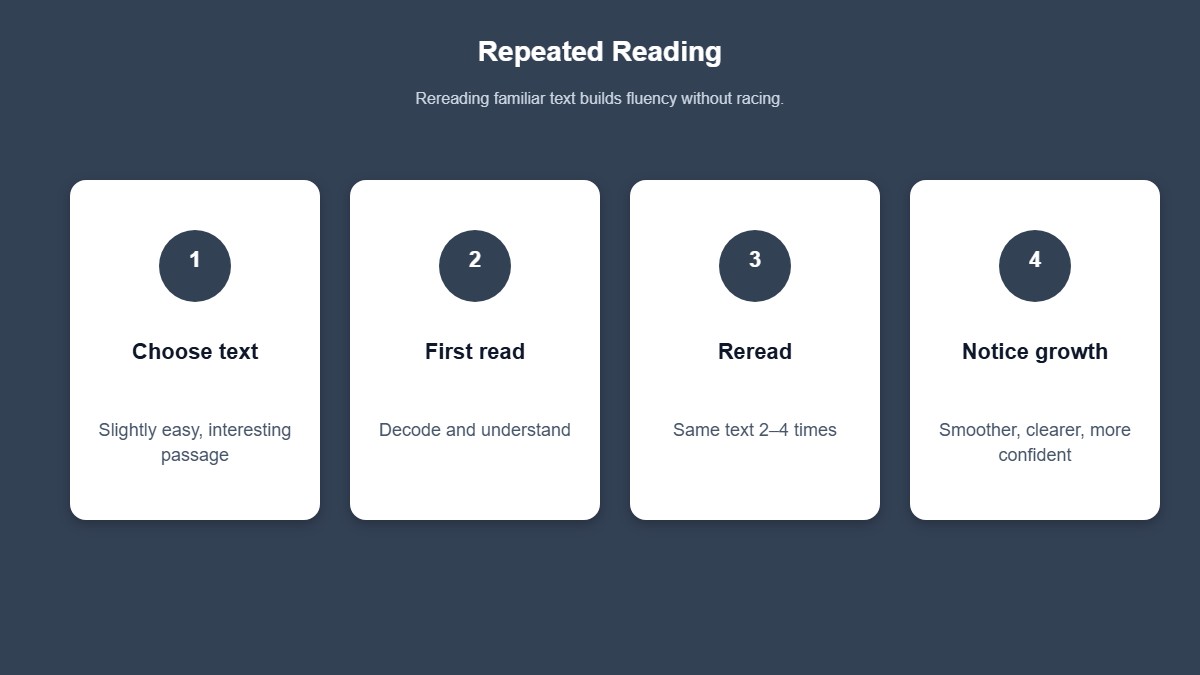
Repeated reading is one of the most effective fluency methods: the same short passage read several times across a session or week.
Choose a short text (a paragraph, a page, or a brief poem) at an easy-to-instructional level. First read: support decoding. Second and third reads: focus on smoothness and phrasing. Later reads: add expression.
Track progress with simple notes (“smoother today,” “fewer stops”) rather than only a speed score. Children often feel proud when a hard page becomes easy — that motivation matters.
Rotate texts so practice stays fresh, but keep some favourites for confidence. Printable short passages and graded reading practice fit well with reading worksheets.
Printable: Fluency Strips
Reread short, controlled sentences for smoother phrasing.


7. Echo, Paired, and Choral Reading
Supported oral reading builds fluency without leaving the child alone with hard text.
Echo reading: You read a sentence or short chunk; the child repeats it. Ideal for phrasing and expression.
Choral reading: Teacher and child (or group) read together. Useful for nervous readers who need a safety net.
Paired reading: Two readers take turns or read together. A stronger reader can lead; partners can also “shadow” — one reads slightly ahead, the other joins in.
Keep pairs kind and purposeful. Fluency practice should feel like teamwork, not public ranking. Short, successful turns beat long embarrassing ones.
8. Reading Aloud With Purpose
Reading aloud is practice for the ear and the voice, not a test.
Give a purpose before each read: “Make the pauses clear,” “Sound like the character is excited,” or “Read so we can retell what happened.” Purpose keeps attention on fluency goals.
Alternate: teacher models a paragraph, child reads the next. Record a short take on a device (optional) so the child can hear their own improvement after a few days — only if they are comfortable.
Silent reading still matters for stamina and enjoyment, but oral practice is where phrasing and expression are easiest to coach.
9. Choose Texts That Support Fluency
Text choice can make or break fluency lessons.
- Mostly decodable or familiar vocabulary for the child’s level
- Short enough to reread in one sitting
- Interesting enough that rereading does not feel like punishment
- Clear print and manageable line length for beginners
Decodables support accuracy; patterned books and poems support phrasing; familiar stories free attention for expression. Mix types across the week.
If comprehension collapses after a “fluent” read, the pace may be fake-fast or the language may be too dense. Ease the text and reconnect with how to teach reading comprehension strategies.
Broader reading instruction still sits inside how to teach someone to read; fluency is one strand, not the whole reading programme.
Printable: Easy Fluency Passages
Use short school and sky strips that stay in the learner’s accuracy range.


10. Build Confidence and Reduce Anxiety
Many children who “hate reading aloud” are protecting themselves from embarrassment.
Start privately or in a pair. Let them rehearse before reading to a group. Celebrate smoother phrasing and clearer pauses — not only speed.
Allow a preview: walk through tricky names or new words first. A thirty-second warm-up can prevent a public stumble.
Never use round-robin reading as the only fluency method for struggling readers; unpredictability raises stress and lowers practice quality. Prefer echo, choral, paired, and prepared repeated reads.
11. Fluency Activities for Class and Home
Short, focused activities work better than rare long sessions.
- Phrase scoops: draw arcs under word groups, then read
- Punctuation walk: step or clap at full stops
- Character voices for dialogue-heavy pages
- Reader’s theatre with short scripts (practise, then perform once)
- Poem of the week: daily reread for rhythm and expression
- “Smooth vs choppy” teacher models for the child to judge
- Partner check: “Did that sound like talking?”
At home: read a favourite page three times before bed; alternate pages with a parent; echo funny lines from a picture book. Keep it light and regular.
Plan structured sessions with English lesson plans and reinforce decoding gaps with phonics worksheets when accuracy slips.
Printable: More Fluency Practice
Add routine and possessive strips for home and centre rereading.


12. Common Fluency Problems and How to Help
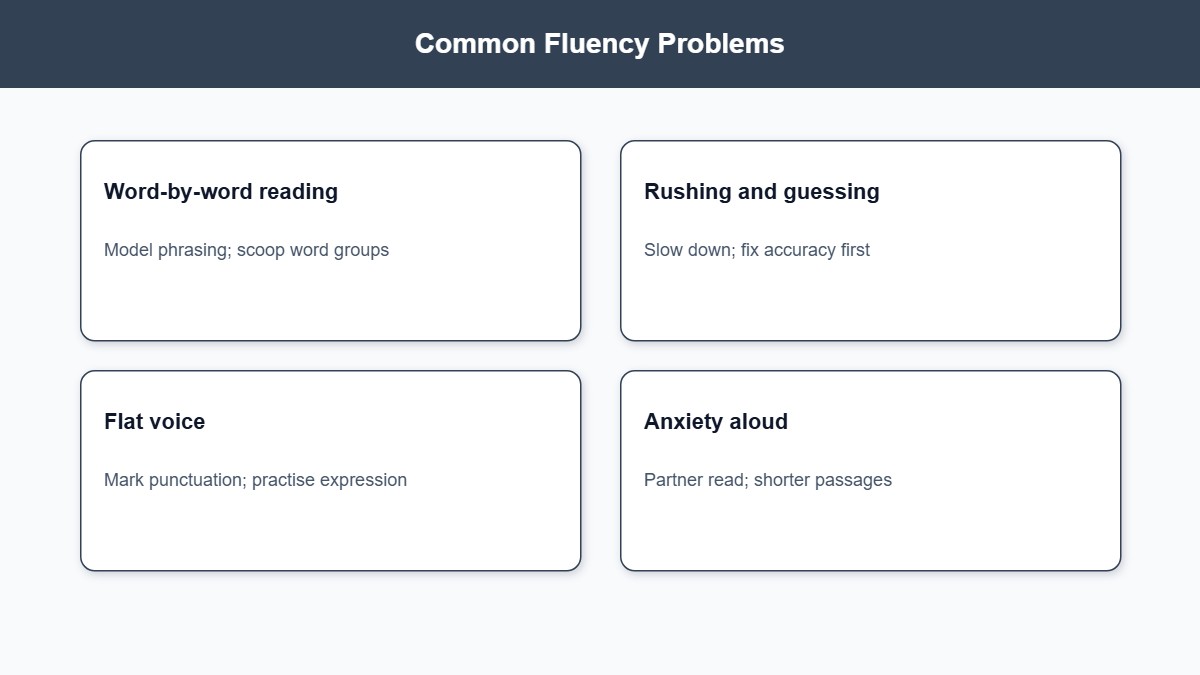
Word-by-word reading: Text may be too hard, or phrasing was never modelled. Drop difficulty, scoop phrases, use echo reading.
Guessing from the first letter: Slow down; insist on full decoding or known sight words; shorter, more controlled texts help.
Racing and mumbling: Ask for “listener-friendly” reading; practise punctuation pauses; praise clarity over speed.
Flat, monotone voice: Model emotion on one sentence; practise questions vs statements; use dialogue.
Accuracy collapses when they try to go faster: Return to accuracy-first rereads. Speed follows smoothness, not the other way around.
Avoidance: Shorten the task, increase support (choral/echo), and choose high-interest easy text until confidence returns.
13. How to Increase Difficulty
Raise challenge only when accuracy and phrasing are steady:
- Slightly longer passages
- Less familiar topics and richer vocabulary
- More complex sentences and punctuation
- Less echo support; more independent oral reading
- Expression goals (mood, character, emphasis)
- Connecting fluency rereads to retelling or how to teach reading comprehension questions
If errors spike, step back. Fluency growth is uneven — harder books temporarily slow the voice, and that is normal.
A Simple Reading Fluency Lesson Structure
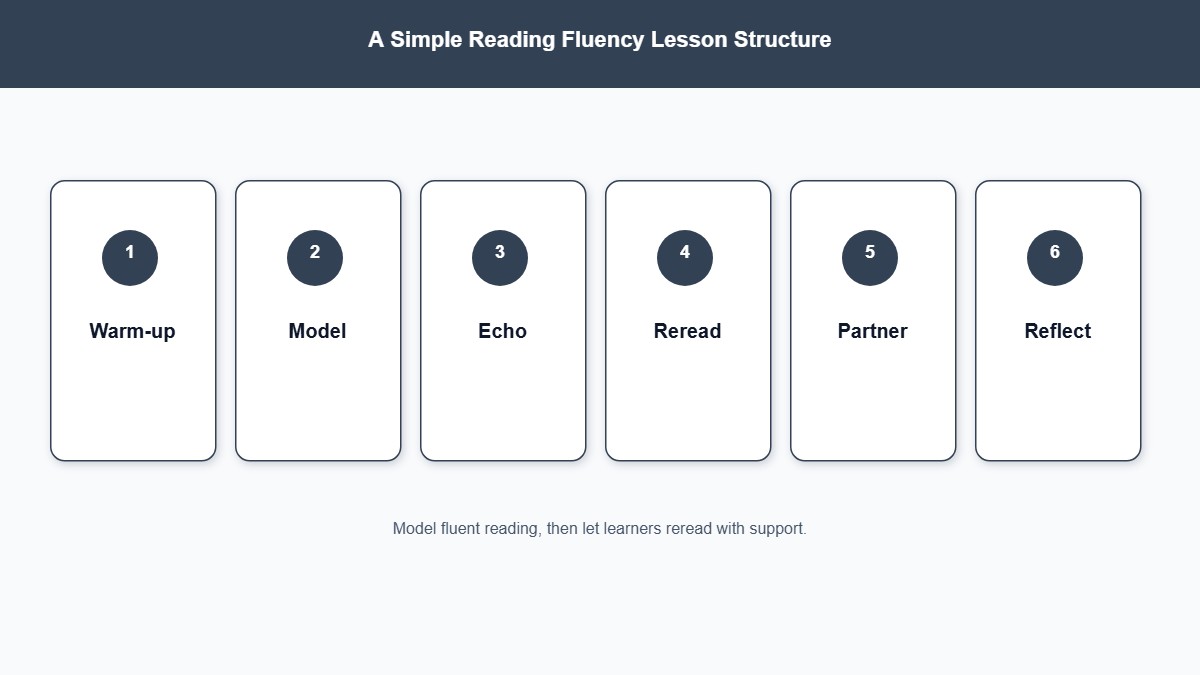
A short fluency lesson can follow this sequence:
- Warm-up — Quick review of a few tricky words or a familiar phrase from yesterday’s text.
- Model — Read a short section with clear phrasing, pauses, and expression.
- Supported practice — Echo, choral, or paired reading of the same section.
- Repeated read — Child reads again with a focus (smooth phrases / punctuation / expression).
- Brief check — One meaning question or “read this sentence like a question.”
- Wrap-up — Note one improvement; preview tomorrow’s reread or a new short poem.
Ten to twenty focused minutes often beats a long unfocused round of oral reading. Use English lesson plans when you need a full session plan.
Printable: Connected Reading
Close a lesson with simple phonics sentences and another sight-word set.


How to Teach Reading Fluency Step by Step
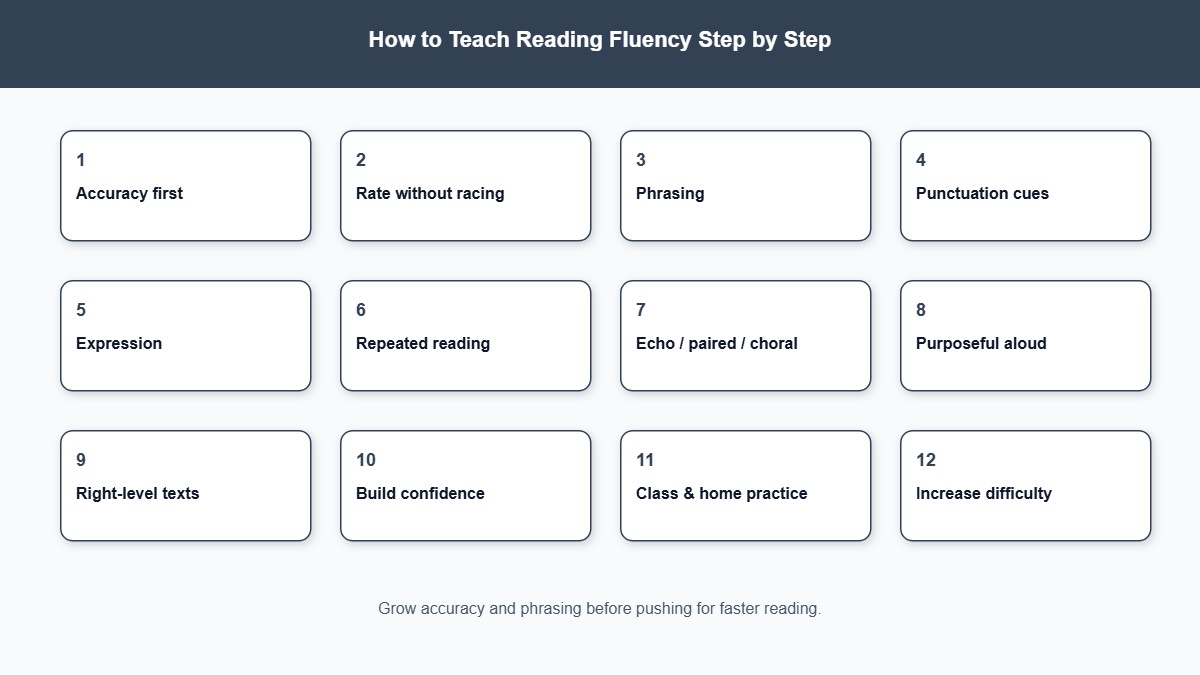
A practical progression looks like this:
- Confirm the child can decode most words in the practice text (accuracy first).
- Model fluent reading of a short passage — phrasing, pauses, natural pace.
- Practise with echo and choral reading so the child feels the flow.
- Use repeated reading of the same short text across several days.
- Teach punctuation as voice cues (stop, pause, question tone).
- Add paired reading and prepared reading aloud for confidence.
- Coach expression once accuracy and phrasing are stable.
- Gradually increase text length and complexity; keep speed secondary to clarity.
- Link fluent rereads to meaning through light how to teach reading comprehension talk.
- Maintain decoding strength with how to teach phonics and how to teach sight words as needed.
Stay longer on supported rereads if anxiety or choppiness persists. Fluency is built through successful practice, not pressure.
How to Help at Home
Parents and carers can support fluency without formal tests.
Read aloud to the child daily so they hear what fluent reading sounds like. When they read to you, choose easier books for oral practice and save harder books for shared reading.
Try “my turn, your turn” on alternate pages. Reread a short favourite three times in a week. Praise specific wins: “You paused at the full stops,” or “That sounded like the character was asking a question.”
If homework reading causes tears, shorten the passage, read together first, and talk to the teacher about level. Confidence recovers faster than it breaks.
Final Thoughts
Teaching reading fluency means teaching accurate, phrased, expressive reading — not speed alone. Model clearly, practise short texts often, and use echo, paired, and repeated reading so children feel success.
Choose texts they can mostly read, teach punctuation as a guide for the voice, and protect confidence while you stretch challenge. Strong decoding from how to teach phonics and automatic how to teach sight words free the mind for flow; meaning work from how to teach reading comprehension makes fluency purposeful.
Short, regular, well-supported practice changes how reading sounds — and how willing children are to read aloud again tomorrow.
Frequently Asked Questions
Common questions answered for downloading and using our premium printable designs.





Comments (0)
Leave a Reply
Be the first to leave a comment!