
How to Be a Good Teacher
Practical advice on becoming a better teacher: clear explanations, lesson preparation, classroom management, feedback, patience, and continuous improvement.
 Amanda Williams
Being a good teacher is about more than knowing a subject well. Teachers also need to explain ideas clearly, understand their students, manage the classroom, create a positive learning environment, and adjust their teaching when students are struggling.
Table of Contents
- What Makes a Good Teacher?
- 1. Know Your Subject
- 2. Prepare Your Lessons
- 3. Explain Things Clearly
- 4. Be Patient With Students
- 5. Listen to Your Students
- 6. Create a Positive Classroom Environment
- 7. Learn How to Manage a Classroom
- 8. Make Lessons Interesting
- 9. Use Different Teaching Methods
- 10. Check Whether Students Understand
- 11. Give Useful Feedback
- 12. Treat Students With Respect
- 13. Get to Know Your Students
- 14. Be Organised
- 15. Learn From Your Mistakes
- 16. Keep Learning as a Teacher
- 17. Be Flexible
- 18. Encourage Students to Think
- 19. Build Good Relationships With Students
- 20. Remember That You Do Not Have to Be Perfect
- How to Become a Better Teacher
- Final Thoughts
You do not have to be a perfect teacher to make a difference. Good teaching develops over time through experience, preparation, feedback, and a willingness to learn. Whether you are a new teacher, exploring how to be a substitute teacher, or someone with years of classroom experience, there are practical ways to improve how you teach.
What Makes a Good Teacher?
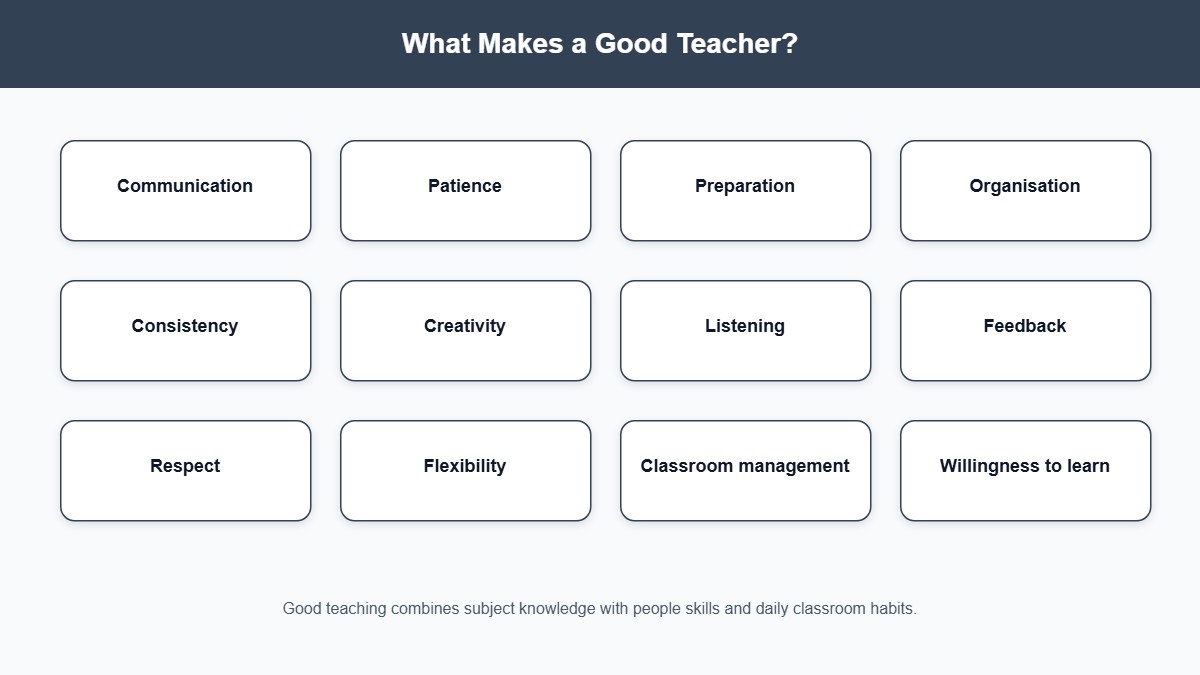
A good teacher helps students understand what they are learning and gives them the support they need to make progress. This includes explaining concepts clearly, asking useful questions, providing opportunities to practise, and checking whether students actually understand the work.
Good teachers also recognise that students learn differently. Some students may understand a concept quickly, while others need additional explanations, examples, or practice. Being willing to change your approach can make a significant difference.
Some important qualities of a good teacher include:
- Good communication skills
- Patience
- Preparation
- Organisation
- Understanding
- Consistency
- Creativity
- Classroom management skills
- The ability to listen
- Willingness to learn
- Respect for students
- Ability to give useful feedback
1. Know Your Subject
One of the foundations of good teaching is having a strong understanding of the subject you teach.
You should know more than just the information that appears in a textbook. Understanding the subject allows you to explain concepts in different ways, answer questions, and recognise common mistakes. Guides such as how to teach phonics, how to teach multiplication, and reading comprehension show how deep subject knowledge supports clearer explanations.
You do not need to know the answer to every question a student asks. If you are unsure, it is perfectly reasonable to say that you will check the answer and come back to it.
Being a good teacher also means continuing to learn about your subject.
2. Prepare Your Lessons
Good lessons usually require preparation.
Before entering the classroom, think about what students need to learn, how you will introduce the topic, what activities they will complete, and how you will check their understanding. Ready-made lesson plans can be a helpful starting point, then adapted to your students.
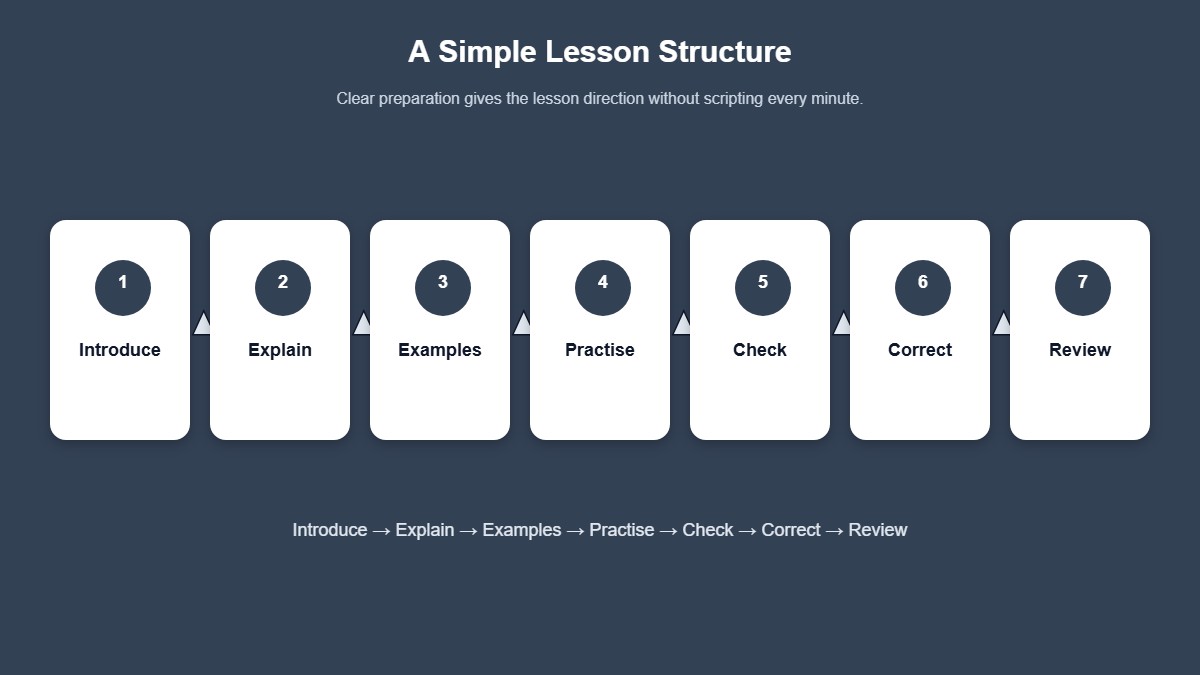
A simple lesson structure could include:
- Introduce the topic.
- Explain the main concept.
- Give examples.
- Allow students to practise.
- Check their understanding.
- Correct mistakes.
- Review the main points.
Preparation does not mean that every minute of a lesson has to be planned. It means you have a clear idea of where the lesson is going and what students should achieve by the end.
3. Explain Things Clearly
Knowing something yourself does not automatically mean you can teach it effectively.
A teacher needs to break complicated ideas into smaller, understandable parts. Avoid introducing too many new concepts at once, particularly when students are learning something for the first time.
Use examples that students can understand and connect new ideas to things they already know. Early years teachers working through how to teach preschoolers or how to teach kindergarten often rely on this kind of clear, step-by-step explanation.
If students repeatedly make the same mistake, that can be a sign that the explanation needs to change rather than simply repeating the same instructions.
4. Be Patient With Students
Students do not all learn at the same speed.
One student might understand a mathematical concept after one example, while another may need several examples and additional practice. A student learning to read—or working on handwriting—may also need more time to develop confidence than another student.
Patience allows students to ask questions, make mistakes, and try again without feeling embarrassed.
Instead of immediately saying that an answer is wrong, ask questions that help the student understand where they went wrong.
5. Listen to Your Students
Teaching is not only about talking.
Listen when students ask questions, explain their thinking, or tell you that they are struggling with something. Their questions can provide useful information about what they understand and where they need additional support.
Sometimes a student may not directly say that they are confused. Their work, questions, and behaviour can provide clues.
Paying attention to these signs can help you adjust your teaching.
6. Create a Positive Classroom Environment
Students learn better when they feel comfortable participating in the classroom.
A positive classroom does not mean that there should be no rules. Students still need clear expectations about behaviour, participation, respect, and completing their work.
The important thing is to apply expectations consistently and treat students fairly.
A classroom where students are afraid of making mistakes can make participation difficult. Encourage students to ask questions and understand that mistakes are part of learning.
7. Learn How to Manage a Classroom
Classroom management is one of the most important skills a teacher develops.
Good classroom management involves setting expectations, maintaining routines, and dealing with disruptions before they completely interrupt the lesson. This is especially useful if you are becoming a substitute teacher and walking into unfamiliar classrooms.
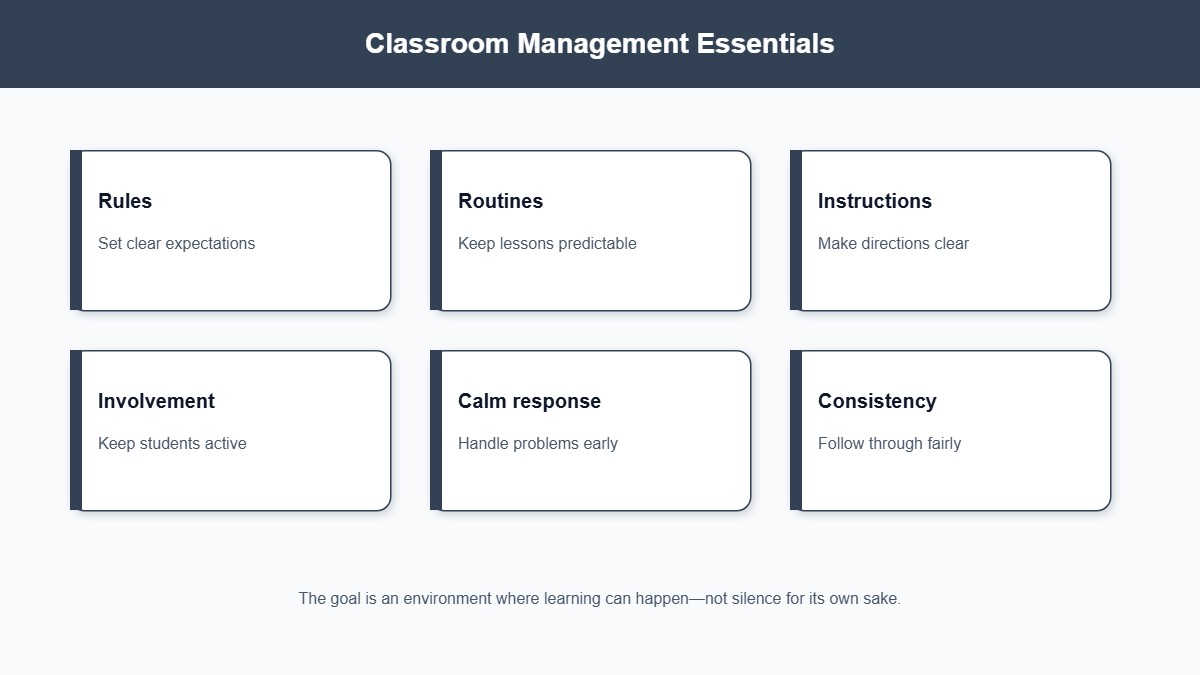
Useful classroom management strategies include:
- Establish clear classroom rules.
- Explain expectations at the beginning.
- Keep lessons organised.
- Use consistent routines.
- Give clear instructions.
- Keep students involved.
- Address problems calmly.
- Avoid unnecessary arguments with students.
- Recognise positive behaviour.
- Follow through consistently when rules are broken.
The goal is not simply to keep students quiet. The goal is to create an environment where learning can take place.
8. Make Lessons Interesting
Students are more likely to participate when they are actively involved in the lesson.
Depending on the subject, this could involve discussions, questions, demonstrations, group work, practical activities, reading exercises, problem-solving, or educational games.
You do not need to turn every lesson into an elaborate activity. Sometimes a simple change in how students interact with the material can make a lesson more engaging.
For example, instead of explaining a topic for the entire lesson, you could explain the concept briefly, give students an example, and then allow them to solve a problem or discuss the answer.
9. Use Different Teaching Methods
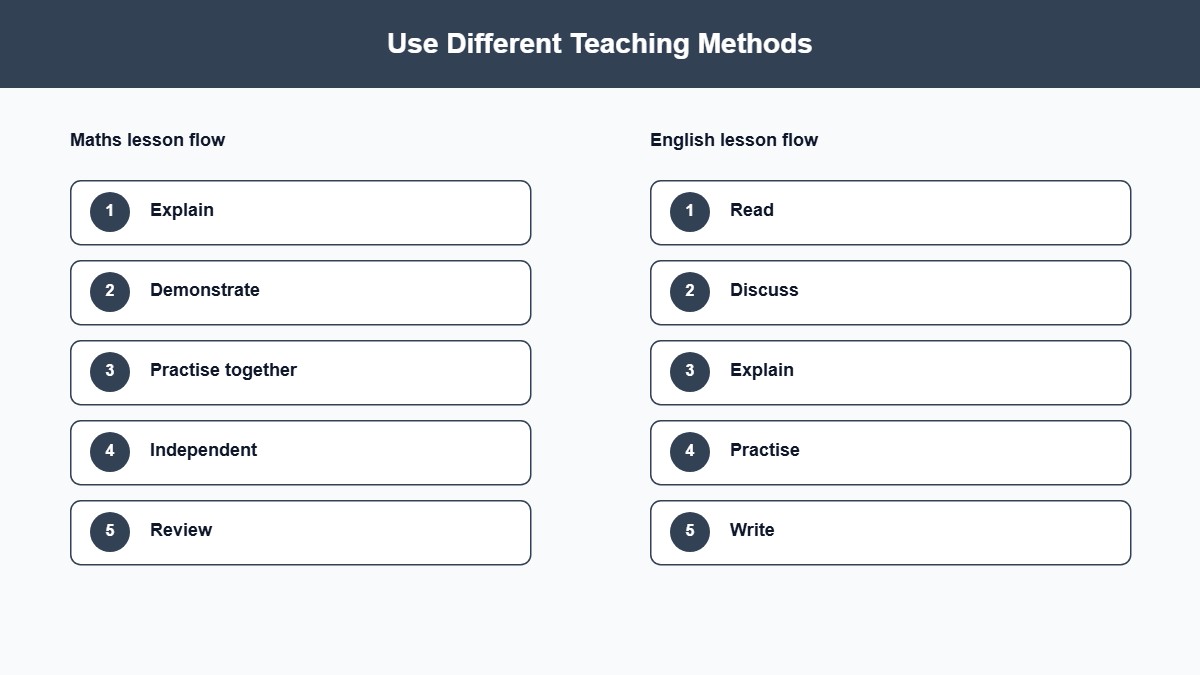
There is no single teaching method that works perfectly for every student or every topic. Browse more teaching strategies for subject-specific approaches.
You can combine explanations, demonstrations, discussions, written practice, activities, visual resources, and independent work.
For example, when teaching a new maths concept, you could:
Explain → demonstrate → practise together → independent practice → review
For an English lesson, you might use:
Read → discuss → explain → practise → write
Changing the approach when necessary can help students who do not respond well to one particular method.
10. Check Whether Students Understand
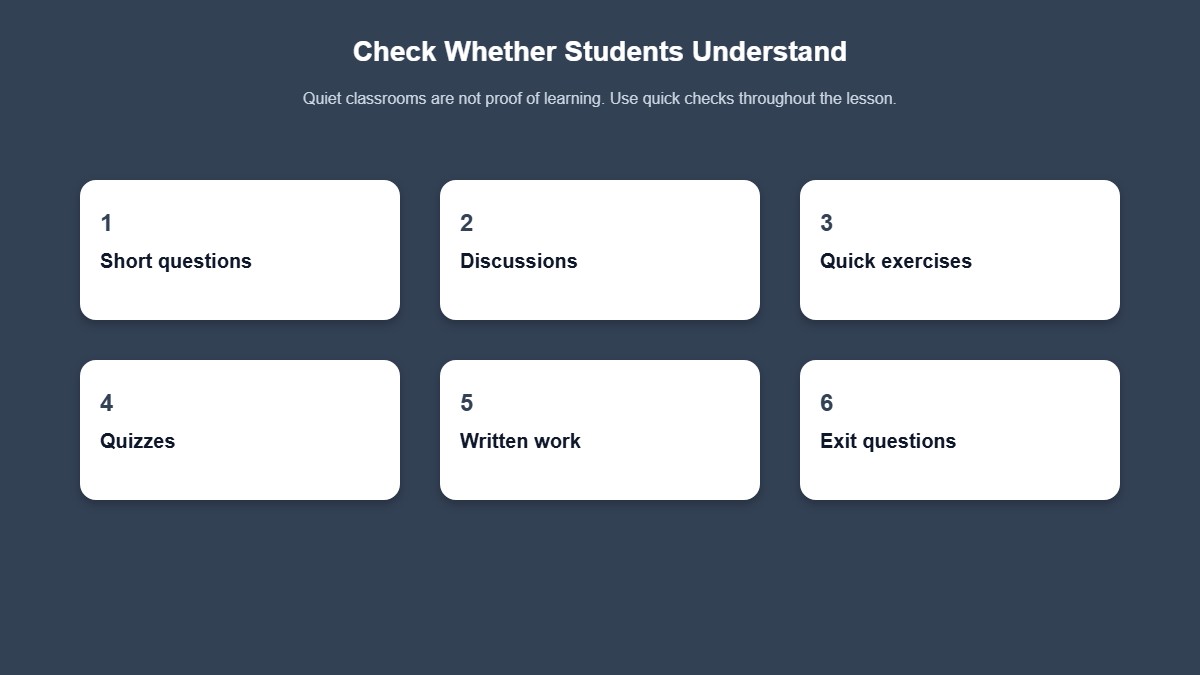
A common mistake is assuming that students understand because they are quiet or because they completed an activity.
Ask questions and look at their work to find out what they actually understand.
You can use:
- Short questions
- Class discussions
- Quick exercises
- Quizzes
- Written work
- Practical activities
- Exit questions
- Individual questioning
Assessment does not always need to be a formal test. Even a few questions at the end of a lesson can help you identify areas that need more attention.
11. Give Useful Feedback
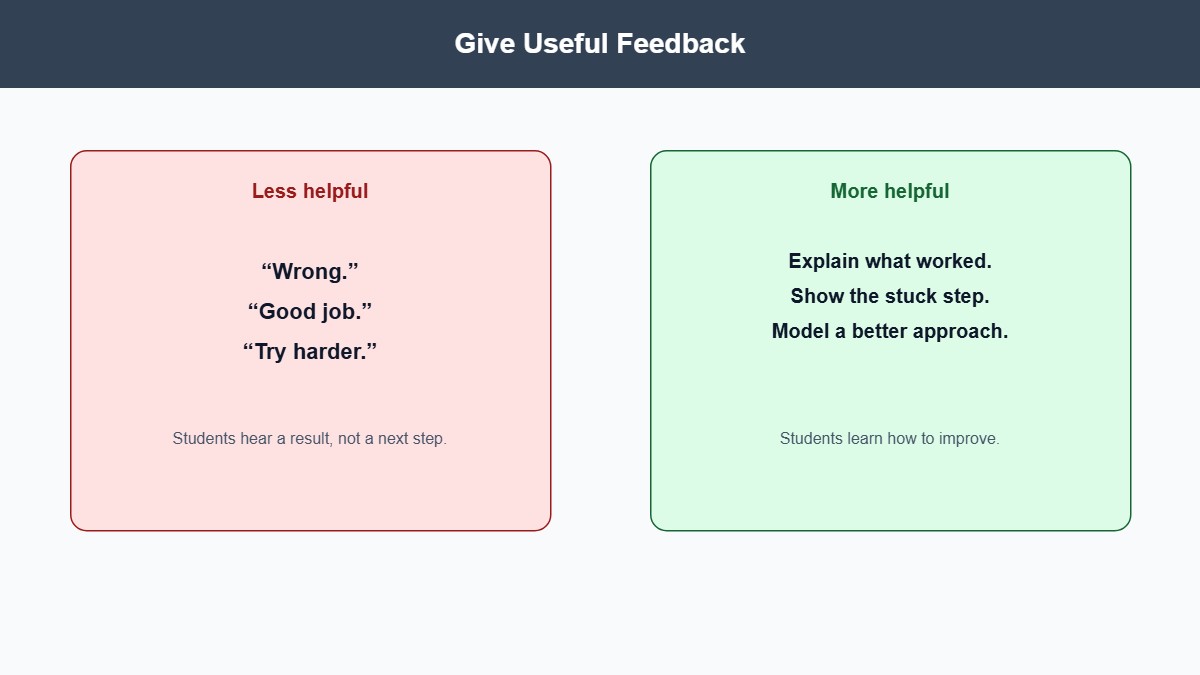
Students need to know what they are doing well and what they need to improve.
Simply saying "good job" or "wrong" does not always give students enough information.
Useful feedback explains what was done correctly and what needs to change.
For example, instead of saying "Your answer is wrong," you could explain which part of the process caused the problem and show the student how to approach it differently.
Good feedback should help students understand how they can improve.
12. Treat Students With Respect
Students should be treated with respect regardless of their academic ability.
Avoid embarrassing students in front of their classmates when they make mistakes. Correct behaviour when necessary, but separate the behaviour from the student's value as a person.
Students are more likely to trust a teacher who is fair, respectful, and consistent.
Respect also means listening to students and taking their questions seriously.
13. Get to Know Your Students
You do not need to know every detail about a student's personal life, but understanding your students as learners can help you teach them more effectively.
Pay attention to their strengths, weaknesses, interests, and areas where they need additional support.
For example, if a student consistently struggles with reading instructions, you may need to provide clearer instructions or check that they understand what they are expected to do before beginning an activity.
Understanding your students helps you make better teaching decisions.
14. Be Organised
Organisation can make teaching much easier.
Keep your lesson plans, notes, assessment materials, and other resources organised so that you can find them when you need them.
It can also help to prepare classroom materials before the lesson begins.
Good organisation saves time and allows you to spend more of your attention on teaching rather than searching for resources or deciding what to do next.
15. Learn From Your Mistakes
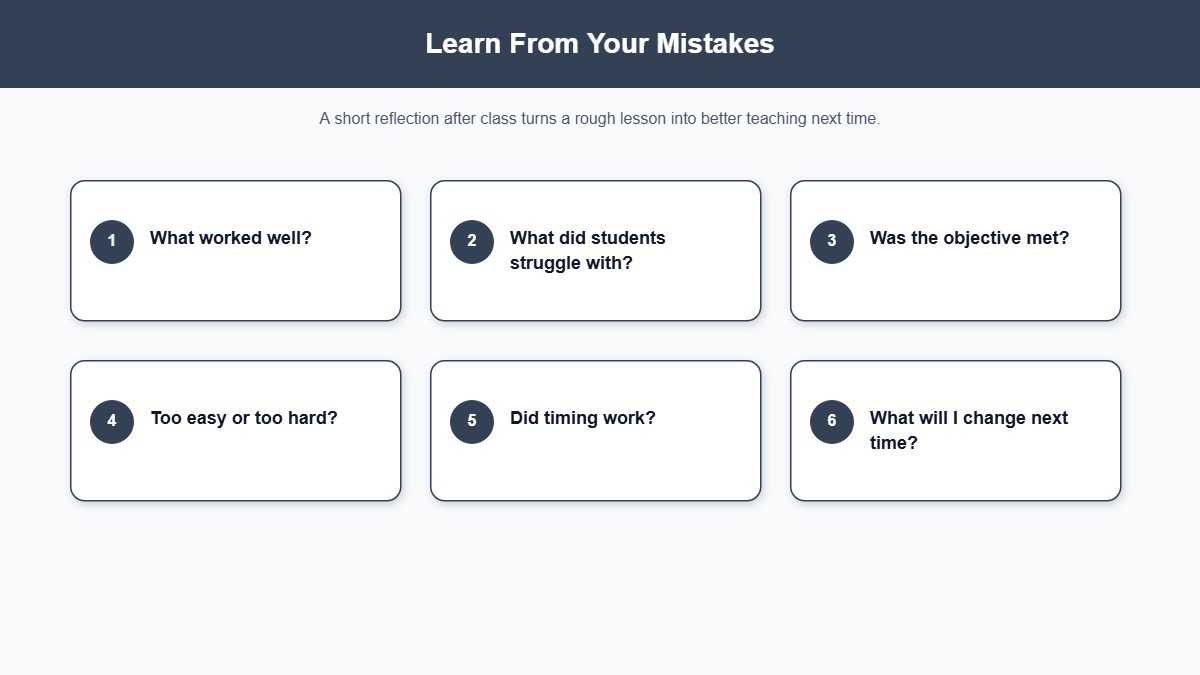
Not every lesson will go exactly as planned.
An activity may take longer than expected. Students may struggle with something you thought would be easy. A particular explanation may not work. Classroom behaviour may also affect your original lesson plan.
Instead of seeing these experiences as failures, use them to improve your next lesson.
After a lesson, ask yourself:
- What worked well?
- What did students struggle with?
- Did students achieve the lesson objective?
- Was the lesson too easy or too difficult?
- Did the activities take the expected amount of time?
- What would I change next time?
This type of reflection can help you become a better teacher over time.
16. Keep Learning as a Teacher
Teachers are also learners.
Education changes, new teaching resources become available, and teachers continue to discover better ways of explaining concepts and supporting students.
Read teaching articles, attend training when possible, learn from other teachers, and pay attention to what works in your own classroom.
You can also learn a lot simply by observing experienced teachers and discussing teaching challenges with colleagues.
17. Be Flexible
Sometimes you need to change your lesson while you are teaching it.
If students clearly do not understand the topic, continuing with the original plan may not be the best option. You might need to slow down, provide another example, change the activity, or revisit an earlier concept.
Flexibility is particularly important because classrooms contain students with different abilities and learning needs.
A lesson plan should guide your teaching, but it should not prevent you from responding to what is actually happening in the classroom.
18. Encourage Students to Think
A good teacher does not simply provide every answer.
Give students opportunities to think, explain their reasoning, solve problems, and ask questions.
Instead of immediately telling a student the answer, ask:
- "How did you get that answer?"
- "What do you think the next step is?"
- "Can you explain your thinking?"
- "What would happen if we changed this?"
- "Can you find another way to solve it?"
Questions like these can encourage students to become more independent learners.
19. Build Good Relationships With Students
A good teacher-student relationship can make a classroom more comfortable and productive.
Students should know that their teacher expects them to work hard while also being willing to help them when they struggle.
Be consistent, communicate clearly, and show students that you care about their learning.
At the same time, teachers need to maintain appropriate professional boundaries. Being supportive does not mean removing classroom expectations or rules.
20. Remember That You Do Not Have to Be Perfect
One of the most important things to remember is that becoming a good teacher takes time.
You will have lessons that go extremely well and lessons that do not go according to plan. You will sometimes make mistakes, misunderstand a student's needs, or realise afterwards that you could have explained something better.
What matters is what you do next.
Reflect on your teaching, learn from your experiences, and continue looking for ways to help your students learn.
How to Become a Better Teacher
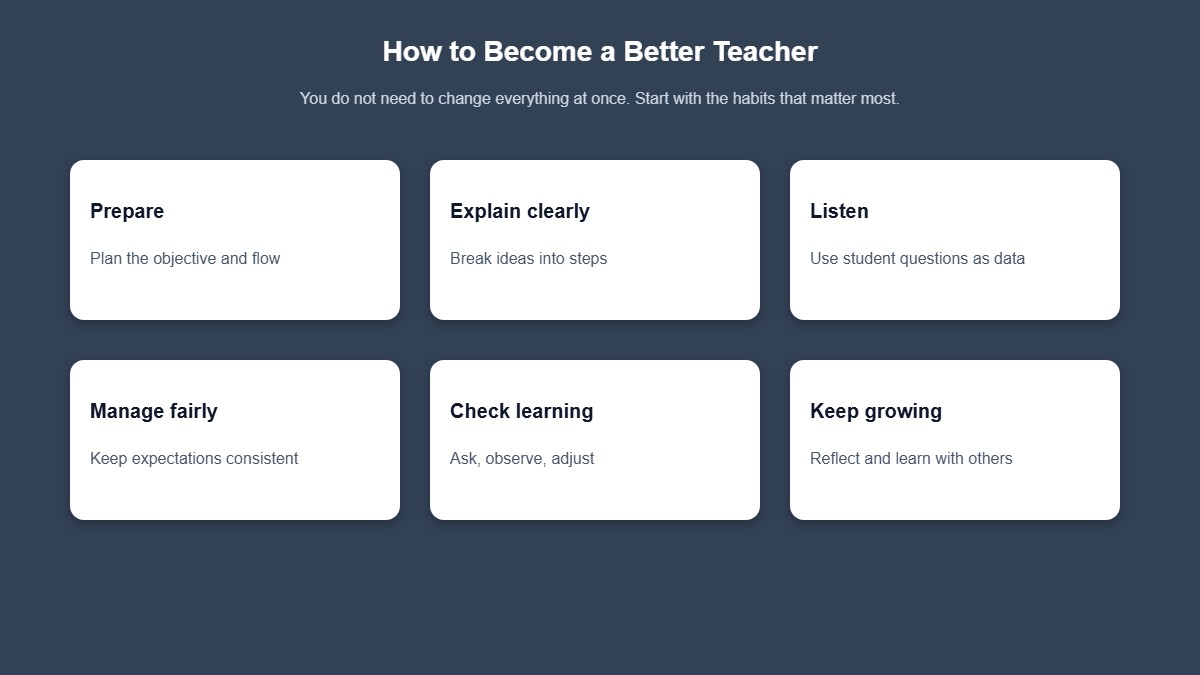
Becoming a better teacher is an ongoing process. Start by focusing on the areas that will make the biggest difference in your classroom.
Prepare your lessons carefully, explain concepts clearly, listen to your students, establish consistent expectations, and regularly check whether students understand the work.
You can also improve by asking other teachers for feedback, reflecting on your lessons, and trying different teaching approaches from our teaching strategies guides.
You do not need to change everything at once. Small improvements in preparation, communication, and classroom management can gradually make your teaching more effective.
Final Thoughts
Being a good teacher is about helping students learn while creating an environment where they feel supported, respected, and encouraged to participate.
Strong subject knowledge is important, but good teaching also requires patience, preparation, communication, organisation, and flexibility. The best teachers continue learning themselves and are willing to change their approach when something is not working.
Whether you are a new teacher preparing your first lessons or an experienced teacher looking for ways to improve, focusing on your students and how they learn is a good place to start.
Frequently Asked Questions
Common questions answered for downloading and using our premium printable designs.




Comments (0)
Leave a Reply
Be the first to leave a comment!